
Top outdoor team building activities for kids: boost skills and confidence
Discover the best team building activities for kids to boost their confidence and skills. Transform camp experiences into powerful growth moments!
TL;DR:
- Choosing intentional, skill-focused outdoor activities enhances children’s confidence, resilience, and teamwork at camp. Effective facilitation through reflection, role rotation, and appropriate challenge levels is crucial for lasting development. Camp programs that integrate these principles foster meaningful growth beyond mere entertainment.
Picking the right outdoor activities for your child’s camp experience goes far beyond keeping kids entertained for a week. The choices you make have a direct impact on confidence, friendship skills, and the ability to bounce back when things get tough. Adventure and team-based camp programs show measurable gains in youth self-confidence and resilience, especially when activities are designed with intention. This guide walks you through the criteria, options, and facilitation strategies that turn a good camp week into a genuine turning point for your child.
Table of Contents
- How to choose outdoor team building activities for kids
- 10 evidence-backed outdoor team building activities for camps
- Comparison of activities: Choosing the right fit for your child
- How to facilitate and adapt activities for maximum impact
- Why skill-focused, flexible facilitation matters more than flashy activities
- Next steps: Explore skill-building camps and activities
- Frequently asked questions
Key Takeaways
| Point | Details |
|---|---|
| Criteria comes first | Choosing the right activities matters more than simply picking ‘fun’ games for growth. |
| Evidence-backed activities | Adventure and team-building style games drive resilience, confidence, and better social skills. |
| Compare before you choose | Match activities to your child’s age, personality, and desired outcomes for the best impact. |
| Facilitation unlocks growth | Structured debriefs and role rotation help transfer skills beyond camp sessions. |
| Safe, inclusive participation | Use challenge-by-choice and specific facilitation steps so every child can join in meaningfully. |
How to choose outdoor team building activities for kids
Not every “outdoor activity” is built the same. You can fill an afternoon with relay races and zipline runs, but if there’s no thoughtful structure behind it, older kids especially may walk away having had fun without actually growing. The difference between an activity that builds skills and one that just passes time often comes down to a few specific design features.
When choosing outdoor camps or reviewing their activity programs, look for these core criteria:
- Adaptability: Can the activity be scaled up or down in difficulty based on the group’s age or comfort level?
- Role rotation: Does every child get the chance to lead, follow, communicate, and problem-solve at different points?
- Meaningful responsibility: Are kids given real jobs within the team, not just token tasks?
- Reflection time: Is there a structured debrief or discussion after the activity?
- Progressive challenge: Does difficulty increase as kids build confidence, rather than staying flat?
Active games without these mechanisms may be weaker for skill transfer, particularly for older kids who need autonomy and real decision-making moments to internalize lessons. A 10-year-old needs different scaffolding than a 15-year-old, and great programs know the difference.
Pro Tip: When evaluating a camp program, ask directly: “How do you use reflection or debriefs after activities?” If the staff can’t answer clearly, the program likely prioritizes entertainment over development.
10 evidence-backed outdoor team building activities for camps
With solid criteria in mind, here are activities proven to deliver results, and how each one works best in a camp setting.
1. Adventure ropes courses
High and low ropes courses push kids to face fear, communicate under pressure, and trust teammates. Adventure-style activities show measurable gains in resilience, help-seeking behavior, and self-confidence. Best for ages 10 and up. Works for groups of 6 to 20.
2. Cooperative sports games
Modified versions of soccer, volleyball, or relay-style sports where teams earn points together rather than competing directly. A 12-week sports intervention study found that team-building-focused physical education produced clear improvements in resilience-related traits in children. Works for all ages with adjusted rules.
3. Outdoor scavenger hunts
Map-based or clue-based hunts require communication, planning, and trust. They’re naturally differentiated, meaning a 9-year-old and a 14-year-old can both engage meaningfully. Easy to adapt for large or small groups.
4. Trust walks
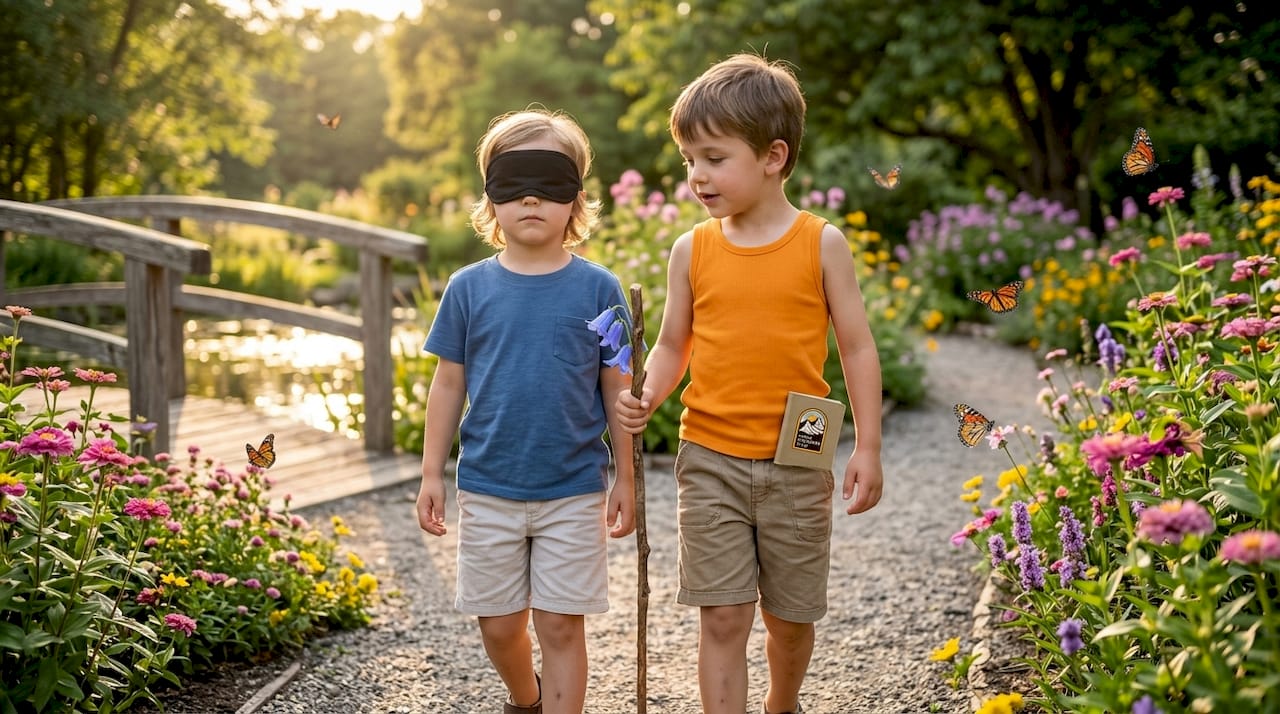
One child is blindfolded, another guides using only voice commands. This activity directly builds teamwork and confidence in a low-stakes environment. Ideal for ages 8 and up as an icebreaker or relationship-building exercise.
5. Survival challenge
Teams are given limited supplies and a task, such as building a shelter, starting a fire safely, or purifying water. This is a high-engagement activity that teaches critical thinking, resource management, and genuine collaboration.
6. Problem-solving relay
Rather than physical speed, this relay requires each leg of the race to solve a puzzle, answer a riddle, or complete a logic task before the next teammate can begin. Works beautifully for mixed-age groups.
7. Communication games
Classic examples include “back-to-back drawing” (one child describes a shape while another draws it without seeing) and “human knot” (a group untangles themselves without releasing hands). These highlight how assumptions break communication.
8. Wilderness shelter build
Small teams use only natural materials to construct a shelter that meets specific criteria. This teaches planning, negotiation, and the kind of team challenges and resilience that kids remember long after camp ends.
9. Team art project
Groups design a large mural, land art, or collaborative sculpture. This is particularly powerful for quiet, creative kids who may feel overshadowed in more physical activities. It also surfaces unexpected leaders.
10. Multi-day expedition
For teens especially, a two to three day wilderness hike or paddling trip requires sustained cooperation, conflict navigation, and shared responsibility for safety. This is the gold standard for personal development at camp.
“80% of campers enjoyed adventure-style programs, and girls reported even higher improvements in confidence following structured team-building activities.”
Pro Tip: Use “challenge-by-choice” framing for every activity, meaning kids can participate at whatever level feels safe to them. This keeps anxious children engaged rather than shut down, and it removes the stigma from opting for a less intense version.
Comparison of activities: Choosing the right fit for your child
Now let’s compare top activity types side by side so you can make an informed choice based on your child’s personality, age, and the camp environment.
| Activity | Key skills developed | Ideal age range | Facilitation needs | Group size |
|---|---|---|---|---|
| Adventure ropes course | Confidence, trust, communication | 10 to 17 | High (trained facilitators required) | 6 to 20 |
| Cooperative sports | Resilience, teamwork, physical fitness | 8 to 17 | Medium (role rotation important) | 10 to 30 |
| Scavenger hunt | Communication, planning, creativity | 8 to 15 | Low to medium | 4 to 40 |
| Trust walk | Trust, listening, empathy | 8 to 14 | Low (brief debrief needed) | Any size |
| Survival challenge | Problem-solving, leadership, resourcefulness | 11 to 17 | Medium to high | 4 to 12 |
| Multi-day expedition | All of the above, plus emotional regulation | 13 to 17 | Very high (safety oversight) | 6 to 16 |
| Team art project | Creativity, inclusion, communication | 8 to 17 | Low | Any size |
Education-based program lists, such as team-building game categories developed by educators, suggest grouping activities into problem-solving, communication and trust, and outdoor movement categories. That framework helps you match an activity to exactly what your child needs most right now.
Here’s a quick guide to matching your child’s personality:
- The shy introvert: Team art project, trust walk, scavenger hunt. Lower performance pressure, more space for quiet contribution.
- The natural leader: Survival challenge, multi-day expedition. Real stakes and genuine leadership opportunities.
- The high-energy kid: Cooperative sports, ropes course, problem-solving relay. Keeps them moving and channeling energy productively.
- The anxious child: Trust walk with challenge-by-choice, communication games. Low stakes, clear roles, and success built on cooperation.
Understanding the confidence in teamwork connection also helps here. Kids who feel genuinely useful to their team gain confidence faster than kids who are simply “present.” Reviewing the major benefits of teamwork can also help you explain to your child why these activities matter before camp even begins.
How to facilitate and adapt activities for maximum impact
You’ve chosen your activity. Now comes the part that actually determines whether it changes anything. Facilitation is how an activity moves from entertainment to education.
Here are the core steps every good facilitator (and every parent reviewing a camp) should look for:
- Set clear objectives before the activity begins. Kids perform better when they know what they’re working toward. Not “we’re going to do a ropes course” but “today we’re going to practice trusting each other and asking for help.”
- Assign and rotate roles. Every child should have a meaningful role, whether that’s navigator, communicator, timekeeper, or encourager. Rotate these roles across sessions so every child experiences leading and following.
- Use challenge-by-choice. Avoiding competition-only formats is particularly important for kids who shut down under public performance pressure. Frame participation as a personal choice, not an obligation.
- Run a structured debrief after every activity. Ask three simple questions: What happened? What did you notice about how your team worked? What would you do differently next time? This reflection is where the real learning happens.
- Increase challenge progressively. Start with lower-stakes activities like communication games and trust walks in the first days of camp. Move toward survival challenges or expeditions as trust and cohesion build.
For fostering team spirit without competition, the key is framing success as a collective achievement. When teams celebrate solving a problem together rather than beating another team, inclusion increases and anxiety decreases.
The first day of camp is its own challenge entirely. Thoughtful ice-breaker games for camp lower social barriers so that the team-building activities later in the week have fertile ground to work in. Don’t underestimate that foundation.
Adapting for mixed-age or mixed-ability groups requires some additional creativity. In survival challenges, for example, older teens can take on planning and leadership roles while younger kids handle specific physical or creative tasks. This naturally mirrors real-world collaboration. For larger groups, well-structured group outing tips also translate into effective camp activity management.
Pro Tip: Capture simple before-and-after feedback from your child, or ask the camp to share post-program surveys. Even a quick rating scale on confidence or ability to work in a team gives you real data on growth, not just camp story highlights.
Why skill-focused, flexible facilitation matters more than flashy activities
Here’s something most camp brochures won’t say out loud: the activity is almost irrelevant. What matters is how it’s run.
A well-facilitated trust walk will do more for your child’s self-confidence than a poorly run ropes course that costs ten times as much. This is not a knock on any specific activity type. It’s a fundamental truth about youth development. The vehicle matters far less than the driver.
Research from post-program survey data shows that confidence and self-efficacy gains are most reliably tied to reflective discussion and role rotation, not to the physical intensity of the activity itself. Kids who had time to talk about what they experienced, and who were given real responsibilities within their group, showed stronger growth signals than those who simply completed activities.
Parents often measure camp success by how excited their child is in the moment. “He loved the zipline!” But that excitement doesn’t automatically translate into lasting change. The question to ask isn’t “Did they have fun?” It’s “Can they tell you what they learned about themselves or their team?”
We also see this play out in how camps handle conflicts between campers. Camps that treat conflict as a facilitation opportunity, rather than something to smooth over quickly, produce kids who return home better equipped to navigate disagreement. That’s a transferable life skill, and it only develops when facilitation is intentional.
Don’t mistake excitement for growth. Look for behavior changes after camp. Is your child more willing to ask for help? Do they show more patience in group situations? Are they better at expressing what they need? Those are the real indicators that a team-building program delivered on its promise.
Next steps: Explore skill-building camps and activities
Knowing what makes team-building activities effective is only the first step. The next is finding a program that puts these principles into practice, not just talks about them in a brochure.
At Young Explorers Club, every activity in our Swiss-based summer camp program is designed around exactly the criteria and facilitation principles described in this article. From ropes courses and survival challenges to multi-day expeditions in the Alps, each experience includes structured debriefs, role rotation, and challenge-by-choice frameworks that make growth real and measurable. Explore our full range of top outdoor activities for kids or learn more about our specialized teen summer camp programs designed for ages 13 to 17. Reach out to us directly and we’ll help you match the right program to your child’s goals.
Frequently asked questions
Which team-building activity works best for shy or anxious kids?
Activities built around “challenge-by-choice” and shared team goals, like trust walks or team art projects, work best because they let anxious kids contribute meaningfully without the pressure of public performance or competition.
How can I tell if my child’s confidence really improved from camp activities?
The most reliable signals come from anonymous post-camp surveys and observable behavior changes at home. Simple pre/post survey data on self-confidence and collaboration skills, collected by the camp, can give you concrete evidence of growth.
Are traditional sports or adventure games better for developing resilience?
Both contribute, but adventure-style and cooperative games with built-in reflection and role rotation show stronger resilience gains, especially for older children and teens who need more autonomy in their learning.
How can camp facilitators adapt activities for mixed-age groups?
Facilitators should scale task difficulty by age, rotate leadership roles so both younger and older kids lead at different points, and use group debriefs that allow everyone to contribute observations regardless of their experience level. Cooperative game guidelines offer solid frameworks for making this work across wide age gaps.
What is the most important factor for lasting skill development from camp?
Effective facilitation and structured reflection consistently outperform activity choice alone. Without reflection and role rotation built into the program design, even high-quality activities may not transfer meaningful skills beyond the camp environment.