Environmental Science Camps For Kids
Environmental science camps—day or residential—teach ecology, field science, outdoor skills and stewardship to build STEM skills & leadership.
Environmental science camps
Environmental science camps run as day programs or residential sessions. They mix hands-on ecology, field science, outdoor skills, and stewardship to build measurable STEM knowledge and practical field skills. Session length and intensity—from single-day experiences to multi-week residential programs—shape learning, social-emotional growth, and leadership. We recommend families match format to age and readiness.
Key Takeaways
Format and duration matter
Day camps (typical hours ~9:00–3:30) give broad, hands-on exposure and are usually best for younger children or families seeking shorter commitments. Residential programs (commonly 1–8 weeks) provide deeper skill building, extended practice time, and greater social-emotional gains. Match duration to a child’s stamina and goals.
Measurable benefits
Camps produce measurable learning and behavioral outcomes: studies and program evaluations often report environmental knowledge gains in the range of ~15–30% on pre/post tests. Camps also boost teamwork, leadership skills, and increase outdoor physical activity, which strengthens long-term stewardship attitudes.
Safety and staffing
Safety and staffing are essential considerations for families.
- Check staff-to-camper ratios: day ~1:8–10; residential ~1:6–8; specialty teen ~1:4–6.
- Verify background checks and required certifications such as CPR/First Aid and lifeguard certification where applicable.
- Confirm accreditation or state licensing and ask about staff training hours and supervision plans.
Curriculum and metrics
Camps typically pair field protocols with citizen-science tools—species monitoring, water-quality testing, and GIS mapping are common. Typical program outcomes to ask about include:
- Hours spent outdoors (often 20–40/week).
- Species lists recorded (commonly 20–200/week depending on habitat and intensity).
- Validated data uploads to authorized repositories or citizen-science platforms.
We advise checking whether programs use standard protocols and provide training so participants collect reliable, scientifically useful data.
Costs and access
Costs vary widely. Typical U.S. ranges are $150–$500/week for day camps and $400–$1,500+/week for residential programs. Many programs reserve 10–50% of spots for financial aid. Verify scholarship availability and application deadlines—apply early and contact programs about sliding-scale options.
Why Environmental Science Camps Matter (definition, formats, ages, and core benefits)
Environmental science camps are short-term day or overnight programs focused on ecology, conservation, field science, outdoor skills, and stewardship.
Day and residential formats serve different goals. Day camp (typical hours 9:00–3:30) gives hands-on field activities and a return-to-home each evening. Residential or overnight camps run multi-day stays with evening programs, round-the-clock supervision, and more immersive skill-building and social development opportunities. We choose the format to match a child’s readiness and family logistics.
Program length and intensity shape outcomes. Brief exposures—single-day or one-week sessions—produce clear cognitive gains and lift engagement. Immersive multi-week residential experiences tend to deliver larger knowledge gains, deeper practical skills, and stronger social-emotional growth. We encourage families to weigh short-term samples for introduction against longer stays for sustained impact.
Ages served: We serve kids across the typical age span that camps advertise: about 3–17. We break groups into familiar bands:
-
Preschool ages 3–5
-
Elementary ages 6–11
-
Middle school ages 11–14
-
High school / leadership tracks 14–17+
We offer everything from an introductory environmental science camp to focused nature and ecology camp modules, so parents can match theme and developmental level. We emphasize outdoor learning and field science for kids in every age band.
Typical session lengths vary by format. Residential sessions commonly run 1–8 weeks, with one-week blocks the most common unit. Day programs range from single-day experiences to multi-day series or weekly blocks.
Core benefits — what kids actually gain
Below are the main advantages I see in practice, with practical notes on how to maximize each outcome.
-
Cognitive & academic gains: Outdoor STEM and environmental education link to measurable improvements in environmental knowledge and science achievement. Programs often report knowledge gains of ~15–30% on pre/post tests (aggregated range). We recommend camps that include baseline and end-of-session assessments and hands-on field labs to lock in learning.
-
Social-emotional development: Camps build teamwork, leadership, resilience, problem-solving, and communication through group projects and expeditions. We structure small teams and reflective debriefs to accelerate these skills.
-
Physical health: Increased active time outdoors helps kids meet daily activity goals and supports overall fitness. Programs that promote free play, guided hikes, and skill stations align with CDC recommendations for 60 minutes of daily active play. We design schedules that mix guided activity with unstructured exploration.
-
Long-term stewardship and attitudes: Early, repeated nature exposure tends to correlate with pro-environmental attitudes and behaviors later in life. We include stewardship projects and citizen-science elements so kids take home practices they can repeat.
Camp logistics, costs, and staffing
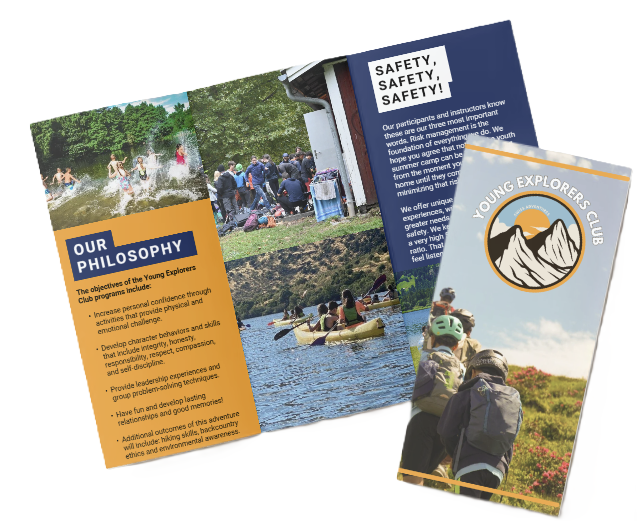
Session sizes and cohort structures vary by program. Session sizes range from small groups of 10–20 (typical ranges) to large camps of 100+ (typical ranges) per session. We, at the young explorers club, recommend checking whether camps run by age cohort or mixed-age groups; smaller cohorts mean faster skill progression and safer outings.
Staffing and training
Counselor-to-camper ratios are a core safety metric. Typical ratios are:
- Day camps: 1:8–1:10 (typical ranges) for younger children.
- Residential overnight: 1:6–1:8 (typical ranges).
- Specialty teen expeditions: 1:4–1:6 (typical ranges).
Lower ratios provide more supervision and individualized attention. Many camps require counselors to be 18+ and expect at least 40+ hours of pre-season training for residential staff (typical benchmark). Background checks are mandatory. CPR/First Aid certification is required. Lifeguard certification is required for waterfront programming. Specialized credentials — like certified naturalist or environmental educator — add program depth. Accreditation from the American Camp Association (ACA) is a recognized standard for safety and quality; also check state licensing for day camps.
Session hours and programming
Day camp hours typically run 8–9 a.m. to 3–4 p.m. (typical ranges). Residential programs extend into evenings with nature programs and night activities that support nocturnal ecology lessons and team-building. Most sessions are one week (typical ranges), but some camps offer multi-week or single-day options.
Fees, scholarships, and financial aid
Costs depend on facilities, location, and program intensity. Typical ranges for the U.S. are:
- Day camp: $150–$500 per week (typical ranges).
- Residential environmental camp: $400–$1,500+ per week (typical ranges).
Many nonprofit camps allocate subsidized spots; typical ranges are 10–50% of spots as financial aid, though availability varies widely. I recommend verifying specific scholarship criteria and deadlines with each camp.
What parents should request from camps
Please ask camps for the following details before enrolling; here are the items I suggest you request and review:
- Staff-to-camper ratios by age group.
- Accreditation status (ACA) and state licensing.
- List of staff certifications and training hours.
- A sample emergency plan and medical protocols.
- Immunization and health policies.
- Clear tuition inclusions and refund policy.
Verify exact figures with specific camps. For a sense of program expectations on-site, check our note on What kids should expect.
Types of camps, curricula, and concrete sample schedules (models, signature activities, day/week templates)
Core program models and signature activities
Below I list core camp types, three–five signature activities per type, and an example measurable outcome for each.
-
Ecology / field science camps:
- Transect/quadrat sampling
- Biodiversity monitoring with iNaturalist
- Soil-profile digs
- Basic GIS-for-kids mapping
Measurable outcome example: 20–200 species recorded over a week depending on habitat richness.
-
Marine / coastal camps:
- Water quality testing (pH, dissolved oxygen, turbidity)
- Tidepool quadrat surveys
- Plankton net sampling and ID
- Microplastic counts on shore transects
Measurable outcome example: 5–15 macroinvertebrates identified per 1-m² sample for stream/shore comparisons; paired pH and DO records for baseline.
-
Forest / wildlife camps:
- Camera-trap surveys
- Avian studies with eBird checklists
- Leaf-litter macroinvertebrate sorting
- Nest-box building and monitoring
Measurable outcome example: Weekly bird checklist of 20–100 species depending on region.
-
Urban nature camps:
- Green-space biodiversity audits
- Stormwater runoff demo with simple impervious-surface measurements
- Rooftop or community-plot native planting
Measurable outcome example: Divert 50–500 lbs of compostable material per week or establish 50–200 native seedlings in a season.
-
Citizen-science camps:
- Structured projects using iNaturalist and eBird
- Schoolyard phenology logs
- Community data sprints for local NGOs
Measurable outcome example: 100–1,000 validated citizen-science observations per week across cohorts, contributing to regional datasets.
-
Sustainability / living labs:
- Waste audits and composting circuits
- Energy-audit demos and measured solar kWh experiments
- Closed-loop mini-gardens
Measurable outcome example: Divert 50–500 lbs of compostable material per week per group; demonstrate measurable kWh from a small solar array.
-
Outdoor leadership / expedition programs:
- Expedition navigation and first aid
- Multi-day monitoring transects
- Overnight wilderness camps integrating data collection
Measurable outcome example: Completion of a multi-day survey route and presentation of baseline-to-followup comparisons by week’s end.
Sample schedules, protocols, and learning approach guidance
I recommend sequencing single-day lessons as discrete skill or protocol sessions, and week-long modules as a three-phase arc: introduction & baseline → repeated data collection and skill practice → analysis and presentation. We, at the young explorers club, pair tech and traditional methods—e.g., iNaturalist plus quadrats, nets, and a secchi disk—so kids gain both field craft and data literacy.
Typical day-camp (ages 7–11) — model template:
- 09:00 arrival & orientation
- 09:30 field ID walk (transects/quadrats)
- 11:00 hands-on water quality testing (pH, DO, turbidity)
- 12:00 lunch & debrief
- 13:00 shelter-building & team challenge (navigation/first aid skills)
- 14:30 citizen-science data entry (iNaturalist)
- 15:30 wrap-up & pickup
Week-long residential (ages 12–15) — day-by-day template:
- Day 1: orientation, safety, baseline surveys (biodiversity and water quality)
- Day 2: watershed fieldwork and repeated sampling protocols
- Day 3: habitat restoration and native-plant nursery work
- Day 4: overnight expedition with transect surveys and camp-based data logging
- Day 5: data synthesis, GIS-for-kids map-making, and presentations
Signature activity protocol example — water quality testing:
- Collect pH, dissolved oxygen, and turbidity readings at three fixed stations; record temperature and time of day.
- Perform macroinvertebrate kick-samples in three 1-m² reaches; preserve sorted specimens for ID.
- Expected outcome: 5–15 macroinvertebrates identified per sample; compare counts to baseline to assess stream health.
Practical tips I use in camp design:
- Consistency: Keep sample units consistent (same transect length, same quadrat size).
- Variety: Blend short tech sessions with hands-on tasks so attention stays high.
- Targets: Set numeric targets (species counts, seedlings planted, compost weight) to measure progress.
- QA training: Train kids in simple QA: duplicate one sample per group and compare results.
- Real-world impact: Use citizen-science platforms for feedback loops; link lessons to local datasets and stakeholders.
For guidance on modern field pedagogy and evidence that outdoor programs boost learning, see our piece on outdoor learning.

Tools, tech, citizen-science platforms, and measuring outcomes (apps, gear, metrics, visualizations)
We, at the Young Explorers Club, select tools that let campers collect real data, learn scientific methods, and see results. Our toolkit balances kid-friendly apps, industry-standard platforms, simple field hardware, and clear outcome measures.
Recommended apps, platforms and field gear
Below are the core apps and hardware we use, with age notes and typical uses.
- Apps and platforms:
- iNaturalist — species observations and community verification; best for ages 10+ with supervision.
- eBird — structured bird checklists for counts and migration tracking.
- Seek by iNaturalist — kid-friendly ID for quick, camera-based identifications; ages 6+.
- Merlin Bird ID — fast bird ID and sound recognition for sessions focused on birds.
- Google Earth — landscape context and simple mapping exercises for older kids.
- ArcGIS Online — advanced mapping and story maps for teens in mapping modules.
- Epicollect5 — create custom field forms and upload structured observations in the field.
- Field gear and hardware:
- Handheld GPS units and smartphones with GPS enabled.
- Secchi disk and turbidity tube for water clarity.
- pH strips or meters and dissolved oxygen kits for freshwater testing.
- Dip nets, sample containers, thermometers, and hand lenses.
- Field microscopes and waterproof notebooks for closer observation.
- First-aid kit and waterproof storage for electronics and samples.
We introduce apps progressively: start young campers on Seek and supervised Merlin sessions, then graduate them to iNaturalist projects and ArcGIS story maps as skills grow. We obtain parental consent and set privacy to protect location data on public platforms.
We train campers on data quality from day one. We emphasize clear metadata, time stamps, observer names, and repeatability. We calibrate meters before each use and use duplicates or group cross-checks to reduce error.
We measure outcomes with simple, comparable indicators and label numeric figures as typical ranges for transparency. Core metrics we track include:
- Pre/post knowledge tests showing learning gains (15–30% aggregated range).
- Hours in nature per camper during camp sessions: 20–40 hours/week (typical ranges).
- Species lists length over a week: 20–200 species depending on habitat richness (typical ranges).
- Project outputs such as number/area of restoration projects completed and hours contributed to citizen science.
- Retention/adoption: percent of campers who return next year and percent who volunteer for follow-up projects.
We recommend verifying those figures with individual programs and reporting the ranges rather than single-point claims. For consistency we run the same pre/post instrument across cohorts and visualize changes with simple charts.
We use these visualizations to tell the story of impact:
- Bar charts for pre/post test scores and demographic breakouts.
- Line charts for water-quality parameters tracked over time.
- Maps of observation density, species richness, or restoration sites.
- Infographics summarizing trees planted, hours volunteered, or waste diverted.
We phrase findings in plain, repeatable language when we share reports. Examples we use include: “Campers increased freshwater ecosystem knowledge by X% and recorded Y new species.” and “Campers logged Z hours outdoors and contributed N observations to iNaturalist and eBird.” We name platforms (iNaturalist, eBird, Seek, Merlin, ArcGIS Online, Epicollect5) so stakeholders can replicate methods.
We link tech choices to pedagogy; for a deeper look at how outdoor approaches boost learning, we point instructors to resources on outdoor learning. We also keep reporting short, visual, and action-focused so funders and families see both the science and the social impact.

Safety, inclusivity, sustainability practices, and equity considerations (standards, accessibility, impact metrics)
I set clear safety standards for every environmental science camp we run. Background checks required for all staff are non-negotiable. Counselors hold CPR/First Aid certification, and any water-based session is led by lifeguard certified personnel. I maintain written emergency action plans with contact trees, and I require formal headcounts at set intervals and whenever groups move sites. High-risk activities are scheduled only under staff who hold the appropriate credentials and documented training.
I recommend parents confirm a camp’s external validation. We seek ACA accreditation as a standard recommendation and pursue state licensing when available. Many residential programs expect 40+ hours of pre-season training for counselors, and many camps set an 18+ age minimum for counselor roles; I use those benchmarks when hiring and scheduling.
Accessibility and equity barriers show up in predictable ways: cost, transportation, cultural fit, language, and physical accessibility for campers with disabilities. I address those barriers through practical solutions:
- Scholarships and sliding-scale fees
- Outreach through schools and community centers
- Transportation stipends
- Bilingual staff and materials
- Adaptive programming and inclusive equipment
I track scholarship and access metrics so I can be accountable. Typical metrics I report include:
- Percent of low-income campers (illustrative range: 10–30% typical; program range: 10–50% depending on mission)
- Percentage of campers receiving financial aid (illustrative ranges listed above)
Label these as illustrative or typical ranges and verify specifics with each camp.
I run sustainability operations as hands-on curriculum and operational policy. Meal planning targets low-waste meals and clear allergy protocols. Composting diverts organic waste and becomes a teaching tool. I stage renewable energy demonstrations and model leave-no-trace practices throughout activities. On-site native plant gardens support habitat learning and restoration work.
I set measurable sustainability targets and report outputs so impact is real and auditable. Example illustrative targets for a mid-size camp include:
- Plant 50–500 native seedlings per season (illustrative)
- Divert 50–500 lbs of compostable material per week (illustrative waste diversion pounds)
- Report trees planted X, acres restored Y, or solar kWh used as program outputs
I label those targets as illustrative and advise parents to verify actual numbers with each program.
Parent checklist: safety, inclusivity, and access documents
I suggest parents request the following documents and confirmations before enrollment:
- Staff certification lists (show background checks required, CPR/First Aid, and lifeguard certified where applicable)
- Sample emergency action plan and on-site medical contacts
- Accessibility accommodations policy and examples of adaptive equipment
- Sample menu with allergy policy and low-waste meal practices
- Financial aid application process and recent financial aid percentage reporting
- Evidence of inclusive programming and bilingual staff availability
- Sustainability reports that include waste diversion pounds and trees planted X (illustrative outputs)
I make these items easy to find and answer follow-up questions directly. Parents should confirm any figures labeled illustrative or typical ranges with camp administrators. For families wanting a preview of program flow and expectations, I point them to what to expect resources like what to expect so they can see how safety and inclusion show up day-to-day.

How to choose the right camp: checklist for parents, FAQs, case studies and resources to explore
We, at the young explorers club, prioritize safety, learning outcomes, and fit. I’ll list the essentials you should confirm before you enroll a child.
Selection checklist
- Age-appropriate curriculum and measurable goals (look for sample daily/weekly schedules and camper outputs).
- Staff credentials: background checks, CPR/First Aid/lifeguard certifications, and clear hiring-age policies.
- Counselor-to-camper expectations: staff-to-camper 1:6–1:10 (typical ranges).
- Safety & emergency protocols: written emergency action plan, medication and allergy policies.
- Accreditation and oversight: ACA accreditation or state licensing.
- Cost transparency: cost per week $150–$1,500 (typical ranges); clear list of included fees and extras.
- Scholarship availability: 10–50% (typical ranges) of spots reserved or financial aid options.
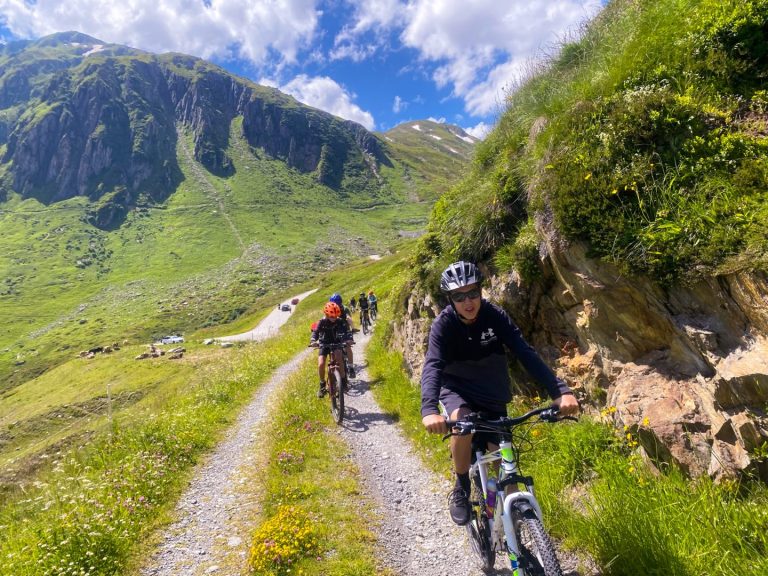
- Location & logistics: transport, drop-off/pick-up, cell policy, weather plans. For cross-border or alpine programs see our Swiss outdoor adventure.
- Sample deliverables: species lists, project reports, citizen-science uploads (iNaturalist, eBird).
- Staff training hours and onboarding (residential counselor benchmark: 40+ hours).
- Inclusion plans: support for disabilities or language needs.
- Refund/cancellation terms and visitation policies.
I include a compact set of sample questions to ask when you call a director:
- What are your staff-to-camper ratios by age group?
- Are staff background checks and CPR/First Aid/lifeguard certifications current? How many staff hold each certification?
- Is the camp ACA-accredited or state-licensed?
- What is included in tuition (meals, gear, field trips)? What are additional fees?
- What is your emergency action plan and how do you manage medications/allergies?
- Can you provide sample daily/weekly schedules and recent camper outputs (species lists, project reports)?
- What % of spots are reserved for financial aid or scholarships and how do families apply?
- What is your refund/cancellation policy (sample: full refund if cancelled 30+ days prior — check specific camp)?
- What training hours do residential counselors receive (typical benchmark: 40+ hours)?
- How do you support campers with disabilities or language needs?
- May parents visit or observe a session? What are visitation policies?
- What are your staff hiring age and supervision policies (e.g., staff 18+ for counselor roles)?
Red flags to watch for
- No written emergency plan.
- Unclear staff training or lack of documentation.
- Absence of references or contactable past families.
- No allergy/medication policies or missing medication administration protocols.
- Opaque refund terms.
FAQs (brief model answers)
- What does tuition typically include? Meals, basic field gear, and most program materials are often included; special trips or rental gear may cost extra — verify camp specifics.
- How are allergies/medications handled? Camps should provide a written medication and allergy management policy and trained staff to administer meds.
- Homesickness policy? Camps use graduated support, buddy systems, and parent contact protocols to help campers adjust.
- Visitation rights? Many camps limit unannounced visits but allow scheduled observations.
Practical packing checklist (sample)
- Field clothes
- Waterproof boots
- Sunscreen
- Hat
- Refillable water bottle
- Binoculars for older kids
- Waterproof notebook
- Completed medication form
Case studies to research
- NatureBridge
- Audubon Camps
- Sierra Club Outings and camps
- YMCA nature camps
- Campfire
- Outward Bound environmental programs
Resources to explore by role
- Accreditation & policy — ACA accreditation
- Curriculum & educator support — NEEF, NatureBridge
- Citizen-science tools — iNaturalist, eBird, Seek, Merlin
- Public health & activity guidance — CDC 60 minutes/day
- Education materials — EPA, NPS, Cornell Lab
Verify exact program figures and policies with individual camps before enrolling.

Sources
American Camp Association — Accreditation
National Environmental Education Foundation — The Value of Environmental Education
Centers for Disease Control and Prevention — How much physical activity do children need?
U.S. Environmental Protection Agency — Environmental education (EE)
National Park Service — Education | National Park Service
Cornell Lab of Ornithology / eBird — About eBird
Cornell Lab of Ornithology — Merlin Bird ID
iNaturalist (California Academy of Sciences & National Geographic) — About iNaturalist
iNaturalist — Seek by iNaturalist
Esri — ArcGIS Online | Cloud-based mapping and analysis
Epicollect5 — Epicollect5 (free mobile & web data collection)