

What Is Personal Growth for Teens: A Parent’s Guide
Discover what personal growth for teens really means. Learn how to support your teenager’s journey towards self-awareness and resilience.
TL;DR:
- Personal growth for teens involves developing self-awareness, resilience, and identity through ongoing experience and reflection. It is a process shaped by environment, support, and repeated challenges rather than specific achievements. Creating psychological safety at home and engaging teens in meaningful, sustained activities fosters authentic development and adaptability.
Most parents think personal growth for teens means better grades, a stronger resume, or hitting the right milestones on schedule. That framing is understandable but it misses something bigger. What is personal growth for teens, really? It’s the ongoing process of building self-awareness, resilience, and identity through experience, not outcomes. When you understand that distinction, your entire approach to supporting your teenager shifts. This guide breaks down what teen personal development actually looks like, what gets in the way, and what you can do about it.
Table of Contents
- Key takeaways
- What personal growth for teens actually means
- Common challenges teens face and how parents can help
- Personal growth activities for teens that actually work
- Comparing growth approaches: what format works best
- My honest take after years working with teens and families
- How Youngexplorersclub supports teen personal growth
- FAQ
Key takeaways
| Point | Details |
|---|---|
| Growth is a process, not a destination | Teen personal growth unfolds through experience and reflection, not through hitting specific milestones. |
| Psychological safety comes first | Teens explore identity and take healthy risks when home feels like a safe, non-judgmental space. |
| Consistency beats intensity | Short daily habits like journaling matter more than one-time intensive programs. |
| Real challenges build real skills | Sustained, repeated exposure to difficulty develops resilience far better than short bursts of activity. |
| Parents guide, they don’t drive | Your role is to accompany your teen through growth, not to engineer the outcome. |
What personal growth for teens actually means
Personal growth for teens is not a single event or a checklist you can complete. It’s a developmental process that touches every part of adolescence: how your teen sees themselves, how they handle setbacks, and how they figure out who they want to become.
Psychologist Erik Erikson identified this stage as a central tension between identity and role confusion. Teens are actively experimenting with different versions of themselves, testing values against their peer group and questioning the assumptions they inherited from family. That experimentation is not a problem to be solved. It’s the work itself.
Three core elements define what personal growth means for teens in practical terms:
- Self-awareness: The ability to recognize emotions, strengths, and triggers without collapsing under them. This develops through reflection, honest conversation, and repeated real-world feedback.
- Resilience: The capacity to bounce back after failure without losing confidence. Identity development through peer connection, family support, and a sense of future possibility collectively builds this quality.
- Growth mindset: The belief that abilities can be developed through effort and learning. Teens who adopt this thinking treat challenges as information rather than threats.
“Psychological safety at home is the bedrock of lasting teen mental health. When teens know they can explore, stumble, and return without judgment, they grow in ways no external program can replicate.”
The interplay of family values, peer culture, and personal experience shapes all of this. You cannot fully control which direction your teen grows, but you can shape the conditions that make growth possible.
Common challenges teens face and how parents can help
Understanding the obstacles is just as important as knowing the destination. Here are the most common challenges teens encounter on their personal development path, and what a genuinely supportive parent does in response.
1. Identity confusion and peer pressure. Your teen is simultaneously trying to fit in and stand out. The social pressure to conform while discovering what they actually believe is genuinely disorienting. Open, non-judgmental communication grounded in the teen’s own values helps buffer that stress.

2. Fear of failure and perfectionism. Many teens link their self-worth to performance. A failed test or a rejected friend request can feel catastrophic. The instinct to rescue your teen from disappointment is natural, but it shortcircuits the exact learning they need.
3. Emotional overwhelm. Adolescence involves intense, fast-moving emotional states that teens often cannot name. Without language for what they’re feeling, those emotions tend to drive behavior instead of inform it.
4. Lack of autonomy. Teens who feel micromanaged stop investing in their own development. They either comply without ownership or rebel without direction. Neither leads anywhere useful.
5. Short-term thinking. Most teens live in the present tense. Long-range goal-setting feels abstract and disconnected from anything they care about right now.
Here is what effective parental support actually looks like in practice:
- Ask open questions more than you offer solutions. “What do you think you should do?” develops judgment faster than giving the answer.
- Let natural consequences teach when the stakes are low. Missing a deadline at school hurts less than missing a deadline at work.
- Validate the emotion before addressing the behavior. Teens who feel heard calm down faster and think more clearly.
- Acknowledge your own mistakes out loud. When parents model imperfection, teens stop treating failure as shameful.
- Set clear, consistent boundaries while explaining the reasoning. Structure and autonomy are not opposites. Teens need both.
Pro Tip: Try replacing “You need to try harder” with “What felt hard about that, and what would you do differently?” That single shift moves the conversation from judgment to reflection, which is where genuine growth actually starts.
Personal growth activities for teens that actually work
The difference between an activity that builds real skills and one that just looks good on a form is this: sustained engagement with real stakes. Long-term commitment to projects without guaranteed success builds leadership and resilience in ways that one-day workshops simply cannot replicate.
Here are the personal growth activities for teens worth investing in, along with the reasoning behind each.
- Journaling with low pressure. Expressive journaling reduces anxiety and strengthens self-esteem in teens. The key is keeping sessions short, five to ten minutes, and removing any expectation of quality. The goal is consistency, not performance. A plain notebook and a daily prompt is enough.
- Volunteer work or community projects. Committing to something outside themselves gives teens perspective and a sense of competence that classroom success alone cannot provide. Projects where results are uncertain teach healthy frustration tolerance.
- Leadership roles in group settings. Leading a team, even informally, forces teens to manage conflict, communicate clearly, and take responsibility. These skills transfer directly to adult life.
- Physical challenges and outdoor activity. Adventure-based experiences like climbing, mountain biking, or survival skills teach teens that discomfort is survivable. That lesson, repeated in a supported environment, rewires how they approach difficulty everywhere else.
- Goal-setting conversations at home. Rather than assigning goals, ask your teen to define one thing they want to get better at over the next month. Growth mindset language at home, phrases like “not yet” instead of “failed,” creates the mental framework that makes those goals stick.
The pattern across all of these is the same. Real growth requires repeated exposure to challenge in an environment where failure is acceptable and reflection is built in. Experiential learning that combines adventure with reflection embeds exactly that kind of growth.
Pro Tip: If your teen resists structured programs, start smaller. A weekly 15-minute conversation where they review one thing they learned and one thing they struggled with builds the reflection habit without triggering resistance.
With 66% of teens interested in entrepreneurship or leading their own projects, connecting growth activities to real ownership and real stakes is more effective than generic self-improvement routines.
Comparing growth approaches: what format works best
Not every teen develops the same way, and not every program delivers on what it promises. The table below breaks down the main formats available to parents considering structured support for teen personal development.
| Approach | Best for | Strengths | Watch out for |
|---|---|---|---|
| Academic enrichment programs | High-achieving teens wanting intellectual challenge | Builds knowledge depth and discipline | Can reinforce performance over process thinking |
| Self-directed independent projects | Self-motivated teens with clear interests | High autonomy and genuine ownership | Lacks feedback loops and social challenge |
| Leadership development programs | Teens who need structured accountability | Builds confidence through role and responsibility | Short duration programs have limited lasting impact |
| Experiential outdoor camps | Teens needing confidence and resilience building | Real challenge, teamwork, and reflection combined | Quality varies widely; look for sustained engagement |
| Therapy or coaching | Teens facing emotional blocks or anxiety | Targeted, professional, and personal | Not a substitute for social and real-world experience |
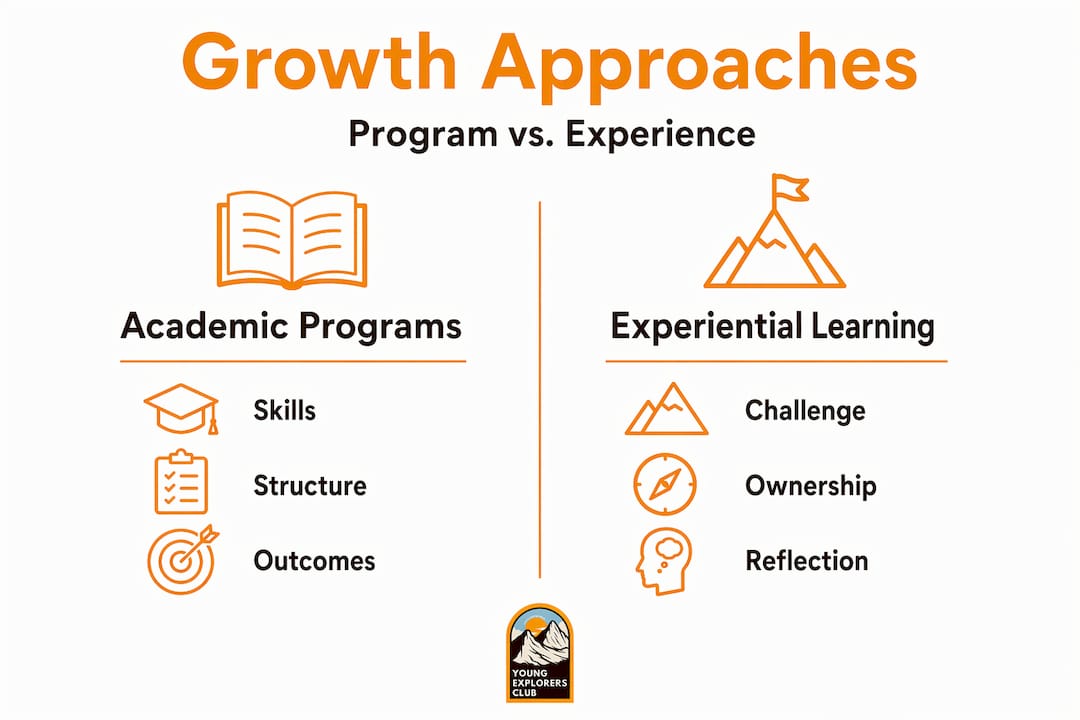
The research is consistent here. Sustained, repeated challenge over weeks or months produces far deeper skill development than any isolated event. When choosing a program or approach, look for one that includes group dynamics, real problem-solving, and room for your teen to fail and recover. Adventure-based environments that combine leadership in outdoor settings with structured reflection hit multiple growth drivers at once.
My honest take after years working with teens and families
I’ve watched hundreds of teens go through programs, activities, and support systems that looked excellent on paper. What I’ve learned is that the ones who grow the most are almost never the ones whose parents pushed hardest. They’re the ones whose parents stayed curious instead of certain.
The most damaging thing I see regularly is parents treating personal growth as a performance problem. Their teen is not growing fast enough, not confident enough, not focused enough. So they add more programs, more pressure, more comparison. What that produces is a teen who learns to perform growth rather than actually experience it.
What I’ve found actually works is disarmingly simple. Create a home environment where your teen can express confusion without being fixed. Let them pick an activity they care about, even if it doesn’t fit your vision of what’s impressive. Celebrate the moment they tried something hard, independent of whether it worked.
The psychological safety you build at home is not soft parenting. It is the foundation on which every other growth activity rests. Without it, even the best program produces surface-level change. With it, teenagers surprise you.
My take is this: stop managing your teen’s growth and start accompanying it. The difference is everything.
— Guillem
How Youngexplorersclub supports teen personal growth
At Youngexplorersclub, we’ve designed our programs around exactly the principles this article covers. Teens grow most when they face real challenges in supportive, social environments. Our activities are built to deliver that.

Whether your teen needs a confidence boost, wants to develop leadership skills, or simply needs space to discover who they are outside of school, our programs offer the right mix of challenge and support. From weekly outdoor activities to international summer camps for teens in Switzerland, every experience combines adventure, teamwork, and structured reflection. Teens leave with skills they actually remember because they earned them through experience. Explore our weekly activities in Vaud to find the right starting point for your teen.
FAQ
What does personal growth mean for teens?
Personal growth for teens means the ongoing process of building self-awareness, resilience, and identity through real experience and reflection. It is a developmental process, not a single achievement or milestone.
What are the best personal growth activities for teens?
Journaling, volunteer work, outdoor challenges, and leadership roles in group settings are among the most effective personal growth activities for teens. Sustained, repeated engagement with real stakes produces the deepest results.
How can parents support teen personal development without adding pressure?
Parents support teen development most effectively by creating psychological safety at home, asking open questions instead of offering constant solutions, and letting natural consequences teach when the stakes are manageable.
Why is the importance of growth for teenagers often misunderstood?
Many parents focus on outcomes like grades or achievements rather than the developmental process itself. Real teen personal growth includes identity exploration, failure, and recovery, all of which look messy from the outside but are signs of healthy development.
How do experiential programs like camps help teens grow?
Adventure-based camps place teens in sustained, real-world challenges that build confidence, resilience, and teamwork in ways classroom settings rarely can. The combination of physical challenge, group dynamics, and reflection creates lasting personal growth.
