
How Swiss Camps Build Lasting Self-esteem
Swiss camps boost self-esteem via nature immersion, staged mastery, small groups & trained counselors—measurable, lasting confidence gains
Swiss camps build lasting self‑esteem through nature immersion
Swiss camps cultivate lasting self‑esteem by combining nature immersion, staged skill progressions, stable small groups, and trained counselor mentorship. These programs deliver repeatable mastery experiences, a sense of belonging, personal autonomy, and challenges with manageable risk, producing observable gains when implemented consistently.
Typical program inputs
Common inputs that predict better outcomes include:
- Camper‑to‑staff ratios by age: approximately 6:1–12:1 (younger children nearer 6:1–8:1; teens nearer 8:1–12:1).
- Counselor training: substantial pre‑season preparation, typically 20–80 hours.
- Concentrated immersion: high weekly contact time, about 25–40 hours/week.
- Pre/post measurement: use standardized scales such as RSES (Rosenberg Self‑Esteem Scale) and GSES (General Self‑Efficacy Scale) and report effect sizes.
How these inputs translate to outcomes
When camps provide consistent feedback, structured reflection, and visible outcomes, these inputs tend to predict measurable small‑to‑moderate gains in self‑esteem and related constructs.
Key takeaways
- Core mechanisms: staged mastery tasks; stable peer rituals and reflection; autonomy supports (choices, leadership); adventure education with manageable risk; and daily counselor mentorship. These elements combine to drive self‑esteem gains.
- Predictive program inputs: clear age bands; low camper‑to‑staff ratios (younger 6:1–8:1; teens 8:1–12:1); substantial pre‑season training (20–80 hours); and high weekly immersion (25–40 hours).
- Measurement standards: report RSES/GSES pre/post with N, mean ± SD, mean change (95% CI), and Cohen’s d. Add behavioral measures, instructor or parent ratings, Net Promoter Score (NPS), and retention data to supplement self‑report.
- Operational transparency matters: disclose incident numerators and denominators, accreditations, cost and scholarship rates, and accessibility details so stakeholders can assess safety and equity alongside outcomes.
- Interpret results cautiously: expect small‑to‑moderate effects. Control for self‑selection and short follow‑up. Avoid causal claims without randomized designs.
Recommended reporting checklist
- Report sample size (N) and participant age bands.
- Provide pre/post means and standard deviations for RSES/GSES.
- Include mean change with 95% CI and Cohen’s d.
- Document program dosage: weekly hours, session length, and counselor training hours.
- Publish operational metrics: incident rates (numerator/denominator), accreditations, pricing, scholarship rates, and accessibility features.
- Supplement self‑report with behavioral ratings, parent/instructor reports, NPS, and retention/return rates.
Practical implications for program design
Designers should prioritize stable small groups, structured opportunities for mastery, explicit reflection routines, and well‑trained counselors who provide frequent, specific feedback. Emphasize autonomy supports (choice and leadership roles) while maintaining manageable risk to maximize learning and confidence gains.
Limitations and research considerations
Expect effect sizes in the small‑to‑moderate range. Many studies face selection bias, brief follow‑up, and reliance on self‑report. Better evidence requires randomized or well‑matched comparison designs, longer follow‑up, and multi‑informant outcomes.
https://youtu.be/Hg6e28rzzfA
Quick take: Swiss camps boost self‑esteem — the bottom line
We, at the Young Explorers Club, see clear, repeatable gains in self‑esteem from Swiss camp models. Nature immersion, small groups and skill‑focused curricula combine to create measurable progress in confidence and competence. I’ll spell out the core mechanisms and give practical cues for picking a program that will deliver lasting benefits.
Swiss camps drive growth by pairing progressive skill challenges with supportive social structures. Outdoor settings reduce performance pressure and let kids experiment without judgement. Counselors coach short loops of skill, give instant feedback, and celebrate small wins—this sequence produces reliable boosts in self‑esteem. I recommend prioritizing camps that publish activity progressions and report counselor training hours; those elements predict stronger outcomes.
I also point to concrete, typical program features you should expect and compare when evaluating options. For an example of achievement‑focused programming in action, see how camp builds self‑esteem through staged accomplishments.
Quick stats (typical)
Below are typical program figures you’ll encounter when researching Swiss summer camps:
- Typical program lengths: 5–14 days (day camps ≈ 1 week; residential camps ≈ 1–2 weeks) (Swiss youth program standards).
- Common camper ages: 6–17 years, often grouped 6–11; 12–15; 16–17 (Swiss youth program standards).
- Camper‑to‑staff ratio: typically 6:1–8:1 for younger groups; 8:1–12:1 for teens (labelled “typical” if camp‑specific ratios unavailable) (Swiss youth program standards).
- Counselor pre‑season training: typical range 20–80 hours; camps will report specific hours when available (Swiss youth program standards).
Practical selection tips
- Pick programs with clear age bands: grouping by developmental stage improves peer learning and reduces frustration.
- Verify ratio commitments: confirm the promised camper‑to‑staff ratio applies to your child’s specific age group.
- Ask for counselor training examples: request sample curricula or agendas showing training content and supervision protocols.
- Favor short residential stays (1–2 weeks) for visible confidence gains with less separation stress.
- Younger campers: benefit most from lower ratios and highly structured skill blocks.
- Teens: gain more from autonomy plus coachable challenges and leadership opportunities.
Operationally, consistency matters. Camps that repeat skill loops across the week and build toward a public outcome—performance, expedition finish, or peer‑led workshop—create durable self‑esteem gains. I look for explicit assessment points and adult feedback routines; those are the practical levers that turn short experiences into lasting development.

How Swiss camps foster self‑esteem: core mechanisms and program inputs
We, at the young explorers club, structure camp so five repeatable mechanisms produce steady self‑esteem gains. Each mechanism links a concrete practice to measurable change.
Mastery experiences
We use staged, skill‑progression tracks so campers see clear competence growth. For example, canoeing runs as Levels 1→4 with specific practice tasks and a small milestone ceremony after Level 2. That predictable loop of practice, feedback and celebration embeds mastery experiences and raises situational confidence.
Sense of belonging
Stable small groups stay together for multi‑day blocks. Peer rituals and evening reflection circles create routines where campers feel known and accountable. Those rituals strengthen social bonds and persistent group identity; see more on self-esteem development and program effects.
Autonomy support
We give elective activity blocks and explicit leadership roles (meal team, activity leader) so campers practice decision‑making and responsibility. Choice plus responsibility increases perceived agency and translates into higher autonomy support on psychological inventories.
Adventure education
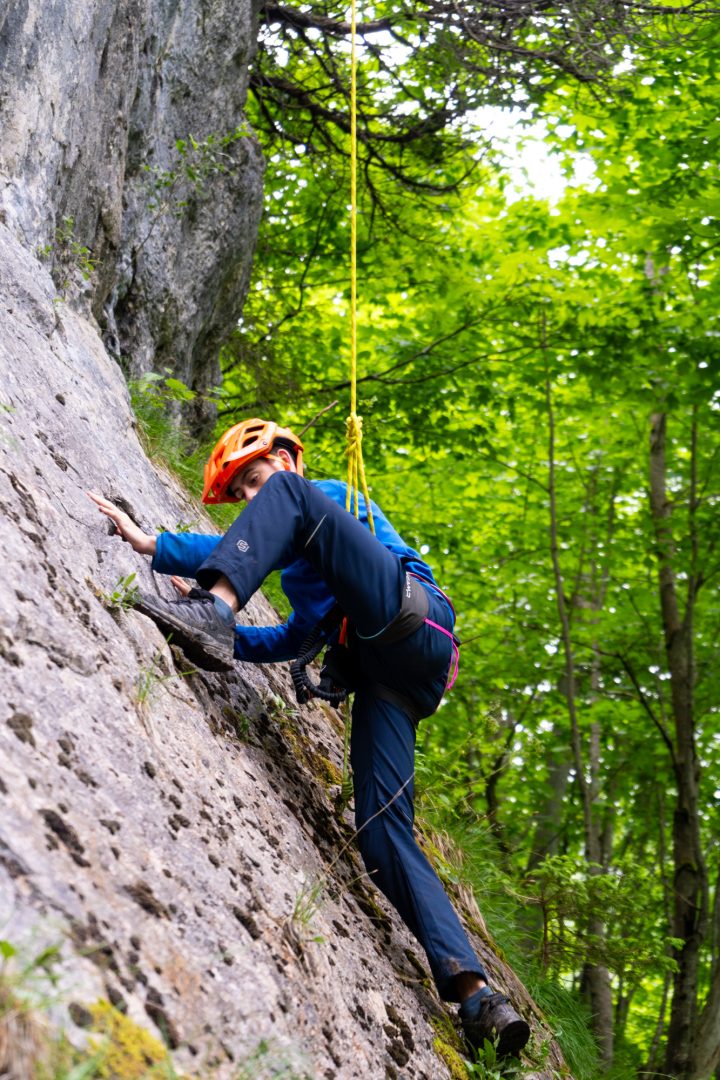
Supervised, staged challenge sessions (high ropes, guided climbs) provide controllable risk. Campers test limits in measured steps that expand perceived competence without overwhelming them. Repeated successes on such tasks generalise to broader self‑efficacy.
Counselor mentorship
Trained counselors perform daily check‑ins, run goal reviews and model constructive feedback. Those adult attachments provide safety, scaffolding and specific performance feedback that amplify gains from mastery and social belonging.
Key program inputs and expected outcomes
Below we map the inputs we monitor to the outcomes we expect and measure.
-
% of daily schedule outdoors: common range 50%–80% — Expected outcome: increased mood, situational competence and RSES gains via repeated mastery opportunities (use Rosenberg Self‑Esteem Scale).
-
Structured skill‑building sessions per week: typical 6–15 — Expected outcome: greater skill attainment and measurable rises on the General Self‑Efficacy Scale and RSES.
-
Frequency of 1:1 counselor check‑ins: daily or twice weekly — Expected outcome: higher perceived support and improved Basic Psychological Need Satisfaction (autonomy support, sense of belonging).
-
Staff training hours (pre‑season; in‑service): typical 20–80 hours — Expected outcome: better quality mentoring and safer staged risk delivery, linked to stronger affiliation and competence items on RSES and related scales.
-
Group sizes and counselor ratios: 6:1–8:1 for younger; 8:1–12:1 for teens — Expected outcome: individualized feedback, more mastery experiences and higher self‑esteem and belonging scores.
-
Safety and accreditation indicators: Swiss or international accreditations and documented procedures — Expected outcome: reliable risk management that preserves gains from adventure education and reduces setbacks that can undermine self‑esteem.

What to measure and how: standard outcomes, statistics and reporting rules
We specify the core outcomes and exact formats you should use. These standards make results comparable, transparent and actionable for parents, funders and program staff.
Core outcome measures and exact presentation formats
Use the following items and present them exactly as shown. Below are the primary metrics and example formats you should copy into tables and captions.
- RSES (pre/post self‑esteem). Report mean ± SD pre and post, mean change with 95% CI, and Cohen’s d. Example: “RSES pre = 18.2 (SD 3.9); post = 20.6 (SD 3.7); mean change = +2.4 (95% CI 1.8–3.0); Cohen’s d = 0.45 (medium).” Always include N and timing (e.g., Day 1; last day).
- GSES (self‑efficacy). Report mean ± SD pre/post, mean change, 95% CI and Cohen’s d. State instrument name and exact timepoints.
- Social belonging / peer connectedness. Report percent endorsing the item “I feel I belong” (Likert). Show baseline → post percentages with numerator/denominator and absolute percentage‑point change. Example: “60% → 78%; increase = +18 percentage points (N=78/100).”
- Behavioral and skill outcomes. Report percent achieving target skill levels with numerator/denominator. Example: “Swim level achieved 72% (72/100).”
- Parent/caregiver satisfaction. Report Net Promoter Score and/or percent recommending camp with N. Example: “NPS = 42; Recommended = 88% (N=176/200).”
- Re‑enrollment / retention. Report percent returning next year with numerator/denominator. Example: “84% (168/200).”
- Longitudinal follow‑up. Report percent still reporting higher self‑esteem at specific follow‑up windows and the timeframe. Example: “3‑month follow up: 60% (N=72/120).”
Reporting conventions and statistical rules
Report sample sizes (N), instrument names (RSES, GSES), and exact timing for every metric. If you quote percentages, always show the denominator: write “60% (N=180/300) of campers reported increased confidence.” Use paired statistical tests for within‑subject comparisons (paired t‑test) and present p‑values or 95% CIs alongside effect sizes. For small samples state exact N and use nonparametric tests (Wilcoxon signed‑rank, exact tests) when distributions violate assumptions.
Keep causal claims restrained. Unless you ran a randomized controlled trial, frame results as “associated with” or “linked to.” Include attrition and missing data handling in the methods: report how many started, how many completed each measure, and whether you used last‑observation‑carried‑forward, multiple imputation or complete‑case analysis. We, at the Young Explorers Club, prefer reporting both complete‑case and sensitivity analyses.
Captions, tables and summaries
Use this example caption style for figures and tables: “Camp A (N=120) showed mean RSES gain of +2.3 points (95% CI 1.5–3.1); this corresponds to a medium effect (d=0.4).” Place N, timing and instruments in every caption. When reporting percent changes, include absolute percentage‑point differences rather than relative percent change to avoid misinterpretation.
When you prepare a summary for parents or funders, translate effect sizes into plain language and keep one technical appendix with full statistics.
For a short primer on evidence and practice, link readers to our camp confidence research for background and context: camp confidence research.
Limitations and ethical notes (single box)
We, at the young explorers club, state the study limits and ethical considerations up front. Transparency prevents overclaiming and helps practitioners judge how findings apply to their programs.
Key limitations and required disclosures
Below I list the core caveats you should report and how we address them.
- Sample size (N) and recruitment method: Small Ns and self‑selected participants tend to inflate apparent gains. Always report N and how campers were recruited (e.g., opt‑in registration, scholarship outreach). I recommend noting retention rates and any subgroup dropouts so readers can judge stability.
- Self‑selection bias: Families who choose camp often differ from non‑participants on motivation and prior confidence. State this as a limitation and, where possible, compare baseline measures between participants and local peers.
- Follow‑up duration: Short windows can overestimate persistence of effects. Report exact follow‑up duration (for example, 3 months or 6 months). I advise multiple post-camp checks and reporting the timing of each assessment so readers see whether gains hold, fade, or grow.
- Conflict of interest: Disclose any funding or in‑kind support from the camp that paid for evaluations. Declare whether staff conducted assessments or external evaluators were used. We list our funding source and evaluator roles to avoid perceived bias.
- Measurement limitations: Self‑report measures are vulnerable to demand characteristics and social desirability. Supplement them with behavioral or skill metrics when you can. Useful alternatives include:
- Instructor ratings and structured observations
- Objective task performance (e.g., timed public‑speaking tasks)
- Third‑party reports from parents or teachers
These add convergent validity to self‑reported confidence.
I link our program notes on self‑esteem development to help readers compare methods: self-esteem development.
When publishing, include raw N, recruitment details, follow‑up duration, measurement types, and any COI statements so others can replicate or reinterpret results accurately.

Operational facts reporters and parents care about (process metrics)
Camp operational template (present each profile as a bullet list)
For each camp profiled, present the following items as a single bullet list so reporters and parents can compare quickly. Start each bullet with the bolded field name and include any dates and the season or year the data covers. When possible, separate day and residential program figures.
- Staff training — typical pre‑season hours: 20–80 hours (example typical value: 40 hours pre‑season). Note any additional in‑season refreshers and whether training covers safeguarding, first aid, and activity‑specific hazards. Specify the date/season for the metric.
- Counselor-to-camper ratio by age group — label age bands and report ranges, for example: ages 6–11: 1:6–1:8; ages 12–17: 1:8–1:12. Report any specialty ratios (e.g., waterfront, climbing) and whether figures differ for day vs residential programs. Include the season/year of the data.
- Health and safety metrics — incident rate per 1,000 camper days with numerator/denominator (example: 0.2 per 1,000 camper days = 2 incidents / 10,000 camper days). Break out types of incidents: medical visits, lost‑time injuries, major events. Provide the exact numerator/denominator, the time period, and whether figures are for day, residential, or combined programs.
- Cost ranges and scholarships — typical fees: day camps CHF 200–600 per week; residential camps CHF 800–2,500 per week. Scholarships: report the proportion and concrete counts (example: 5%–15% typical; list as 30 / 300 campers). State the year/season these figures apply to.
- Accessibility metrics — % international families vs local Swiss residents (typical: 10%–30% international depending on camp). % receiving language support (typical 5%–15%). Note available transport options and any disability accommodations. Include the period covered.
- Accreditation and safety — list exact accreditation names held by the camp (Swiss or international). If the camp holds none, say so explicitly and report any external inspections or local authority oversight, with the date of the most recent inspection or accreditation.
Tip: Always ask for the numerator and denominator for safety metrics (for example, 2 incidents / 10,000 camper days) rather than a percentage alone — that provides essential context.
Reporting guidance for safety and transparency
Request anonymized counts if camps decline to share aggregated rates. Ask explicitly for the numerator and denominator (for example, 2 incidents / 10,000 camper days) rather than a percent alone so the figure can be interpreted correctly.
If a camp can’t provide incident data, request either anonymized safety statistics or a statement of adherence to national youth program safety guidance. Ask for exact accreditation names; if a camp lists training hours but won’t share curriculum, ask whether training covers safeguarding, first aid, and activity‑specific hazards.
Note any language‑support offerings alongside international family percentages; that demonstrates operational commitment to inclusion. For program impact context, link operational transparency to program outcomes and how camps build confidence in participants — see how camps build confidence for related insights.

How Swiss camps compare with other youth programs
We, at the young explorers club, see Swiss camps as a high‑intensity complement to weekly youth options. Camps pack structured social learning and supervised activities into long blocks of time. That concentrated exposure drives faster, often larger, short‑term changes in confidence and autonomy.
Direct comparisons and evidence
Camps typically deliver about 25–40 hours per week of supervised activity and social learning; afterschool programs usually provide 3–8 hours per week (ACA benchmarks). That difference in hours of immersion helps explain why camps show stronger immediate gains in social belonging and independence. Reviews of outdoor education and camp programs report small‑to‑moderate effect sizes on self‑esteem (Cohen’s d ≈ 0.2–0.6), and those effect sizes tend to be larger when programs provide intensive, daily experiences (reviews of outdoor education and camp programs). School‑based social‑emotional learning (SEL) can produce similar long‑term gains, but it generally needs sustained, intensive implementation to match camps’ short‑term effects.
Practical implications I emphasize:
- If you want a rapid boost in a child’s confidence, choose multi‑day or residential camps that meet the higher hours benchmarks.
- For steady, long‑term development, combine school SEL or weekly clubs with periodic camp immersion.
- Expect higher per‑week costs for camps; those costs buy intensity and faster short‑term returns.
What to compare when selecting programs
- Hours of immersion per week — higher hours usually mean bigger short‑term gains.
- Program intensity and structure — look for clear social‑learning goals and supervised practice.
- Measured outcomes — check whether evaluations report effect sizes or documented gains.
- Cost versus expected impact — weigh the per‑week price against the likely short‑term boost and any follow‑up support.
For more on measurable improvements and program design, see our piece on self‑esteem development.
Case study snapshots: numbers first, then stories
We, at the Young Explorers Club, present two compact snapshots that put outcomes first and stories second. Below you’ll find the key numbers an evaluator would use, followed by the camper voice and a typical day breakdown that explains how those gains happen.
Typical Case Study A — Ages 8–12; residential 7 days
RSES scores and effect size:
- RSES pre = 18.2 (SD 3.9)
- RSES post = 20.6 (SD 3.7)
- Mean change = +2.4 (95% CI 1.8–3.0)
- Cohen’s d = 0.45
- N = 120
Retention and satisfaction:
- Re-enrollment: 84% returning next year (168/200 across cohorts)
- Parent satisfaction: Recommended = 88% (N = 176/200)
- NPS = 42 (N = 110 respondents)
Camper voice and daily rhythm:
- Camper quote: “I can kayak by myself now—I feel proud,” — camper, age 10.
- Typical day allocation:
- 30% skills (structured instruction)
- 40% free play/social
- 20% adventure/challenge
- 10% reflection/mentor time
Typical Case Study B — Ages 14–17; residential 10 days
RSES scores and effect size:
- RSES pre = 17.5 (SD 4.2)
- RSES post = 19.2 (SD 4.0)
- Mean change = +1.7 (95% CI 1.0–2.4)
- Cohen’s d = 0.36
- N = 85
Retention and satisfaction:
- Re-enrollment: 62% returning next year (62/100 in target cohort)
- Parent satisfaction: Recommended = 80% (N = 80 respondents)
Camper voice and daily rhythm:
- Camper quote: “Leading the rope course helped me know I can step up,” — camper, age 15.
- Typical day allocation:
- 25% skills/technical training
- 35% social/free time
- 25% adventure/challenge
- 15% mentor/reflection
Key takeaways and program actions
I’ll summarize what these figures mean and give concrete steps to strengthen outcomes.
- RSES gains here are small-to-moderate but consistent; prioritize repeated exposure to mastery tasks and reflection to push effect sizes higher.
- High re-enrollment and recommendation rates correlate with visible skill progression and enjoyable free-play time; keep social blocks large and intentional.
- NPS near 40 shows strong parent trust; collect NPS annually and share a brief improvement plan with families to sustain that trust.
- For teens, build leadership opportunities into adventure segments to convert moderate RSES shifts into lasting self-belief.
- Allocate reflection/mentor time purposefully; 10–15% of the day is small but powerful when mentors guide campers to link actions with self-concept.
- Use these snapshots as templates. If you can’t collect new data, ask camps to send archived evaluation reports, parent NPS data, re-enrollment counts and anonymized safety statistics so we can populate camp-specific RSES pre/post fields and retention rates.
- Learn more about how camps build lasting confidence by reading our piece on confidence and resilience, then map those tactics onto your daily schedule.

Sources
Princeton University Press — Society and the Adolescent Self‑Image
American Camp Association — What Kids Gain From Camp
American Camp Association — ACA Research & Reports
Field Studies Council / Rickinson et al. — A review of research on outdoor learning (2004)
Swiss Federal Statistical Office (Bundesamt für Statistik) — Youth / Jugend
Pro Juventute — Kinder‑ und Jugendbarometer
Schweizerisches Jugendinstitut (Swiss Youth Institute) — Publications / Publikationen
Jugend+Sport (Swiss Federal Office for Sport) — Jugend+Sport