

What Is Outdoor Resilience Training? A 2026 Guide
Discover what outdoor resilience training is and how it can enhance your coping skills and adaptability through nature-based challenges.
TL;DR:
- Outdoor resilience training combines nature-based challenges with structured reflection to develop coping skills, emotional regulation, and adaptability. It employs experiential learning cycles, using physical challenges and guided debriefs governed by the Learning Zone Model and challenge by choice principles to ensure psychological safety and growth. The training benefits diverse populations, including youth, educators, therapeutic clients, and corporate teams, by fostering emotional strength, self-efficacy, and team cohesion through immersive, multi-sensory experiences.
Outdoor resilience training is the intentional use of nature-based challenges combined with reflective practice to build coping skills, adaptability, and emotional strength. Unlike classroom instruction or app-based programs, it places participants directly inside the challenge, whether on a climbing wall, a ropes course, or a multi-day expedition, and then guides them through structured reflection to extract lasting growth. The field draws on frameworks like the Learning Zone Model and challenge by choice, both of which have become standard in youth development, teacher education, and corporate team programs worldwide. If you want to understand how to build resilience outdoors in a way that actually sticks, the method matters as much as the setting.
What is outdoor resilience training and how does it work?
Outdoor resilience training is a structured, experiential learning approach that uses physical challenges in natural settings to develop coping strategies, emotional regulation, and personal adaptability. The industry term for the broader discipline is adventure education, and outdoor resilience training sits within it as a goal-directed application focused specifically on psychological and social growth. Programs range from single-day workshops to 6-day intensive courses like the University of Vermont’s Resilience-based Outdoor Education offering for teacher candidates.
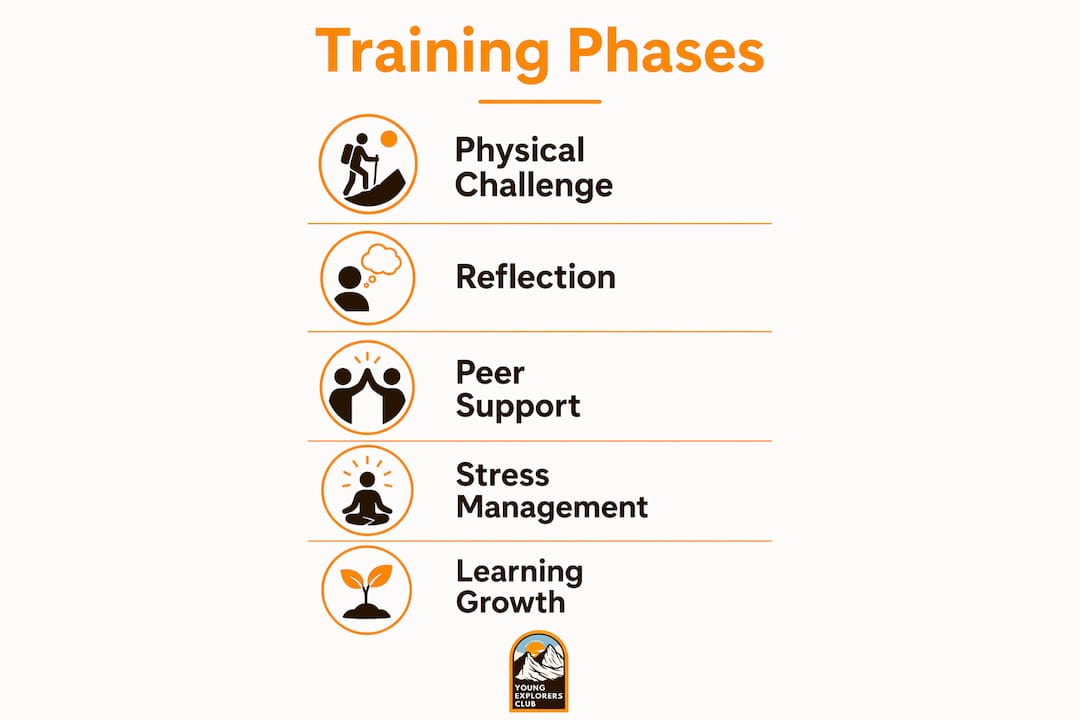
The structure of a typical session follows three phases. First, participants engage in a physical or social challenge outdoors, such as a rope element, a navigation task, or a group problem-solving scenario. Second, a trained facilitator leads a debrief that turns the raw experience into usable insight. Third, participants re-apply what they learned in a new challenge, completing what researchers call an action-reflection cycle that deepens learning with each repetition.
Two frameworks govern how facilitators manage participant stress during this process. The Learning Zone Model divides experience into three rings: a comfort zone, a growth zone, and a panic zone. The goal is to keep participants operating in the growth zone, where challenge is real but not overwhelming. The challenge by choice principle complements this by giving participants the right to step back from any activity that pushes them into panic, which protects psychological safety while still demanding genuine effort.
Programs like the SALTO-YOUTH Art of Resilience 2026 training course demonstrate this structure in practice. The course combines experiential outdoor activities with individual and group reflection sessions, shifting the focus from theory delivery to lived experience. That shift from lecture to challenge plus reflection is what separates outdoor resilience programs from most conventional training formats.
Pro Tip: When evaluating any outdoor resilience program, ask whether it includes structured debriefs after each activity. A program without guided reflection is adventure recreation, not resilience training.
What are the benefits of outdoor resilience training?
The benefits of resilience training in outdoor settings span emotional, cognitive, and social domains, and they compound across repeated sessions. Participants do not just feel better after a challenging day outside. They develop transferable skills that show up in classrooms, workplaces, and relationships.
The core benefits include:
- Emotional regulation. Navigating physical challenge under uncertainty teaches participants to manage fear, frustration, and discomfort in real time. The Roots and Rocks program, which integrates climbing and mindful nature activities over 4.5 hours, specifically targets emotional coping through this combination.
- Self-efficacy. Completing a challenge you doubted you could finish produces a direct, embodied sense of capability. This is more persuasive than being told you are capable.
- Mental clarity and stress reduction. A 2026 narrative review published in MDPI found that forest-based mindfulness fosters emotional flexibility, perceived coping, and vitality. This means time in nature is not just pleasant. It measurably shifts how people process stress.
- Team cohesion. Shared challenge creates trust faster than most team-building exercises. When a group solves a problem together outdoors, the memory of that shared effort becomes a reference point for future collaboration.
- Adaptability. Outdoor environments are unpredictable by nature. Weather changes, routes shift, and plans fail. Participants who train in these conditions practice adapting in real time, which builds cognitive flexibility.
The role of team challenges in this process is worth emphasizing. Group dynamics outdoors expose interpersonal patterns that rarely surface in office settings. A participant who struggles to ask for help on a ropes course often carries the same pattern into their professional life. Outdoor training makes those patterns visible and workable.
How does outdoor resilience training compare to other approaches?
Resilience training takes many forms, and each has genuine value. Understanding what makes outdoor training distinctive helps you choose the right approach for your goals.
| Approach | Method | Strengths | Limitations |
|---|---|---|---|
| Cognitive-behavioral (CBT-based) | Thought reframing, journaling, therapy sessions | Strong evidence base, highly personalized | Primarily cognitive, limited physical engagement |
| Mindfulness programs | Meditation, breathwork, body scans | Accessible, scalable, well-researched | Requires consistent personal practice to maintain gains |
| App-based resilience tools | Digital exercises, mood tracking, guided audio | Convenient, low barrier to entry | No social or physical challenge component |
| Outdoor resilience training | Experiential challenge, reflection, nature immersion | Integrates body, mind, and emotion simultaneously | Requires facilitation, logistics, and physical access |
The key distinction is integration. Cognitive approaches work primarily through the mind. Mindfulness works through attention and the nervous system. Outdoor resilience training works through all three channels at once, because a physical challenge in nature activates the body, demands mental focus, and generates emotion simultaneously. That simultaneous activation is what makes the learning transfer more broadly.
Pacing is also a structural advantage of well-designed outdoor programs. Because facilitators use the Learning Zone Model to manage stress exposure, participants build resilience gradually rather than through overwhelming exposure. This is a meaningful difference from approaches that simply place people in difficult situations and expect growth to follow.
Who benefits from outdoor resilience training and how to get started
Outdoor resilience programs serve a wider range of populations than most people expect. The common assumption is that these programs are designed for physically fit young adults. The reality is that resilience training techniques used outdoors are adapted regularly for children, teenagers, teachers, corporate teams, and therapeutic populations.
Contexts where outdoor resilience training is actively applied include:
- Youth education. Schools and summer camps use ropes courses, climbing, and wilderness expeditions to build self-confidence and coping skills in children and teens. Youngexplorersclub runs programs in Switzerland that combine mountain biking, climbing, and survival skills specifically for this purpose.
- Teacher training. The University of Vermont’s Resilience-based Outdoor Education course trains educators to use nature-based methods in their own practice, recognizing that teachers who understand resilience can model and teach it more effectively.
- Therapeutic settings. Programs like Roots and Rocks use outdoor climbing alongside nature-based mindfulness as a clinical intervention for emotional regulation challenges.
- Corporate teams. Organizations use outdoor challenge days to surface team dynamics, build trust, and develop leadership under pressure. Affordable adventure experiences are increasingly used by companies to deliver this kind of development without large program budgets.
- Family groups. Shared outdoor challenges give families a context for practicing communication, support, and problem-solving outside their normal routines.
Adaptations for physical ability and cultural context are standard in quality programs. Challenge by choice means no participant is forced into an activity that exceeds their capacity. Facilitators modify rope elements, climbing routes, and expedition distances to match the group. Nature-based mindfulness components, such as guided sensory walks or sit spots in forest settings, are accessible to nearly everyone regardless of fitness level.
Pro Tip: When searching for an outdoor resilience program, look for certified facilitators trained in adventure education or outdoor therapy. Certification bodies like the Association for Experiential Education (AEE) set standards for both safety and pedagogical quality.
To get started, identify your primary goal. Personal growth, team development, and therapeutic support each call for different program structures. Then look for programs that explicitly describe their reflective practice component. The outdoor setting is the context. The reflection is where the resilience actually forms.
Key takeaways
Outdoor resilience training builds lasting coping skills because it integrates physical challenge, emotional activation, and structured reflection in a single experience, making growth both immediate and transferable.
| Point | Details |
|---|---|
| Definition and method | Outdoor resilience training uses nature-based challenge plus guided reflection to build coping skills and adaptability. |
| Core frameworks | The Learning Zone Model and challenge by choice keep participants in a growth zone without triggering panic or shutdown. |
| Multidimensional benefits | Programs develop emotional regulation, self-efficacy, mental clarity, and team cohesion simultaneously. |
| Distinctive advantage | Outdoor training integrates body, mind, and emotion at once, which cognitive or app-based approaches cannot replicate. |
| Broad applicability | Programs serve youth, teachers, corporate teams, and therapeutic populations with appropriate adaptations. |
Why I think most people misunderstand what resilience training actually is
After years of watching outdoor programs in action, the most common misconception I encounter is that resilience training is about toughness. Parents send their kids to challenging camps expecting them to come back harder. Managers book team days expecting their people to push through discomfort and stop complaining. That framing misses the point entirely.
True resilience, as quality programs define it, is about growing through challenge with clarity and intentional recovery. It is not about enduring more. It is about processing experience more skillfully. The difference shows up in outcomes. A participant who learns to recognize when they are approaching their panic zone and chooses to step back is practicing more sophisticated resilience than one who white-knuckles through an activity they are not ready for.
The other thing I have noticed is that people underestimate the role of failure. When a group fails to complete a challenge, most participants feel embarrassed. A skilled facilitator treats that moment as the most valuable data point of the day. The debrief after a failure, focused on what participants noticed, what they would change, and what they learned about themselves, produces more lasting growth than a clean success. That is what failure by choice means in practice.
If you are considering an outdoor resilience program for yourself, your child, or your team, look past the activity list. Ask how the program handles setbacks. Ask what the debrief process looks like. The answer will tell you whether you are looking at genuine resilience training or just a well-marketed adventure day.
— Guillem
Build resilience outdoors with Youngexplorersclub
Youngexplorersclub runs weekly outdoor programs and international summer camps in Switzerland designed specifically to develop resilience, self-confidence, and teamwork in children and teens. Activities include climbing, mountain biking, survival skills, and multisport challenges, all facilitated within a structured, risk-managed environment that applies the same challenge by choice principles described in this article.

Every program at Youngexplorersclub pairs physical challenge with reflection and peer support, so participants leave with more than memories. They leave with skills. Families from across the world choose these programs because the combination of Swiss alpine settings, bilingual facilitation, and experienced staff creates conditions where genuine growth happens. Explore the weekly outdoor activities available in Vaud, or browse the full range of summer camp options for teens ready for their next challenge.
FAQ
What is outdoor resilience training in simple terms?
Outdoor resilience training uses physical challenges in natural settings, combined with guided reflection, to help participants develop coping skills, emotional regulation, and adaptability. It is a structured form of experiential learning, not simply time spent outdoors.
How is outdoor resilience training different from regular outdoor education?
Regular outdoor education focuses on skills like navigation, safety, and environmental knowledge. Outdoor resilience training uses those same outdoor contexts but directs the learning specifically toward psychological growth, emotional coping, and personal development through reflection.
What age groups can participate in outdoor resilience programs?
Programs are designed for a wide range of ages, from children in school-based programs to adults in corporate or therapeutic settings. Facilitators adapt activities using the challenge by choice model to match each participant’s physical and emotional readiness.
How long does it take to see results from outdoor resilience training?
Research on experiential learning cycles shows that growth deepens with repeated action-reflection cycles over time. Single sessions build awareness, but multi-day or recurring programs produce the most transferable and lasting resilience gains.
Is outdoor resilience training safe for people with physical limitations?
Yes. Quality programs use the challenge by choice framework, which allows participants to modify or step back from any activity that exceeds their capacity. Nature-based mindfulness components, such as guided forest walks, are accessible regardless of fitness level.
