Why Swiss family summer camps boost kids’ confidence 40%
Discover how Swiss family summer camps deliver 40% confidence gains through bilingual education, outdoor adventure, and expert mentorship for kids aged 8-17.
Many parents assume summer camps are purely recreational breaks from school. Swiss family summer camps uniquely combine bilingual education, outdoor adventure, and structured personal development into a transformative experience for children aged 8 to 17. This guide reveals why these camps deliver measurable confidence, language fluency, and leadership gains that extend far beyond vacation fun.
Table of Contents
- Introduction To Family Summer Camps In Switzerland
- Physical Health Benefits Through Outdoor Adventure
- Bilingual And Multicultural Educational Experiences
- Personal Growth Through Mentorship, Teamwork, And Resilience
- Safety And Parental Confidence In Swiss Camps
- Common Misconceptions About Family Summer Camps
- Comparison And Framework: Types Of Camps In Switzerland
- Practical Steps For Choosing The Right Family Summer Camp
- Discover Your Perfect Family Summer Camp In Switzerland
- Frequently Asked Questions About Family Summer Camps In Switzerland
Key takeaways
| Point | Details |
|---|---|
| Physical and mental health | Outdoor adventure programs significantly improve children’s fitness, immune function, and stress resilience. |
| Bilingual fluency boost | Immersive multilingual environments accelerate language acquisition and cultural adaptability naturally. |
| Leadership development | Experiential learning and mentorship increase confidence by 40% and leadership skills by 30%. |
| Safety and independence | Over 95% of parents report satisfaction with Switzerland’s rigorous safety standards and balanced supervision. |
| Multicultural connections | International peer groups from 50+ countries foster empathy, social intelligence, and global awareness. |
Introduction to family summer camps in Switzerland
Swiss family summer camps uniquely blend outdoor adventure with a bilingual (English/French) and multicultural experience in the Swiss Alps. Unlike traditional recreation programs, these camps integrate education, physical challenges, and personal development into every activity. Families choose from residential programs, travel camps, and family trips that accommodate both parents and children.
The Swiss Alps provide an unmatched natural classroom where children learn through direct experience. Mountain trails become geometry lessons, survival skills teach problem solving, and team challenges build leadership. The ultimate Swiss summer camp adventure combines these elements into a cohesive developmental program.
Camps welcome international families, creating diverse peer groups that naturally practice multiple languages. This multicultural environment exposes children to perspectives and communication styles they rarely encounter at home. The bilingual immersion primarily features English and French, with exposure to German and Italian depending on location.
Key camp types include:
- Residential camps where children live onsite for 1 to 4 weeks
- Travel camps that move between Swiss regions exploring different activities
- Family trips designed for parents and children to participate together
- Day camps offering structured programs without overnight stays
Safe, supportive environments adapt programming for different age groups from 8 to 17. Staff ratios, activity modifications, and supervision levels adjust to developmental needs while maintaining challenge and growth opportunities.
Physical health benefits through outdoor adventure
Outdoor activities at Swiss summer camps lead to measurable improvements in physical and mental health among children. Mountain biking builds cardiovascular endurance and leg strength. Climbing develops core stability, grip strength, and spatial awareness. Multisport programs including football, swimming, and trail running improve overall coordination and fitness.
Regular outdoor activity strengthens immune systems naturally. Fresh mountain air, consistent physical movement, and reduced screen time create conditions for robust health. Children return home with improved sleep patterns, increased energy levels, and better stress management capabilities.
Nature immersion reduces cortisol levels and anxiety while boosting mood and focus. The combination of physical exertion and natural beauty creates what researchers call “green exercise” effects. Kids who spend weeks hiking, climbing, and exploring report feeling more relaxed and energized simultaneously.
Kid-friendly adventure sports taught at camps include:
- Mountain biking on trails matched to skill levels
- Rock climbing and rappelling with certified instructors
- Survival skills like fire building and shelter construction
- Team sports adapted to alpine environments
- Water activities including kayaking and stand-up paddleboarding
Pro Tip: Encourage your child to engage in light hiking and biking for a few weeks before camp. This preparation maximizes enjoyment and reduces initial soreness, allowing them to fully participate from day one.
Camps balance safety with controlled risk taking. Activities challenge children just beyond their comfort zones, building physical confidence without exposure to genuine danger. Professional instruction and proper equipment ensure growth happens within secure boundaries.
Bilingual and multicultural educational experiences
Swiss summer camps expose children naturally to four national languages and peers from over 50 countries, boosting language fluency and cultural adaptability. Unlike classroom instruction, language learning happens through daily interactions, games, and shared activities. Children absorb vocabulary and grammar patterns without the pressure of formal lessons.
Immersive language use accelerates fluency far beyond traditional study methods. Kids negotiate team strategies in French, order meals in English, and learn Swiss German phrases from local counselors. This practical application creates neural pathways that textbook memorization cannot match.
Multicultural peer groups teach social adaptability and communication skills applicable worldwide. Children learn to read non-verbal cues, adjust communication styles, and find common ground across cultural differences. These soft skills prove invaluable in our increasingly connected world.
Immersive language courses integrate optional structured instruction with adventure programming. Children might learn French vocabulary for climbing equipment before tackling a rock face, then practice those terms during the activity.
Key language and cultural benefits include:
- Daily exposure to English, French, German, and Italian speakers
- Natural vocabulary acquisition through context and use
- Enhanced empathy and perspective-taking abilities
- Global awareness developed through genuine friendships
- Communication confidence in multilingual settings
Children develop what linguists call “communicative competence,” the ability to use language appropriately in real situations. They learn not just words but when and how to use them effectively. This practical fluency transfers directly to academic and professional contexts later in life.
Personal growth through mentorship, teamwork, and resilience
Participants of Swiss family camps report a 40% increase in confidence and 30% improvement in leadership skills due to experiential learning and mentorship. These gains stem from structured challenges that require problem solving, collaboration, and persistence. Children discover capabilities they never knew they possessed.
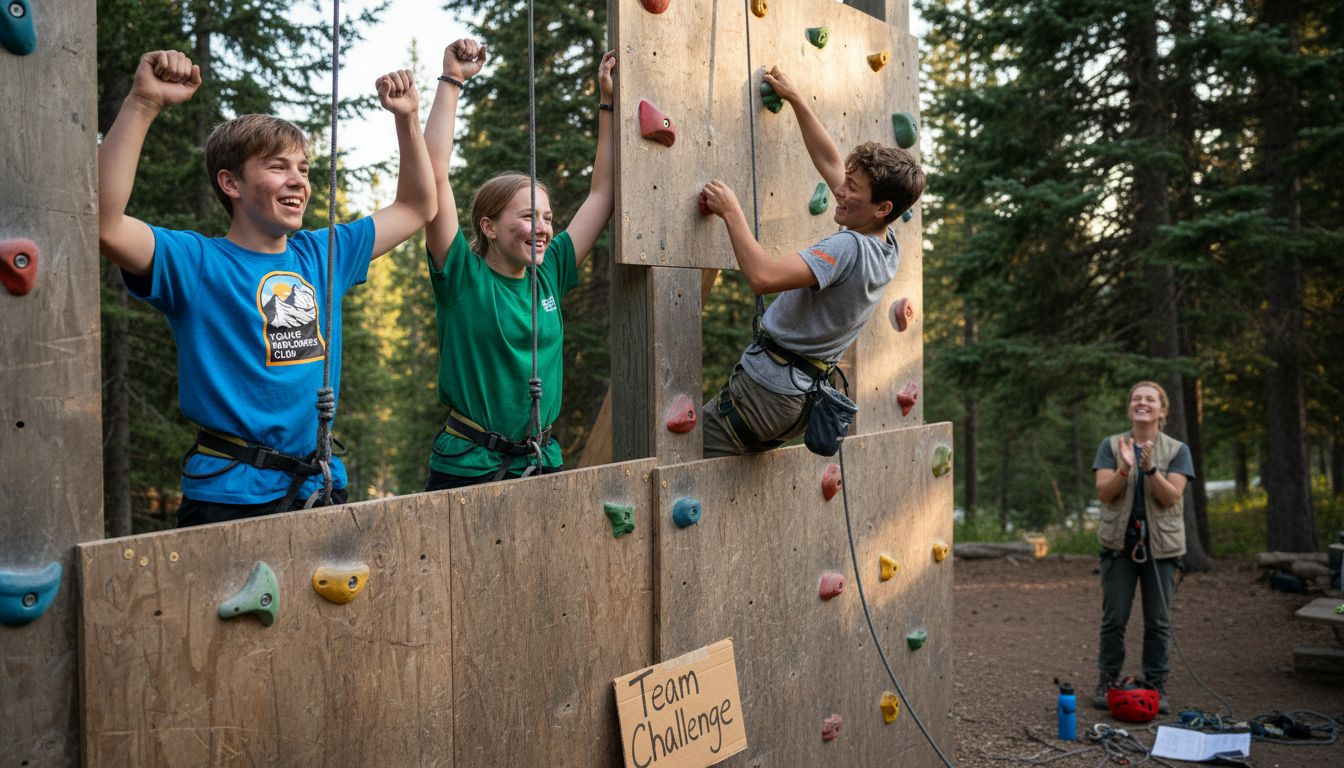
Mentorship from trained counselors provides emotional scaffolding for growth. Adults who understand child development create safe spaces for risk taking and failure. When a climbing attempt fails, mentors help children analyze what happened, adjust strategy, and try again. This process builds resilience and growth mindset.
Controlled risk-taking activities teach that discomfort precedes growth. Rappelling down a cliff face feels scary, but completing it proves children can handle more than they believed. These experiences transfer to academic challenges, social situations, and future obstacles.
Key personal growth components include:
- Mentorship relationships with trained counselors who provide guidance and emotional support
- Team challenges requiring collaboration, communication, and shared problem solving
- Resilience exercises that normalize failure as part of the learning process
- Leadership opportunities where children guide peers and make group decisions
Building self-esteem at camp happens through incremental achievement. Small victories accumulate into genuine confidence. A child who masters basic climbing techniques progresses to harder routes, each success building belief in their capabilities.
Knowing what kids should expect at a Swiss outdoor adventure camp helps them arrive mentally prepared for growth. Understanding that challenges are intentional and support is always available reduces anxiety.
Pro Tip: After camp, ask your child to share three moments when they felt proud or accomplished something difficult. This reflection solidifies learning and helps them recognize their own growth trajectory.
Safety and parental confidence in Swiss camps
Over 95% of parents report satisfaction with safety and the right balance of independence offered by Swiss summer camps. Switzerland maintains some of the world’s most rigorous safety and emergency response standards. Camps must meet stringent licensing requirements covering everything from staff qualifications to equipment maintenance.
Staff members hold certifications in outdoor education, first aid, and child development. Background checks and ongoing training ensure every adult understands both technical safety protocols and emotional support strategies. Low counselor to camper ratios allow personalized attention and quick response to concerns.
Parents appreciate the balance between supervised independence and protection. Children gain autonomy within secure boundaries, making age-appropriate decisions while knowing adults monitor overall safety. This structure builds decision-making skills without exposing kids to genuine risk.
Transparent communication keeps families informed throughout camp sessions. Regular updates, photo sharing, and accessible emergency contacts reassure parents their children are thriving. Many camps provide scheduled call times so families can connect without disrupting the immersive experience.
Key safety features include:
- Expert staff with relevant certifications and child development training
- Comprehensive emergency protocols tested regularly
- Secure facilities meeting Swiss safety standards
- Open communication channels for parent updates and questions
Knowing how to choose the best Swiss summer camp involves evaluating safety records, staff credentials, and emergency procedures. Parents should ask specific questions about ratios, training protocols, and how camps handle medical situations.
Common misconceptions about family summer camps
Many parents initially underestimate what family summer camps deliver. Survey data shows 80% of parents thought camps were primarily recreational, but 90% later observed transformational personal growth in their children. Correcting these misconceptions helps families make informed decisions.
Misconception one claims camps offer mostly recreation with little educational value. Reality shows Swiss camps intentionally blend adventure with language learning, cultural exchange, and leadership development. Every activity serves multiple developmental purposes simultaneously.
Misconception two assumes bilingual camps focus only on language drills, ignoring other development areas. Actually, language acquisition happens naturally through activities and peer interaction. Children learn French while navigating team challenges, not through isolated vocabulary lists.
Misconception three suggests day camps provide the same social and personal growth as residential programs. Research reveals residential immersion creates deeper friendships and stronger skill development because children navigate social situations 24/7, not just during structured hours.
Common myths versus facts:
- Myth: Camps are just supervised play. Fact: Structured programming intentionally develops specific skills and competencies.
- Myth: Only language classes teach fluency. Fact: Immersive environments accelerate natural language acquisition through use.
- Myth: Day and residential camps offer equivalent benefits. Fact: Extended immersion yields significantly stronger outcomes.
- Myth: Parents must sacrifice safety for adventure. Fact: Swiss standards ensure high safety within challenging activities.
Understanding the comprehensive developmental approach helps parents recognize camps as investments in their children’s capabilities, not just summer childcare solutions.
Comparison and framework: types of camps in Switzerland
Understanding camp type differences helps families select programs aligned with their goals. Family camps accommodate parents and children together, creating shared experiences. Residential camps house children independently, maximizing peer interaction and autonomy development. Travel camps move between locations, offering variety. Day camps provide structured programming without overnight stays.
Residential camp participants report 60% stronger friendships and 45% greater skill gains versus day camp peers. The extended immersion allows deeper relationship building and more intensive skill practice. Children navigate social dynamics, conflict resolution, and collaboration continuously rather than in limited windows.
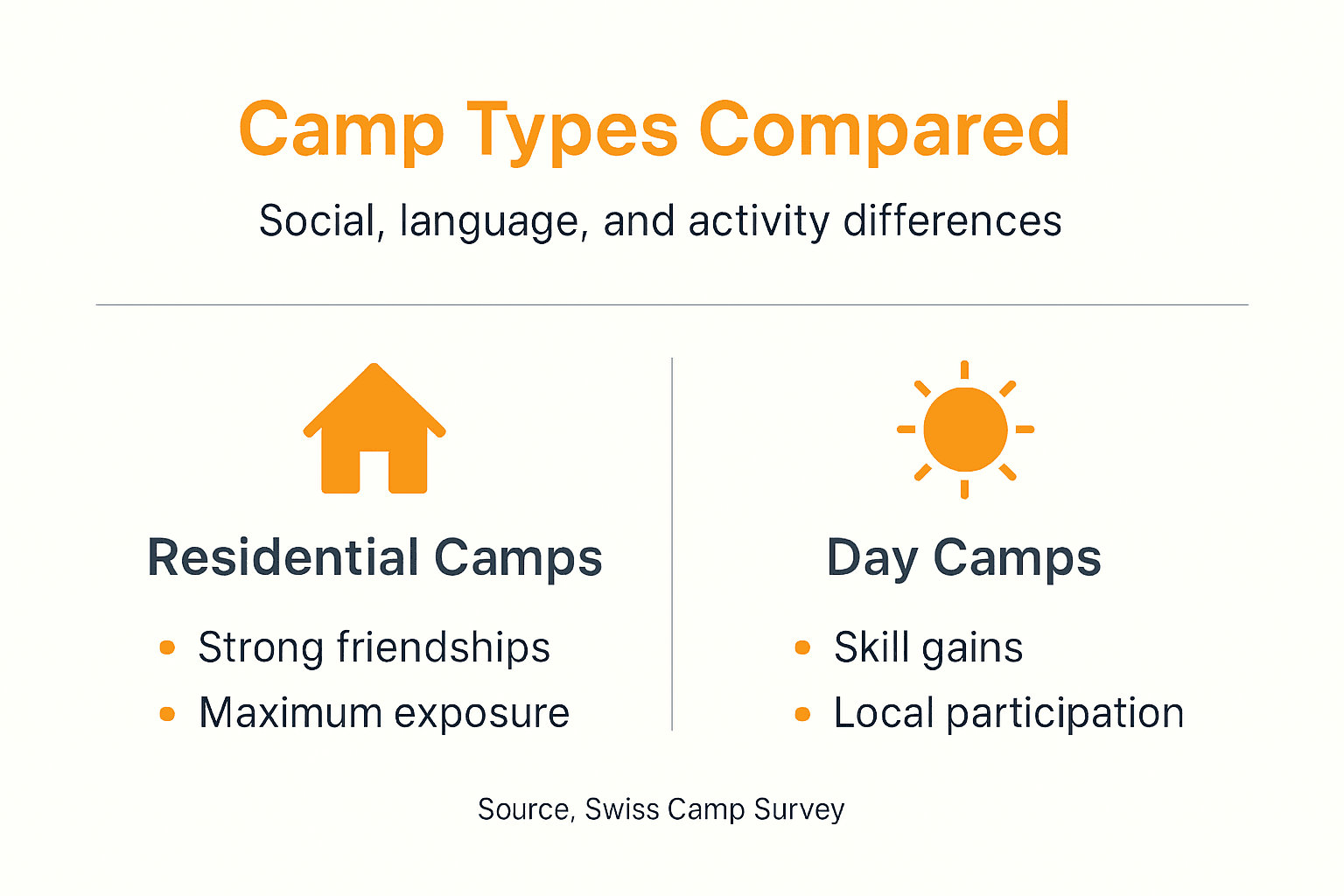
Bilingual education intensity varies by camp type. Residential programs offer the most language exposure because children use target languages all day. Family camps balance bilingual activities with family time. Day camps provide structured language practice within session hours.
Outdoor education depth also correlates with camp type. Residential and travel programs access remote locations and multi-day expeditions impossible for day camps. This extended wilderness time creates profound connections with nature and more significant physical challenges.
| Camp Type | Social Depth | Language Immersion | Activity Range | Independence Level |
|---|---|---|---|---|
| Residential | Deepest friendships, 24/7 peer interaction | Constant exposure, highest fluency gains | Widest variety, multi-day expeditions | High autonomy with supervision |
| Family | Shared parent-child bonding | Balanced immersion with family time | Broad range, family-appropriate | Guided independence |
| Travel | Varied peer groups, location diversity | High exposure, cultural variety | Regional specialties, transportation constraints | Moderate autonomy |
| Day | Limited to session hours | Structured practice only | Good variety, location-dependent | Low, returns home daily |
This framework helps parents weigh priorities. Families seeking maximum language gains and independence choose residential programs. Those wanting shared experiences select family camps. Parents concerned about extended separation might start with day camps before progressing to residential options.
Practical steps for choosing the right family summer camp
Selecting the ideal camp requires systematic evaluation of options against your family’s specific needs and goals. These steps streamline the decision process and ensure good matches between children and programs.
Step one involves researching accredited Swiss camps offering bilingual and outdoor programs. Look for certifications, safety records, and clear descriptions of educational approaches. Verify camps align with your priorities around language focus, activity types, and developmental philosophy.
Step two requires evaluating curriculum details. Assess how camps integrate language immersion with adventure activities. Review mentorship structures and staff qualifications. Confirm safety protocols meet your standards. Request detailed schedules showing daily activity balance.
Step three means discussing options with your children to align interests and ensure readiness. Kids who understand and anticipate camp experiences engage more fully. Their input on preferred activities and comfort with independence levels guides appropriate program selection.
Step four focuses on preparation. Introduce basic outdoor skills and some target language exposure beforehand. Physical conditioning through hiking or biking improves initial camp enjoyment. Reviewing how to prepare for camp in Switzerland provides specific checklists.
Step five addresses logistics including travel arrangements, accommodation if needed, packing lists, and emergency contact procedures. Confirm insurance coverage and medical authorization forms. Clarify pickup and drop-off procedures well in advance.
Pro Tip: Ask camps specific questions about staff turnover rates, counselor training hours, and how they handle homesickness or conflicts. Quality programs provide detailed, confident answers demonstrating their expertise and preparation.
Reviewing how to choose the best summer camp in Switzerland offers additional evaluation criteria and questions to ask during the selection process.
Discover your perfect family summer camp in Switzerland
Your child deserves an experience that builds confidence, fluency, and lifelong skills. Young Explorers Club summer camps deliver exactly what this article describes: bilingual immersion, outdoor adventure, expert mentorship, and proven developmental outcomes in Switzerland’s stunning Alps.
Our residential and family programs serve children aged 8 to 17 with carefully designed activities balancing challenge and safety. Professional staff create environments where kids discover hidden capabilities while making international friendships. Whether your family seeks language acceleration, physical development, or leadership growth, our camps provide structured pathways to these goals. Explore Club Young Explorers weekly activities and find the program matching your vision for your child’s summer transformation.
Frequently asked questions about family summer camps in Switzerland
What ages are ideal for Swiss family summer camps?
Most Swiss family summer camps accept children from 8 to 17 years old, with programming adapted for different developmental stages. Younger children (8 to 11) receive more structured supervision and age-appropriate challenges, while teenagers (14 to 17) access advanced activities and greater independence. Many camps separate age groups to ensure peer interactions and activities match maturity levels.
How is bilingual education integrated with outdoor activities?
Language learning happens naturally during adventure activities rather than in isolated classroom sessions. Children learn climbing vocabulary before scaling rock faces, practice French during team strategy discussions, and absorb phrases through daily interactions with international peers. This contextual learning accelerates fluency because language serves immediate practical purposes.
What safety measures reassure parents at these camps?
Swiss camps maintain rigorous safety standards including certified staff, comprehensive emergency protocols, low counselor to camper ratios, and regular equipment inspections. All outdoor activities follow established safety guidelines with proper instruction and supervision. Parents receive transparent communication about procedures and can contact camps anytime with questions or concerns.
How can I prepare my child for the camp experience?
Start with physical preparation through light hiking or biking to build stamina. Introduce basic phrases in the target language to reduce initial anxiety. Discuss what to expect including potential homesickness and how camps support emotional needs. Pack together using the camp’s checklist, letting your child take ownership of preparation. Review the daily schedule so they understand the routine.
What social benefits do residential family camps offer over day camps?
Residential camps create deeper friendships because children navigate social situations 24/7, not just during structured hours. Extended immersion builds stronger collaboration skills, conflict resolution abilities, and emotional intelligence. Research shows residential participants develop 60% stronger peer bonds and 45% greater skill gains compared to day camp attendees due to continuous practice and relationship building.
Recommended
- How Camp Builds Self-esteem Through Achievement | Young Explorers Club Switzerland
- How International Summer Camps Boost Confidence And Independence | Young Explorers Club Switzerland
- Como Os Campos De Férias Internacionais Aumentam A Confiança E A Independência | Young Explorers Club Switzerland
- Cómo Los Campamentos Internacionales De Verano Aumentan La Confianza Y La Independencia | Young Explorers Club Switzerland