

What Is Youth Personal Development for Teens
Discover what is youth personal development and how it empowers teens through strengths-based learning and essential life skills to thrive.
TL;DR:
- Youth personal development is a structured, strengths-based process that helps young people build competencies and thrive in supportive environments. It emphasizes the development of the 5Cs—competence, confidence, character, caring, and connection—through teachable skills like emotional regulation and communication. Effective programs involve intentional adult relationships, ecological thinking, and strategies for skill transfer across settings to foster genuine growth.
Youth personal development is one of those phrases that gets used constantly by parents, teachers, and program directors, but rarely gets defined clearly enough to act on. What is youth personal development, really? It goes far beyond self-help habits or building confidence through pep talks. Research frames it as a structured, strengths-based process where young people build competencies and thrive when their natural capacities align with genuinely supportive environments. This article breaks down the framework, the skills it targets, and what adults can actually do to support it well.
Table of Contents
- Key takeaways
- What is youth personal development, really?
- Core skills youth personal development builds
- The adult relationships that drive real growth
- Practical strategies for parents, educators, and mentors
- My take on what actually moves the needle
- How Youngexplorersclub supports youth growth in practice
- FAQ
Key takeaways
| Point | Details |
|---|---|
| Development is strengths-based | Youth personal development builds on existing capacities, not just corrects problems or deficits. |
| Skills are teachable and specific | Competencies like emotional regulation, communication, and critical thinking can be directly taught through structured programs. |
| Adults shape outcomes significantly | How mentors, parents, and educators listen, challenge, and encourage determines how much youth actually grow. |
| Environment matters as much as the individual | Thriving happens when youth strengths meet rich, supportive contexts like camps, mentors, and communities. |
| Programs need measurable quality | Evidence-based curricula with trained adults produce far better results than general “good environment” programs. |
What is youth personal development, really?
Most people assume youth personal development means teaching kids to be more confident or disciplined. That framing is too narrow. The field has moved toward what researchers call Positive Youth Development, or PYD, which focuses on building competencies and thriving by aligning youth strengths with supportive environmental resources rather than fixing deficits or managing problems.
The most widely used framework in PYD research organizes development around five core dimensions, commonly called the 5Cs:
- Competence: Academic, social, and vocational skills that allow a young person to handle real-world situations.
- Confidence: A realistic, positive sense of self-worth grounded in actual achievement, not empty praise.
- Character: Integrity, respect for social norms, and a sense of personal responsibility.
- Caring: Empathy and a genuine concern for the wellbeing of others.
- Connection: Strong, positive bonds with peers, family, school, and community.
When all five develop together, researchers describe the outcome as “thriving,” which is distinct from just avoiding bad outcomes. A teen who stays out of trouble is not automatically thriving. A teen who engages meaningfully, contributes to their community, and faces challenges with real skill is thriving in the PYD sense.
Here is how PYD compares to a traditional, deficit-focused approach:
| Approach | Primary focus | How adults respond | What success looks like |
|---|---|---|---|
| Deficit/problem-based | Reducing risky behavior | Correct, intervene, restrict | Absence of negative outcomes |
| Positive Youth Development | Building strengths and assets | Challenge, support, connect | Active thriving and contribution |
The ecological dimension matters here too. Thriving is fostered when youth strengths align with resources like mentoring, parenting, and participation opportunities. Development is not a solo act. It is bidirectional, shaped by the quality of every relationship and context a young person inhabits.
Core skills youth personal development builds
The 5Cs describe what development looks like at a high level. But what specific skills does the process actually build, and how are those skills developed in practice? This is where the facets of personal growth become concrete and teachable.
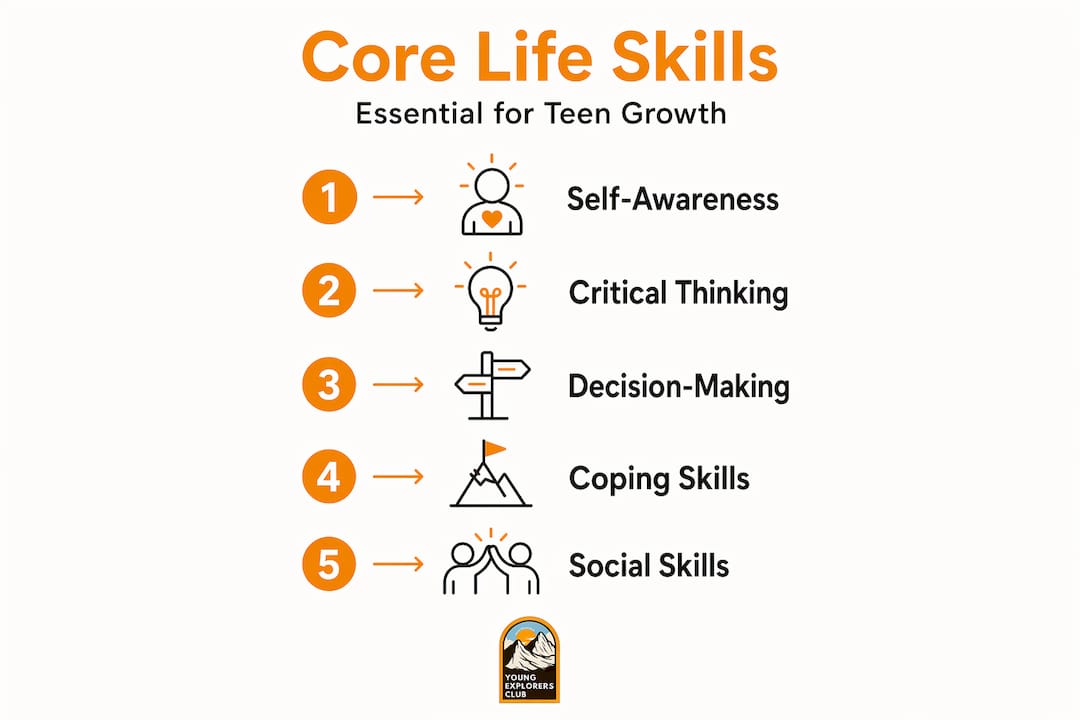
Personal growth for teens centers on a cluster of life skills that the World Health Organization has organized into ten core competencies: critical thinking, creative thinking, decision-making, problem-solving, effective communication, interpersonal skills, self-awareness, empathy, coping with stress, and coping with emotions. These are not personality traits someone either has or doesn’t. They are skills. They can be taught, practiced, and measured.
Structured programs that embed WHO-aligned life skills into interactive, narrative curricula show better skill internalization than lecture-based approaches. A teen who role-plays a conflict resolution scenario with peers internalizes communication skills in a way that a worksheet about communication never could.
School-based social-emotional learning (SEL) programs offer strong evidence for how to develop youth skills at scale. A 2025 meta-analysis found that SEL programs produce positive effects on both academic achievement and social outcomes, particularly in elementary and middle school students. The evidence is clear: structured skill-building works when it is implemented well.
The following sequence reflects how skill-building should unfold in a quality program:
- Name the skill explicitly. Do not assume youth will absorb values from good activities alone. Tell them what they are learning and why it matters.
- Model it through adult behavior. Young people observe how the adults around them handle frustration, conflict, and setbacks. The adult’s behavior is the curriculum.
- Practice in context. Interactive activities, group challenges, and real-world tasks create the pressure needed to test new skills.
- Facilitate transfer. Help youth identify how the skill applies outside the program. A teen who learns to regulate stress during a rock climbing challenge needs help connecting that experience to a stressful exam or difficult conversation at home.
The fourth step is where most programs fall short. Coaches who integrate teachable moments help youth transfer life skills from sport to other settings, improving holistic development. Without that intentional transfer, the skill stays trapped in the activity.
Pro Tip: When selecting a program for your teen, ask specifically how they help youth apply skills outside of sessions. If the staff cannot describe their transfer strategy, the program likely stops at step three.
The adult relationships that drive real growth
Youth empowerment strategies live or die based on the quality of adult relationships surrounding young people. Research on adult-led PYD experiences shows that specific observable behaviors, including listening, encouraging risk-taking, and offering appropriate challenges, correspond directly to gains in social-emotional skills, self-confidence, and motivation.
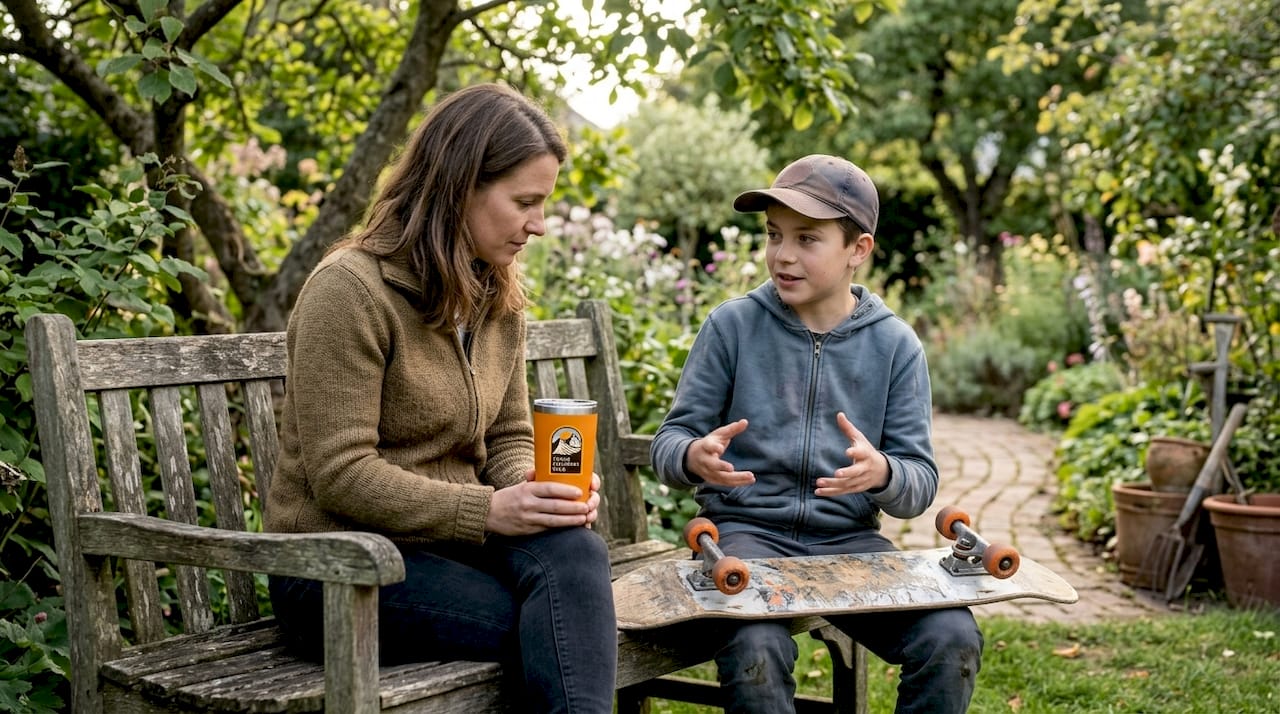
This is not about being a warm, supportive presence in a general sense. It is about specific practices. The adult who sits beside a struggling teen and asks open questions does something measurably different from the adult who offers reassurance. One builds capacity. The other manages discomfort.
What effective adult support looks like in practice:
- Listening without rushing to fix. Young people need to articulate their experiences to process them. Adults who interrupt with solutions short-circuit that processing.
- Giving youth a genuine voice. Asking for input on program design, group decisions, or activity selection builds ownership and accountability.
- Creating calibrated challenges. Tasks that are too easy produce boredom. Tasks that are too hard produce shutdown. Measurable adult-led practices in PYD include deliberately calibrating difficulty to stretch without breaking.
- Modeling psychological flexibility. When an adult handles a setback with visible, honest composure, that modeling teaches more than any lesson plan could.
For parents specifically, supporting teens effectively means providing stability and safety while enabling reflection and problem-solving rather than controlling the experience. The goal is not to protect young people from difficulty. It is to remain steady while they navigate it.
Youth mentorship benefits extend well beyond the mentoring relationship itself. A teen who experiences consistent, high-quality mentorship develops an internal model of what supportive engagement looks like, and that model shapes how they show up in peer relationships, group projects, and eventually in their own leadership roles.
Pro Tip: Parents and mentors can audit their own behavior by asking: “In the last week, did I create space for this young person to solve a problem on their own, or did I solve it for them?” Patterns reveal more than intentions.
Practical strategies for parents, educators, and mentors
Knowing the framework is useful. Knowing what to do Monday morning is more useful. Here are the evidence-based practices that translate youth development theory into daily action:
- Prioritize interactive and contextual activities. Programs built around discussion, challenge, and real tasks outperform lecture-based formats every time. Adventure education offers a strong example of how physical challenge creates genuine social-emotional learning conditions.
- Create regular reflection time. Teens need structured prompts to connect experiences to meaning. Even five minutes of guided journaling or group debrief after an activity builds metacognition.
- Select programs with explicit curricula. General “good vibes” programs are not enough. The EASE program for adolescents, developed by WHO and UNICEF, trains helpers over approximately 80 hours with a structured curriculum to teach emotional coping skills. That level of intentionality is the benchmark.
- Build in community. Teens develop faster in contexts where they feel genuine belonging. Programs that invest in group culture, not just individual performance, produce stronger outcomes.
- Evaluate programs by adult behavior, not just activities. A camp that offers 20 activities is not automatically better than one that offers 10. What matters is how staff engage youth in those activities. Look for trained mentors, explicit skill frameworks, and transfer practices.
A common mistake worth naming: focusing entirely on performance metrics like grades or athletic results while neglecting teen self-improvement across the full range of life skills. Academic achievement matters, but a student who performs well academically while struggling with emotional regulation, peer relationships, or self-awareness has only partially developed. Leadership development in camps addresses this more holistically than most school programs do, which is why structured outdoor and community programs serve as powerful complements to formal education.
My take on what actually moves the needle
I have worked with young people across a lot of different settings, and the pattern I keep coming back to is this: skill-building without relationship is just instruction. It lands, maybe sticks briefly, and then disappears.
The youth I have seen grow most significantly were not necessarily in the most sophisticated programs. They were in settings where at least one adult genuinely paid attention to them as a specific person, not a generic teenager. That adult noticed when they struggled, named what they saw, and stayed consistent even when the teen pushed back.
What I find missing most often in well-intentioned programs is ecological thinking. Adults design a great curriculum and then act surprised when the growth does not transfer home or to school. The problem is that development does not live inside a program. It lives in the spaces between all the contexts a young person moves through every day. A teen who builds confidence at camp but returns to a home environment that dismisses that confidence faces a real erosion challenge.
My honest advice to parents and educators is to stop asking “Is this a good program?” and start asking “Does this program treat development as a whole-system process?” The best programs actively work to involve families, build teacher awareness, and explicitly discuss how skills carry across settings. That is what distinguishes a genuinely growth-focused experience from a well-organized activity.
— Guillem
How Youngexplorersclub supports youth growth in practice
If you are looking for a structured environment where youth personal development is not an afterthought but a design principle, Youngexplorersclub builds its Switzerland-based programs around exactly the PYD principles covered in this article.
Trained adult mentors work with youth across adventure activities, language immersion, and team challenges using explicit skill frameworks and reflection practices. Whether your child is building emotional regulation through mountain challenges or developing communication skills in a multicultural group, the international summer camp experience creates the ecological conditions where real growth happens. Parents can explore specific program options, review how staff training aligns with evidence-based PYD practices, and access enrollment resources directly at Youngexplorersclub. If you want to understand how to select the right fit, the parent’s guide to growth-focused camps is a practical starting point.
FAQ
What is youth personal development?
Youth personal development is a structured, strengths-based process of building competencies across emotional, social, cognitive, and character dimensions. Research frames it through the Positive Youth Development model, which focuses on thriving rather than just preventing negative outcomes.
What are the 5Cs of positive youth development?
The 5Cs are competence, confidence, character, caring, and connection. Together they describe a young person who is not just well-behaved but actively engaged, skilled, and contributing to their community.
How can parents support teen self-improvement at home?
Parents support growth most effectively by providing stability while enabling reflection, asking questions rather than providing immediate answers, and modeling the psychological flexibility they want their teens to develop. Consistency and genuine attention matter more than elaborate interventions.
What makes a youth development program evidence-based?
An evidence-based program includes an explicit skill curriculum, trained adult facilitators, structured reflection practices, and strategies for transferring skills beyond the program context. The WHO/UNICEF EASE program is a useful benchmark for what rigorous program design looks like.
How do mentors improve youth outcomes?
Youth mentorship benefits come from specific adult behaviors including listening without rushing to fix, creating calibrated challenges, and giving youth genuine voice in decisions. These practices directly build motivation, self-confidence, and social skills in measurable ways.
