

Many parents assume adventure education is just outdoor fun, a way to keep kids active and entertained during summer. But adventure education is far more than physical play. It combines outdoor challenges with intentional learning frameworks to develop resilience, leadership, and emotional intelligence in children and teens. For families exploring international summer camps, understanding what adventure education truly offers can help you choose programs that foster genuine personal growth. This guide explains the core principles, evidence-based benefits, methodologies, and practical tips for selecting adventure education experiences that align with your child’s developmental needs and your family’s goals.
Key Takeaways
| Point | Details |
|---|---|
| Growth through adventure | Adventure education promotes resilience, leadership, self concept, and social skills through structured challenges and guided reflection. |
| Evidence of benefits | Research shows gains in leadership, self concept, academics, personality development, and interpersonal skills for youth. |
| Experiential learning cycle | Programs use an experiential learning cycle that includes doing, reflecting, planning, and applying lessons to future actions. |
| Challenge by choice | Participants choose how to participate and contribute, which supports safety and authentic learning. |
| Calibrated difficulty | Programs carefully tailor difficulty to match readiness, stretching abilities without overwhelming. |
Understanding adventure education: definition and core benefits
Adventure education uses outdoor experiences involving risk, challenge, and novelty to promote personal growth and skill development. Unlike traditional physical education or recreational play, adventure education intentionally designs activities to push participants beyond comfort zones in psychologically safe environments. Core components include experiential learning in natural settings, managed physical and emotional challenges, group problem solving, and structured reflection.
Research demonstrates significant benefits. Meta-analyses identify positive outcomes across five domains: leadership, self-concept, academic performance, personality development, and interpersonal skills. For children and teens aged 8 to 17, these programs build resilience through adventure activities by teaching emotional regulation, perseverance, and adaptive thinking. International camp settings amplify these benefits by adding cultural exposure and language learning opportunities.
Adventure education works because it creates authentic challenges where consequences feel real but remain developmentally appropriate. A teen navigating a high ropes course experiences genuine fear and must manage emotions, communicate with teammates, and make decisions under pressure. These experiences translate into increased confidence and competence in daily life.
“Adventure education provides a unique context for young people to develop self-awareness, interpersonal skills, and problem-solving abilities that extend far beyond the outdoor setting into academic and social domains.”
Key benefits for parents to understand include:
- Enhanced self-efficacy and confidence from mastering challenging tasks
- Improved social skills through collaborative problem solving and team activities
- Greater emotional regulation and stress management from navigating uncertainty
- Leadership development through peer mentoring and group decision making
- Resilience building from experiencing and overcoming setbacks in supportive contexts
The adventure-based learning philosophy emphasizes that growth happens at the edge of comfort zones, where challenge meets support. Programs carefully calibrate difficulty to match participant readiness, ensuring experiences stretch capabilities without overwhelming.

Core methodologies and educational principles behind adventure education
Effective adventure education programs employ specific teaching methods grounded in educational theory. Understanding these approaches helps parents evaluate camp quality and alignment with their child’s needs.
| Methodology | Educational Function | How It Works |
|---|---|---|
| Experiential learning cycle | Transforms experience into knowledge | Participants experience, reflect, conceptualize, then experiment with new behaviors |
| Challenge-by-choice | Respects autonomy and readiness | Individuals choose their level of participation without coercion or judgment |
| Progressive challenge sequencing | Builds skills systematically | Activities start simple (icebreakers, low elements) and advance to complex (high ropes, multi-day expeditions) |
| Structured debriefing | Deepens learning through reflection | Facilitators guide discussions connecting experiences to personal insights and real-world applications |
| GRABBS assessment model | Matches activities to readiness | Evaluates Goals, Readiness, Affect, Behavior, Body, and Stage to customize challenge levels |
The experiential learning cycle forms the foundation. After an activity, participants reflect on what happened, identify patterns or lessons, and plan how to apply insights. This cycle repeats throughout programs, reinforcing learning.
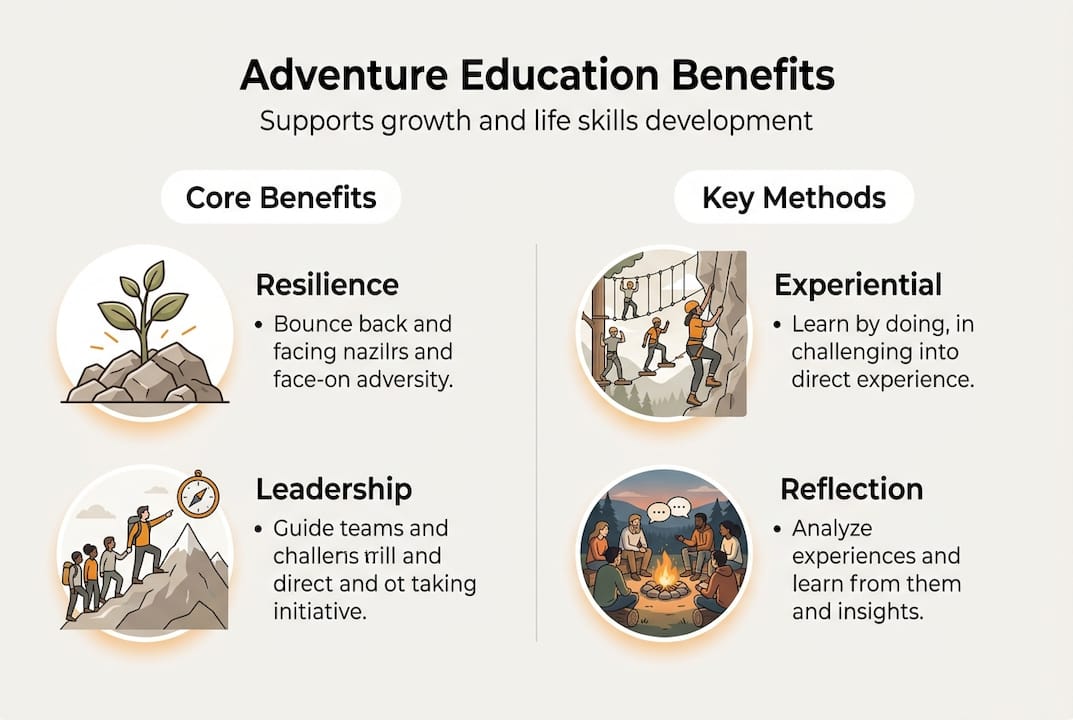
Challenge-by-choice empowers children to make authentic decisions about participation. A child uncomfortable with heights might choose to belay teammates rather than climb, still contributing meaningfully while respecting personal boundaries. This autonomy builds self-awareness and decision-making skills.
Progression ensures appropriate challenge levels:
- Initial activities establish psychological safety through simple team games and icebreakers
- Low-challenge elements introduce manageable risk (trust falls, group initiatives)
- Medium-challenge activities require sustained effort and problem solving (orienteering, multi-pitch climbing)
- High-challenge experiences push limits with significant physical or emotional demands (solo wilderness time, expedition leadership)
- Integration activities help transfer learning to daily life contexts
Debriefing sessions distinguish adventure education from mere outdoor recreation. Skilled facilitators ask open questions that prompt reflection: “What surprised you?” “How did your team overcome that obstacle?” “When might you use that strategy at school?” These conversations transform physical experiences into lasting insights.
Pro Tip: When evaluating custom camps for groups, ask about instructor-to-participant ratios. Programs maintaining 1:6 to 1:10 ratios provide the personalized attention necessary for effective facilitation and safety.
Nuances, challenges, and debates in adventure education
While adventure education offers substantial benefits, parents should understand complexities and potential challenges. Programs vary significantly in quality, philosophy, and outcomes.
Challenge-by-choice represents a humanistic approach respecting individual autonomy. However, some programs historically used coercive methods, forcing participation to “build character.” Modern best practices reject coercion, recognizing that authentic growth requires voluntary engagement. When researching camps, confirm they explicitly embrace challenge-by-choice principles.
Key challenges and considerations include:
- Anxiety from unfamiliar environments can initially overwhelm some children before adaptation occurs
- Failure experiences, while valuable for learning, require skilled facilitation to prevent discouragement
- Transfer of learning to home contexts varies; some skills generalize easily while others need explicit connection
- Gender biases historically limited girls’ access to adventure programs, though modern camps actively address equity
- Cultural differences in risk tolerance affect comfort levels and require culturally responsive facilitation
- Liability concerns sometimes cause programs to reduce challenge levels, limiting developmental impact
Research on learning transfer identifies three approaches: specific (direct skill application), nonspecific (general confidence boost), and metaphoric (symbolic connections between adventure and life challenges). Programs using all three approaches maximize lasting impact.
| Consideration | Potential Benefits | Potential Risks | Practical Implications |
|---|---|---|---|
| Managed risk exposure | Builds resilience and confidence | May trigger anxiety in risk-averse children | Choose programs with gradual progression and opt-out options |
| Group living and collaboration | Develops social skills and empathy | Can overwhelm introverted participants | Look for camps offering both group and individual reflection time |
| Unfamiliar cultural contexts | Enhances adaptability and global awareness | May cause homesickness or culture shock | Select international camps with strong pastoral care systems |
| Physical challenge and exertion | Improves fitness and body confidence | Risk of injury if safety protocols inadequate | Verify instructor certifications and emergency response procedures |
| Reflection and emotional processing | Deepens self-awareness | May surface difficult emotions requiring support | Ensure camps have trained counselors for emotional support |
The benefits generally outweigh risks when programs maintain high safety standards and employ trained facilitators. However, cultural risk aversion and liability concerns sometimes limit access to truly transformative experiences. Parents should seek programs balancing appropriate challenge with robust risk management.
Pro Tip: Ask potential camps about their incident response protocols and staff training requirements. Quality programs maintain current wilderness first aid certifications, conduct regular safety audits, and have clear emergency communication systems.
Choosing and preparing for adventure education summer camps for your child
Selecting the right adventure education camp requires evaluating program design, staff qualifications, and alignment with your child’s developmental stage and interests. International summer camps in Switzerland and similar destinations offer unique combinations of adventure education, cultural immersion, and language learning.
Key selection criteria:
- Challenge-by-choice philosophy explicitly stated in program materials and staff training
- Instructor-to-participant ratios between 1:6 and 1:10 for adequate supervision and personalized facilitation
- Program duration of 2 to 3 weeks, the optimal length for social-emotional gains and skill consolidation
- Structured reflection sessions built into daily schedules, not just activity time
- Staff qualifications including relevant certifications, experience with age group, and training in experiential education methods
- Family involvement opportunities for post-camp integration and learning transfer
- Clear risk management protocols and transparent communication about safety procedures
- Diverse activity options allowing children to explore multiple interest areas
Program length matters significantly. While shorter camps provide valuable experiences, research shows 2 to 3 week programs yield measurable improvements in resilience, self-regulation, and social competence. This duration allows time for initial adjustment, skill building, challenge progression, and integration.
Family involvement enhances outcomes. When parents understand program goals and engage in post-camp conversations, children better transfer learning to home contexts. Some camps offer family participation options or parent education components.
Preparing your child for adventure education camp:
- Build physical readiness through age-appropriate exercise and outdoor time in the months before camp
- Discuss program expectations, emphasizing growth mindset and the value of trying new things
- Practice independence skills like packing, managing belongings, and basic self-care
- Address concerns about homesickness or social anxiety with reassurance and coping strategies
- Research the destination together, building excitement about cultural and environmental features
- Review the camp preparation guide for logistical details and packing lists
- Establish communication expectations, understanding that limited contact supports independence
For international camps, cultural preparation matters. Learning basic phrases in the host country’s language, understanding cultural norms around personal space or meal times, and discussing the value of global community experiences helps children adapt more quickly and gain maximum benefit from cross-cultural interactions.
Pro Tip: Involve your child in activity selection and goal setting before camp. When kids have input into their adventure education experience, they show greater motivation, engagement, and willingness to embrace challenges. Review camp options together and ask what skills or experiences most interest them.
Explore international adventure education camps for your child
Young Explorers Club offers carefully designed adventure education programs in Switzerland that embody the principles and methodologies discussed throughout this guide. Our international summer camps combine outdoor challenges, experiential learning, and cultural immersion in the Swiss Alps.
Programs feature challenge-by-choice frameworks, structured reflection sessions, and progressive skill building across activities like mountain biking, climbing, survival skills, and team initiatives. Our low instructor ratios ensure personalized attention while our bilingual environment (English and French) adds language learning benefits. Whether your child thrives in residential camps, travel adventures, or family trip formats, our adventure-based learning approach prioritizes personal growth alongside outdoor skills.
Explore our program options to discover how adventure education in an international community setting might support your child’s development. Our detailed program descriptions, parent resources, and testimonials provide the information you need to make an informed decision about whether Young Explorers Club aligns with your family’s goals and values.
Recommended
- Helping Kids Build Confidence Through Adventure | Young Explorers Club Switzerland
- Activités D’aventure Et Estime De Soi Chez L’enfant | Young Explorers Club Switzerland
- Adventure Camp Activities List For Kids: 2026 Guide
- Building Confidence Through Adventure Activities | Young Explorers Club Switzerland


