

TL;DR:
- Global camps significantly boost children’s confidence, independence, and emotional resilience through experiential challenges.
- Language immersion and cultural diversity foster faster language learning and global empathy.
- Adventure and nature activities build self-esteem, teamwork, and emotional strength in a supported environment.
Most parents send their kids to summer camp expecting fun. What they don’t expect is a measurable shift in who their child becomes. 70-90% of campers report meaningful gains in confidence and independence after an international camp experience. That’s not a marketing claim. That’s a pattern backed by research and repeated across thousands of families. This guide breaks down exactly why global camps deliver outcomes that go far beyond a good summer. You’ll learn how immersion, adventure, and cross-cultural friendships combine to build skills your child will carry for life.
Key Takeaways
| Point | Details |
|---|---|
| Confidence gains | Over 70% of global campers report higher self-confidence and independence after their experience. |
| Language acceleration | Immersive camps speed up language learning up to 40% more than classroom settings. |
| Emotional wellbeing | Outdoor adventure and nature activities consistently boost mental and emotional health for youth. |
| Cultural friendships | Global camps help kids form long-lasting, cross-cultural friendships that foster empathy and reduce prejudice. |
| Comparative advantages | Global camps offer unique growth opportunities compared to local programs, though families should weigh logistics and costs. |
Core benefits of global camp experiences
When parents think about camp benefits, they usually picture friendships and fresh air. Both matter. But the real gains run deeper, and understanding them helps you choose the right experience for your child.
Global camps are built around structured challenges. Whether your child is navigating a mountain trail, communicating with a bunkmate from Brazil, or learning to cook over a campfire, every activity is designed to push them just beyond their comfort zone. That push is where growth happens. Research shows that international camps boost confidence and independence in ways that persist long after the summer ends.
Here’s what parents consistently report after their children attend international camps:
- Stronger self-reliance: Kids learn to solve problems without a parent nearby.
- Better emotional regulation: Navigating new environments teaches kids to manage frustration and uncertainty.
- Improved social skills: Meeting peers from different countries forces kids to listen, adapt, and communicate more clearly.
- Greater openness to challenge: Campers return willing to try things they previously avoided.
- Increased sense of identity: Time away from home helps kids figure out who they are outside of family and school dynamics.
The science supports this. A peer-reviewed study found that overnight camps reduce anxiety symptoms and increase positive mood and self-confidence in youth, with a statistically meaningful effect size. That’s not a small shift. For a child who struggles with worry or social hesitation, a single summer can genuinely change their trajectory.
“Camp gave my daughter something school never could. She came back knowing she could handle hard things on her own.” — Parent feedback shared with Young Explorers Club
The camp benefits for kids extend into mental and emotional health, not just social skills. Kids who attend global camps often show improved resilience, better peer relationships, and a stronger sense of belonging. These are outcomes worth planning for.
Language immersion and cultural diversity
Confidence is one piece of the puzzle. Language and cultural growth are another, and they’re where global camps truly separate themselves from local alternatives.
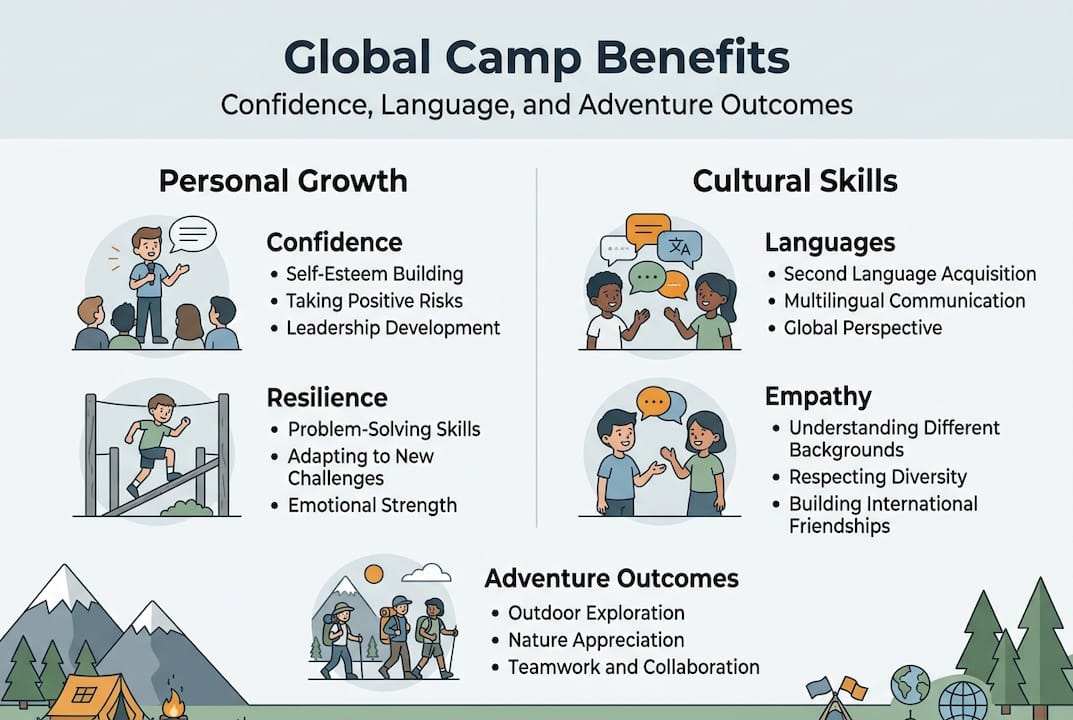
Classroom language learning has real limits. A child can study French for three years and still freeze when a native speaker talks to them. Immersion works differently. When your child lives, eats, plays, and problem-solves in a second language, their brain adapts fast. Language immersion at global camps accelerates learning by up to 40% compared to classroom-only instruction. That’s a significant edge, especially for kids preparing for bilingual schools or international futures.
Here’s how immersion actually works in a global camp setting:
- Daily unscripted practice: Kids use the target language in real conversations, not textbook exercises.
- Peer motivation: When your bunkmate only speaks French, you learn fast because you want to connect.
- Low-stakes mistakes: Camp is a safe space to get things wrong without academic consequences.
- Contextual learning: Words stick when they’re tied to real experiences like climbing a mountain or planning a group meal.
- Cultural context: Language and culture are inseparable. Kids don’t just learn words. They learn how people think.
Beyond language, global camps build something harder to measure but equally valuable: empathy. When your child shares a cabin with peers from Germany, Japan, and Brazil, they stop seeing the world through a single lens. Global camp friendships reduce prejudice and build genuine cross-cultural understanding. Research confirms that international friendships at camp foster empathy and resilience in ways that last well beyond the summer.
Pro Tip: If language growth is a priority for your child, look for camps where the staff itself is multilingual and where language use is woven into daily activities, not just offered as an optional class.
The cultural exposure alone is worth the investment. Kids who grow up with international friendships develop broader worldviews, stronger communication skills, and a natural comfort with difference. Those are traits that matter in school, in careers, and in life.
Nature, adventure, and emotional wellbeing
There’s something specific that happens when a child stands at the top of a mountain they just climbed. It’s not just pride. It’s a recalibration of what they believe they’re capable of. Adventure and nature are core tools in any serious global camp program, and the research behind them is compelling.

Structured nature experiences in camps support mental, emotional, and social health across all age groups. This isn’t about being outdoors for its own sake. It’s about the specific combination of challenge, support, and natural environment that camps provide. When kids face real physical challenges with trained staff beside them, they build genuine self-esteem, not the kind that comes from praise, but the kind that comes from doing something hard.
Here’s a look at how different adventure activities map to emotional outcomes:
| Activity | Primary emotional benefit | Secondary benefit |
|---|---|---|
| Mountain climbing | Self-efficacy | Trust in peers |
| Team survival skills | Problem-solving | Group belonging |
| Mountain biking | Risk tolerance | Physical confidence |
| Multisport challenges | Adaptability | Competitive resilience |
| Nature navigation | Independence | Focus and calm |
For shy or anxious children, the structure matters as much as the activity. Educator-led adventure programs use low staff-to-camper ratios and scaffolded progressions, meaning kids are never thrown into the deep end without support. Anxious kids often thrive in these environments precisely because the challenge is calibrated. They’re stretched, not overwhelmed.
Pro Tip: Ask any camp you’re considering about their staff-to-camper ratio and how they support children who are nervous about new activities. The answer tells you a lot about the program’s philosophy.
Belonging is another underrated outcome. When kids work through a challenge together, whether it’s a survival skills course or a group navigation exercise, they build bonds that feel earned. That sense of shared accomplishment creates peer connections that are often stronger than anything formed in a classroom.
Global camps vs local programs: A practical comparison
Choosing between a global camp and a local program is a real decision, and it deserves an honest look at both sides. Global camps offer things local programs simply can’t replicate. But they also come with trade-offs that matter for some families.
| Factor | Global camp | Local program |
|---|---|---|
| Language exposure | High, daily immersion | Minimal or none |
| Cultural diversity | International peer group | Mostly local peers |
| Cost | Higher investment | More affordable |
| Homesickness risk | Higher for younger kids | Lower |
| Independence building | Strong, by design | Moderate |
| Immersion quality | Varies by program | Not applicable |
Global camps excel in diversity and language exposure compared to local options, but the trade-offs are real. Cost is a genuine barrier for many families. Homesickness is more likely when a child is far from home in an unfamiliar country. And immersion quality varies significantly between programs, so research matters.
Local programs are a smart choice when:
- Your child has never been away from home before and needs a gentler first step.
- Budget is a primary constraint and a local camp offers strong programming.
- Your child has specific needs that require close family proximity.
- You want to test camp life before committing to an international experience.
That said, the confidence outcomes from global camps are consistently stronger than those from local alternatives. The combination of distance from home, cross-cultural challenge, and immersive programming creates conditions that local camps rarely match. For families ready to make the investment, the return is measurable.
The key is matching the camp to the child, not to the trend. A well-chosen local program beats a poorly matched global one every time.
Our take: What most articles miss about international camps
Most articles about global camps focus on the highlights: the friendships, the scenery, the language gains. What they skip is the mechanism. Why do some kids come home transformed while others just had a nice summer?
The answer, based on parent feedback and program research, comes down to three things: scaffolding, staff ratios, and real immersion. Camps that use scaffolded challenges, low staff ratios, and experiential learning produce measurable gains, especially for shy or anxious kids who need support alongside challenge.
Parents often focus on the activity list when choosing a camp. We’d encourage you to focus on the structure behind the activities. How does the camp support a child who’s struggling? How do they build challenge progressively? Are staff trained in youth development, or just activity instruction?
The difference between real confidence and perceived fun is significant. Fun fades. Confidence built through genuine challenge, with the right support, stays. Explore the camp benefits for parents to understand what to look for before you book.
Explore global camp opportunities with Young Explorers Club
If this article has helped you see global camps differently, the next step is finding the right fit for your child.
At Young Explorers Club, we design experiences in Switzerland that combine adventure, language learning, and personal development for children and teens aged 8 to 17. Whether you’re looking for a teen summer camp built around leadership and outdoor challenge, or language immersion camps that make French, English, or German feel natural, we have a program built around real outcomes. Browse all options, download our brochure, or get in touch with our team to discover camp options that match your child’s personality and goals.
Recommended
- How International Summer Camps Boost Confidence And Independence | Young Explorers Club Switzerland
- International Camp Culture: Building Global Friendships
- Benefits Of International Camps: Confidence, Language & Friends
- Building Confidence Through Adventure Activities | Young Explorers Club Switzerland
- Spanish Courses in Singapore | Spanish Language Centre


