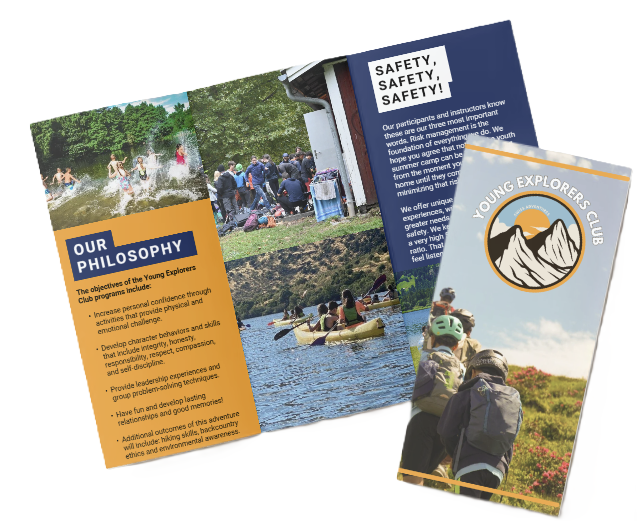

How Camps Help Kids Manage Small Risks Safely
Young Explorers Club: supervised, age-appropriate small risks that build skills, judgment and resilience with clear safety protocols.
At the Young Explorers Club
Approach
At the Young Explorers Club, we use supervised, age‑appropriate small risks—like low‑height climbing, managed near‑water play, and guided tool use—to offer calibrated challenges that build motor skills, risk perception, decision‑making, and resilience. Pairing staged progressions with a written risk–benefit analysis, mandatory PPE checks, staff training and debriefs, and clear metrics keeps hazards controlled. That layered approach teaches practical risk management.
Key Takeaways
Highlights
- Small risks are deliberate, supervised challenges—not reckless exposures—and they teach judgment, confidence, and motor skills.
- Each activity requires a written risk–benefit analysis that lists mitigation choices, Emergency Action Plans, and incident logs.
- Progressive challenge ladders and graduated supervision move campers from coached practice to independent tasks, reducing sudden hazards.
- Staff training, required certifications, PPE inspections, and non‑punitive near‑miss reporting build a safety culture that supports learning.
- We will measure and publish clear metrics — incidents per 1,000 camper‑days, near‑miss counts, PPE pass‑rates, and staff certification rates — and use parent communication and consent to keep transparency.
Why small risks matter for child development
What we mean by small risks
We define small risks as supervised, age-appropriate challenges that let children test limits and learn risk management. Examples include climbing a little higher than the home playground under staff supervision, trying a new rope-swing with a spotter or belay, supervised near-water play with buoyancy aids and a lifeguard, learning to use a pocketknife with direct instruction, balancing on low logs close to the ground, and hiking uneven trails with staff coaching. These activities keep the challenge deliberate and controlled.
We remove or tightly control hazardous risks: uncontrolled heights without fall protection, absent supervision, and activities involving motorized vehicles. We keep safety measures visible—spotters, belays, lifeguards, tool-check protocols—so children can focus on learning rather than fear.
Brussoni et al. (2015) reviewed the evidence and found that risky play links to positive physical and social outcomes and that over-restricting such play limits opportunities to learn risk management. We use that guidance to provide calibrated exposure with supervision and mitigation, not to eliminate risk entirely. Each year in the U.S., more than 200,000 children are treated in emergency departments for playground-related injuries, a useful comparator that helps frame camp injury rates and our prevention priorities. We also pay attention to emotional safety and recovery; see our page on mental well-being for how we integrate support.
Quick comparison: benefits → mechanism → camp example
Here are the core developmental gains and how small risks at camp build them:
- Resilience → repeated manageable challenge plus supportive staff → progressive ropes course with staged increases in height and difficulty.
- Risk perception & decision-making → chance to assess and choose within safe limits → supervised near-water play where children choose depth with a lifeguard present.
- Motor skills → practice balance, strength, and coordination under safe load → balancing on low logs and narrow beams.
- Independence → allowed choice and responsibility under supervision → learning pocketknife or wilderness tasks with tool-check protocols.
- Social negotiation → negotiating turns and communicating boundaries → group climbing or swing activities with role rotation.

How camps keep risks small and purposeful: practices, protocols, and risk–benefit assessment
We, at the Young Explorers Club, design every activity to give campers a progressive challenge while keeping hazards small. I stage climbing heights, set trained belaying progressions, and use skill gates so campers complete Level A before they move to Level B. I increase time and complexity in small steps. That steady escalation builds competence and confidence without exposing kids to sudden danger. I see clear developmental benefit in each step, from motor control to decision-making and the life skills gained through challenge (life skills).
I use a formal risk–benefit analysis for every new activity and for regular sessions. The process documents hazards, likelihood, severity, and the developmental benefit. Each entry records a mitigation plan and a final decision: Mitigate / Allow / Remove. I require staff to write the rationale for each decision and keep the matrix with the activity plan.
I mandate written protocols that operate as minimums for safety and consistency. Every activity area must have an Emergency Action Plan (EAP). Every incident must be recorded in an incident report, with written incident log entries completed within 24 hours (recommended). We require a PPE inspection checklist before each activity and maintenance logs for structures and equipment with dated inspections. Regular safety audits drive continuous improvement. I also require AED availability on site and staff trained to use it.
I set firm equipment controls. Helmets are mandatory for climbing and biking. Life jackets must be USCG-approved at waterfronts. Harnesses must be properly rated, with documented inspection dates and replacement schedules. Staff inspect PPE before use and sign the checklist each time. I keep a written record of harness inspections and replacements. Gloves and other protective wear get added where appropriate. If an audit finds an issue, we remove the gear from service until it passes inspection.
Practical templates and checklists
Below are the templates and checklists staff copy into their activity plans and keep on file.
-
Risk–Benefit Matrix (text template)
Activity | Hazard | Likelihood (Low/Med/High) | Severity (Minor/Moderate/Severe) | Developmental Benefit | Mitigation | Decision (Mitigate / Allow / Remove)
Rationale: (short paragraph explaining why the decision was made)
Retention: (location of file and who signed off)
Example: Low ropes | fall from low height | Low | Minor | balance, confidence | ground padding, spotters | Allow with mitigation
-
Sample Emergency Action Plan (EAP) checklist
- Activity area name and location
- On-site phone numbers and radio channels
- Nearest emergency room name/address and estimated transport time
- Roles: who calls 911, who cares for the injured, who secures the activity area, who notifies parents
- Location of first-aid kit and AED
- Transportation plan (on-site vehicle, driver contact)
- Staff backup and relief plan
- Post-incident reporting steps (who completes incident log and timeline)
-
Required written protocols (minimums)
- Emergency Action Plan required for every activity area
- Incident reporting system with written incident log entries within 24 hours (recommended)
- PPE inspection checklist before each activity (documented and signed)
- Maintenance logs for structures and equipment with dated inspections
-
PPE list and appendix note (for staff binder)
- Climbing/biking helmets — expected certifications and replacement interval
- USCG-approved life jackets — sizes and fit checks logged
- Properly rated harnesses — inspection dates and replacement schedule recorded
- Gloves where appropriate
- AED on site and staff trained in its use
- Appendix: certifications and equipment expectations (record of manufacturer specs, inspection criteria, and replacement thresholds)
I instruct staff to keep these templates editable and dated. That way each session has a current risk–benefit assessment, signed PPE checklists, a site-specific Emergency Action Plan, and an incident log ready should anything happen.
Training, culture, and communication that teach risk management
We, at the Young Explorers Club, set clear expectations so kids learn risk literacy through practice and conversation. I train staff to teach hazard awareness directly, model calm decision-making, and make safety a normal part of every activity.
Active teaching strategies and debriefing
We use these hands-on methods to build skills and confidence:
- Explicit instruction in hazard awareness: we point out hazards, explain why they matter, and teach simple cues kids can spot themselves.
- A decision-making framework: we teach “stop / assess / act” so campers get a repeatable routine for small, everyday risks.
- Buddy systems: we pair kids for mutual checks and communication. Buddies share responsibility and practice calling for help.
- Role-playing scenarios: we run short, realistic drills that let campers choose, explain, and justify decisions in low-consequence settings.
After activities we run short debriefs to reinforce learning and debriefing habits. Typical prompts I use include:
- What felt hard?
- What helped you stay safe?
- What choices did you make and why?
- What would you do differently next time?
- Who helped you and how?
These questions build reflection skills and make safety language routine.
Supervision models, staff training, and parent communication
I use a graduated supervision flow to move campers from coached practice to independent challenges:
- Skill demonstration: staff lead and show the proper technique.
- Gear check: staff verify PPE and explain any adjustments.
- Guided attempt with close belay: staff stay in immediate proximity and coach in real time.
- Independent challenge with distant supervision: staff monitor from a distance but remain ready to step in.
We adjust supervision distance by age, ability, and task risk. That graded approach increases competence while keeping risk reasonable.
Staff certifications are non-negotiable. I set targets: 100% of overnight staff hold first aid/CPR, and 100% of waterfront supervisors and lifeguards hold lifeguard/WSI or equivalent where relevant. Training stretches across the season:
- Pre-camp: 24–40 hours covering program orientation, activity-specific skills, and emergency action plans (EAPs).
- Mid-season: 4–8 hour refresher for policy updates, scenario drills, and equipment checks.
I share clear parent communication before camp starts. Orientation packets explain expected small risks, include consent forms, and list pre-camp skill checklists for swim level, tool experience, and mobility notes. Parents can review what to expect and confirm readiness through our pre-camp materials and consent forms; for practical tips on family prep I point them to parent communication. Campers who complete simple pre-camp tasks arrive with better baseline skills; I encourage families to review a short checklist on common abilities like balance, knot-tying, and basic tool use — see our guide to pre-camp skills for examples.
I keep supervision ratios flexible but transparent. Typical examples I reference are:
- Waterfront swim instruction: often 1:6–1:10 for younger children (verify local standards).
- Low ropes: often 1:8–1:12 depending on age and skill.
Camps must follow local regulations and accreditation standards, so I advise verifying ratios locally.
Finally, staff modeling matters. I coach counselors to show calm, thoughtful risk-taking and to narrate their choices aloud. That modeling, combined with consistent debriefing and steady parent communication, turns day-to-day challenges into repeated learning opportunities and raises overall risk literacy among campers.

The safety picture: typical injuries, benchmarking, and how to measure risk
We, at the young explorers club, record and review incidents every day to keep children safe and active. Most camp injuries are minor: sprains, abrasions, insect bites, and small lacerations are the common events. Serious injuries are rare when camps follow clear standards and protocols, and staff training and equipment checks remain consistent.
I use the camper-day metric to normalize risk across different program sizes and durations. One camper-day equals one child attending camp for one day. The standard formula I apply is: Incident rate = (number of incidents / total camper-days) × 1,000. That gives a comparable incident rate per 1,000 camper-days so we can compare weeks, seasons, and activity types.
For context I use an illustrative benchmark for organized day camps: 0.5–3.0 medical incidents per 1,000 camper-days; severe incidents requiring hospitalization are much lower (often <0.1 per 1,000 camper-days). (Illustrative.) Local verification is still recommended before you set targets. I also compare camp data with broader injury datasets. The CDC reports: “Each year in the U.S., more than 200,000 children are treated in emergency departments for playground-related injuries.” CDC. That number helps frame camp rates against unsupervised play or high-contact sports.
Near-miss reporting is a predictive tool. I collect near-miss counts separately from reportable incidents and categorize them by activity, location, and cause. Making near-miss reporting non-punitive and pairing it with feedback loops drives real reductions in future incidents. We close the loop by reviewing near-miss trends during staff meetings and updating task checks or activity limits where patterns appear.
I recommend sharing simple, practical guidance with parents before camp; they can review what to expect in a focused camp experience to reduce misunderstandings and improve preparation. camp experience
What to measure and how to present
Below are the core metrics I track and how I present them to leadership and parents:
- Incident rate per 1,000 camper-days (overall and by activity). Use the formula above verbatim: Incident rate = (number of incidents / total camper-days) × 1,000. Present rolling 30- and 90-day rates to show trends.
- Breakdowns by injury type (minor vs major) and activity. Display as ratios and raw counts so reviewers see both frequency and severity.
- Near-miss counts and category. Log near-misses by type (equipment, supervision lapse, environment) and convert them into action items with owners and deadlines.
- Response time to incident and EAP (Emergency Action Plan) activation metrics. Record time from event to first responder arrival and time to EAP activation. Use medians and 90th-percentile figures.
- PPE inspection pass-rates and maintenance compliance. Track scheduled inspections, pass/fail outcomes, and corrective action completion dates.
I format reports with a single-page dashboard showing:
- Overall incident rate per 1,000 camper-days and trend line.
- A small table with incident counts by activity and by severity.
- Near-miss heatmap for hotspots.
- Two operational KPIs: median response time and PPE pass-rate.
When local camp data are sparse I present ranges rather than single-point claims and clearly label them as illustrative. That keeps expectations realistic and supports constructive dialogue with regulators, parents, and staff.
Case studies and measurable impacts: templates and sample results
Progressive challenge curriculum — progressive challenge
Background: We needed to raise camper confidence and cut harness-related incidents. Our goal was measurable behavior change during climbing and high-rope activities. We tied the curriculum to staff coaching and gear checks so skills matched exposure.
Baseline metrics (example fields to record):
- Total camper-days: 4,200
- Baseline incidents: 18
- Incidents/1,000 camper-days: 4.3
- % staff certified: 68%
- PPE pass-rate: 82%
- Baseline camper confidence (pre): mean 5.1/10
Intervention: We implemented staged skill gates, mandatory gear checks before each session, a staff coaching protocol with video reviews, and a progressive difficulty ladder for each age group. We linked learning goals to short practice quotas so every camper logged repeat exposures.
Results (modeled): After introducing the progressive challenge curriculum, Camp Y saw a 35% reduction in harness-related incidents and a 20% increase in camper-rated confidence on a post-camp survey (modeled). We labeled all modeled figures clearly for replacement with local data.
Lessons learned: We invested staff coaching time early. Our practice-exposure logs proved critical. We also used tips for parents to align expectations before camp, which helped transfer confidence gains at home (tips for parents).
Structured debrief program — debrief program
Background: We wanted campers to reflect and sharpen risk judgment after activities. Reflection was short and repeatable to suit attention spans.
Baseline metrics (example fields to record):
- Total camper-days;
- Pre-intervention confidence/risk-judgment scores;
- Incident rate by activity;
- % staff trained in facilitation.
Intervention: We ran a five-minute group debrief after each activity using standardized prompts. Staff completed a short facilitation training and used cue cards to keep fidelity high. We used simple prompts for younger groups and layered complexity for older campers. Debrief prompts emphasized what went well and one improvement for next time.
Results (modeled): Mean confidence increased by +1.2 points on a 10-point scale. Minor incidents dropped slightly (modeled). We tracked pre/post measures and used them in our outcome evaluation.
Lessons learned: Debrief fidelity matters. Short prompts work best for younger children. We also drew links between creative problem-solving in activities and resilience, and referenced materials that explain how camps encourage creativity and problem-solving (encourage creativity).
Near-miss reporting + feedback loop — near-miss reporting
Background: We aimed to spot hazards early and improve our safety culture.
Baseline metrics (example fields to record):
- Near-miss reporting rate;
- Incident rate;
- Staff reporting participation.
Intervention: We introduced an easy near-miss form, a weekly safety huddle, an action log with owners, and timely follow-up communication with staff and families. We made reporting non-punitive and celebrated fixes publicly.
Results (modeled): Near-miss reports rose (improved reporting culture), and similar incidents fell 25% over two quarters (modeled). We found quick feedback loops amplified learning.
Lessons learned: Non-punitive reporting and rapid feedback are essential for behavior change. We integrated guidance from our safe cycling and helmet checks initiatives to tighten equipment-related near-miss handling (safe cycling, climbing helmet).
Metrics to track for outcome evaluation
Below are the fields we insist on collecting for reliable evaluation:
- Total camper-days for the period
- Incidents (total) and incidents per 1,000 camper-days (overall and by activity) — include baseline incidents and incidents/1,000 camper-days
- % of staff certified (first aid/CPR, lifeguard, activity-specific)
- PPE inspection pass-rate
- Parent/camper satisfaction scores and pre/post measures of risk judgment or confidence (e.g., change in confidence score — mean change on a 10-point scale)
Reporting and visualization recommendations: Plot quarterly incident rates across two years and mark the intervention start date. Annotate percent change directly on the chart narrative and call out modeled figures clearly. Replace modeled numbers with verified local data. We also cross-reference measures that show broader benefits, such as improved mental well-being and stress relief and boosted self-esteem from achievement (mental well-being, builds self-esteem). Where appropriate, we connect small-risk practice to long-term life skills and responsibility (10 life skills, responsibility at camp) and to confidence gains in outdoor challenges (overcome fear) and expectations for an outdoor program (Swiss outdoor camp).
Data hygiene tips we follow:
- Timestamp every report
- Link reports to camper-days
- Tag by activity
- Require an owner for each action item
- Run quarterly reviews that combine incident rate charts with qualitative notes so staff see both trends and tangible fixes

Addressing parent concerns: consent, transparency, and the data camps should publish
We, at the young explorers club, publish clear, measurable safety information so parents can make informed choices and trust our programs. Parents want plain language on how risks are managed, who cares for their child, and a quick way to compare camps. I outline the exact items you should include with registration materials, how to present numeric fields, and a ready-to-use consent paragraph that you can adapt to local legal requirements. For practical parent-facing wording on parent communication, see parent communication.
Data and sample content to publish (what to show and how)
Publish the following items in registration packets and on your public safety page. Use plain labels and required numeric fields so parents can read a single line and understand program risk.
- Staff-to-camper ratios by activity (e.g., climbing 1:6; low-rope 1:8; waterfront 1:4).
- Percent of staff certified in first aid/CPR and lifeguarding (% certified staff).
- Incident rate per 1,000 camper-days for the most recent season (incidents per 1,000 camper-days).
- Number of minor vs major incidents last season with brief summaries and dates (incident disclosure).
- PPE inspection frequency and pass-rate (% PPE inspection compliance).
- Total camper-days for the reporting period (camper-days).
- Incident counts broken down by type and activity (minor vs major, by activity).
- Staff certification percentages by category (first aid/CPR, lifeguard, activity-specific).
- PPE inspection pass-rate and how often equipment is checked each session.
- Parent/camper satisfaction and mean change in pre/post confidence score (e.g., +X points on a 10-point scale, satisfaction rate).
Presentation guidance — show these numeric fields prominently and consistently
Display the following metrics prominently and consistently so families can compare programs quickly and fairly:
- Incidents per 1,000 camper-days (standardized rate makes comparisons fair).
- % certified staff (round to whole numbers for clarity).
- % PPE inspection compliance and inspection cadence (daily/weekly).
- Mean change in pre/post confidence score with sample size.
Label any modeled or illustrative figures clearly and instruct readers to replace placeholders with verified local camp data.
Use brief explanations under each metric to explain what it means and how you collected it. For example: “Incident rate per 1,000 camper-days: 2.4 (calculated as total incidents ÷ camper-days × 1,000). Modeled figures shown in gray.”
Sample consent paragraph and communication notes
Camp messaging must be short, honest, and actionable. Below is a one-paragraph consent template you can adapt to local law and registration forms:
“Camp [Name] provides supervised, age-appropriate outdoor experiences that include small, managed risks (for example: climbing slightly higher than home playgrounds, supervised near-water play with USCG-approved life jackets, and low-log balance challenges). These activities help campers build judgment, confidence, and motor skills. Staff apply a formal risk–benefit process, maintain written Emergency Action Plans for each activity area, and perform PPE checks before every session. By enrolling, you consent to your child participating in these supervised activities; you will be notified of any significant incidents per our communication policy.”
We also recommend these communication rules:
- Notify parents promptly about any significant incident and follow up with a short incident summary and corrective actions (incident disclosure).
- Publish annual safety reports that include camper-days, incident rates, certification percentages, PPE pass-rate, and satisfaction rate.
- Keep language jargon-free and display selected metrics on registration pages and FAQs.
- Train staff to explain safety measures during drop-off and include quick printed summaries in welcome packets.
We keep transparency central to trust. Clear numbers, plain explanations, and timely parent communication reduce anxiety and make informed consent meaningful.

Sources
International Journal of Environmental Research and Public Health — What is the relationship between risky outdoor play and health in children? A systematic review
Centers for Disease Control and Prevention — Playground Safety
American Camp Association — Research & resources
Childhood (SAGE Journals) — Categorising risky play—how can we identify risk-taking in playgrounds?
The Guardian — No Fear: Growing up in a risk-averse society
RoSPA — Play Safety resources (Managing Risk in Play Provision)
Safe Kids Worldwide — Playground safety tips
American Red Cross — Lifeguarding
Play England — Managing risk in play provision: implementation guide