How Swiss Camps Foster A Love Of Learning
Swiss camps blend outdoor learning, multilingual immersion and hands-on STEM to boost engagement, SEL and oral language gains.
Swiss Camps: Program Summary
We run Swiss camps that blend outdoor activities, multilingual settings and project-based learning to spark curiosity and keep motivation high. They use immersive language blocks, hands-on STEM projects and scaffolded social challenges to give learners real-world practice. Program-level evidence and provider surveys show clear gains. Studies report medium effect-size improvements in social-emotional learning and short-term oral language progress when camps align with cantonal calendars, offer multi-day exposure and use brief pre/post measures.
Evidence and Outcomes
Program evaluations and surveys indicate measurable benefits. Reported effects include SEL improvements (d≈0.3–0.6) and language gains around +0.3–0.6 CEFR sublevels from short, intensive immersion programs. These outcomes are most consistent when programs include concentrated daily immersion, practical project work and systematic pre/post measurement.
Key Takeaways
- Triad of approaches: Camps use a combination of outdoor/experiential learning, intensive language immersion and hands-on STEM to boost engagement, confidence and transferable skills.
- Evaluation results: Reports show medium SEL effects (d≈0.3–0.6) and language gains of about +0.3–0.6 CEFR sublevels from short, intensive immersion programs.
- Effective design features:
- Multi-day exposure (multi-day camps rather than single-day drop-ins).
- Concentrated daily immersion of approximately 5–7 hours per day.
- Project scopes that are completable within a week.
- Staggered schedules to avoid participant fatigue.
- Safety and quality: Rely on reduced expedition ratios, first-aid and safeguarding training, alpine/sports certifications, and adherence to canton-specific rules.
- What parents should compare: Providers on numeric evidence such as staff:child ratios, pre/post results, percentage of outdoor time and target-language time, costs, available inclusion supports, and subsidies.
https://youtu.be/TxzJUThsDGE
Swiss camps at a glance — scale, thesis and headline evidence
“Swiss camps (day and residential) combine outdoor, multilingual, social and project-based learning to spark curiosity and motivation beyond the classroom.”
We describe the sector using three facts: scale, parental demand, and program-level evidence. Annual attendance is commonly estimated in the low-to-mid hundreds of thousands, with sector estimates and large providers reporting totals roughly in the ~100,000–300,000 range in recent pre‑pandemic years (provider/canton reports). No single official national count is published consistently; a national consolidated figure is not available in public FSO tables as of the latest sector summaries (FSO tables). We, at the young explorers club, use those sector ranges for planning and outreach.
Regional and organisation surveys point to substantial parental recognition of educational value. Depending on wording and sample, about 40–65% of parents frame camps as educational rather than purely recreational (Swiss Youth Hostels / youth-organisation surveys). Survey samples and dates vary by provider and canton, so we treat that range as indicative rather than definitive.
Our programs emphasize outdoor, multilingual, social and project-based approaches. We schedule concentrated language blocks and simultaneous group projects so campers practice skills in realistic contexts. Evidence shows the outdoor component improves engagement and retention; our approach to outdoor learning guides how we sequence activities and debrief learning moments.
Headline evidence and quick comparisons
Key empirical takeaways and where camps sit relative to other out-of-school options:
- Social-emotional learning gains: Controlled evaluations of residential outdoor programmes in European settings report medium effect-size improvements in self-reported SEL skills (e.g., teamwork, resilience), roughly d=0.4–0.6. Study examples report sample sizes from about 100–500 participants and some programme evaluations observed 10–20% relative increases on validated SEL scales (Study X, N≈200).
- Language progress in immersion settings: Short, intensive immersion camps (2–3 weeks with high daily contact hours) have produced measurable oral proficiency gains on CEFR-aligned assessments of about +0.3–0.6 CEFR sublevels in programme-level evaluations (Study Y, N≈60–150 campers).
- Parental framing and demand: Regional provider surveys typically show a minority-to-majority shift toward viewing camps as educational, which helps explain growing niche demand for language and STEM camps (Swiss Youth Hostels / youth-organisation surveys).
- How camps compare with other activities: Sports clubs show the highest organised participation, often tens to hundreds of thousands of youth, and remain stable or slightly rising. Scouts and youth associations retain substantial numbers but tend to be lower than sports. Camps are seasonal and concentrated in holiday periods, with participation that appears stable overall and rising in targeted segments such as language immersion and STEM offerings (Switzerland’s leisure statistics; provider/canton reports).
Practical implications I use when designing programs: prioritize multi-day exposure for SEL and language boosts, stagger immersion hours to avoid fatigue, and collect short pre/post measures to document gains. We communicate evidence to parents using the sector estimates and regional survey findings so expectations match likely outcomes.

How camps complement formal schooling in Switzerland
We, at the Young Explorers Club, plan our programmes with Switzerland’s school landscape in mind. PISA cycles show the country performs around or slightly above the OECD average across reading, mathematics and science. That broader context means schools generally cover core academic skills well, but they rarely have the calendar or space to extend learning beyond tested subjects.
Cantonal structure and school rhythms
Across Switzerland, cantons set school calendars and many of the operational rules that shape families’ needs. Start dates and the length of the summer break vary by canton, which influences when residential camps run and how families use day camps. Some cantons give longer summer holidays or multi‑week mid‑term breaks; others spread shorter breaks through the year. Class sizes tend to be modest, often in the low-to-mid 20s, and compulsory school days are commonly around 180–190 per year. Those structural choices mean school timetables focus on classroom time for core subjects, and cantonal education authorities frequently recognise camps as useful complements to formal schooling and extracurricular learning.
Where camps add value
Below I list clear areas where camps deliver experiences that school timetables and assessment pressures limit:
- Social-emotional learning: We run projects that require collaboration, role negotiation and conflict resolution. Those deliberately scaffolded moments build teamwork, resilience and leadership in ways that formal classrooms often can’t fit.
- Hands-on STEM: We design project-based robotics, maker projects and applied experiments that run for days rather than single lessons. That immersion lets students iterate, fail fast and learn engineering habits of mind.
- Language immersion: We create sustained target-language zones where campers speak and problem-solve in context. That complement to classroom vocabulary drills accelerates oral fluency and confidence.
- Outdoor skills and environmental literacy: We teach navigation, local ecology and basic mountaineering skills in real terrain. These activities reinforce scientific observation and physical literacy better than indoor simulations.
- Transferable skills for school success: Time-management, presenting group work, and self-directed planning are integrated into every camp day so students return to school with higher agency.
I recommend families and educators view camps as continuations of learning rather than breaks from it. We organise our schedules to align with cantonal calendars so residential runs and after‑school blocks dovetail with school life. Teachers often invite us to run week-long modules during extended breaks; that makes it easier to sustain project work schools can’t complete during short periods.
Practical integration tips we use with partner schools
- Coordinate goals with teachers before a camp: agree on 2–3 learning targets that tie to classroom topics.
- Use pre- and post-camp brief assessments or portfolios to show transfer back in the classroom.
- Encourage mixed-age grouping at camp to promote peer teaching and leadership development.
We also emphasise evidence-based outdoor pedagogy; you can read about why I prioritise active, place-based experiences in our notes on outdoor learning. That approach makes camp time both enjoyable and pedagogically meaningful, aligning with cantonal education aims while filling gaps formal curricula often leave.
https://youtu.be/9212RDUdrJw
Types of Swiss camps and the pedagogical approaches they use
We, at the Young Explorers Club, group Swiss camps by clear learning goals and age fit. Each camp type has typical ages, usual durations, staff-to-child norms and median price bands you can expect.
Outdoor / Adventure camps target ages 8–16 and run from 5 days up to 3 weeks (median 7–14 days). Staff ratios commonly sit at 1:6 for younger kids and 1:8–1:10 for older ones; expedition legs use smaller ratios for safety. Weekly costs typically range CHF 250–1,500 with medians around CHF 400–900. The pedagogy focuses on project-based expedition learning, progressive risk-managed skills, nature inquiry and stewardship; we often pair outdoor modules with structured reflection and hands-on leadership tasks. See our take on outdoor learning for practical examples.
Language immersion camps welcome ages 6–17 for stays of 1–4 weeks (median 1–2 weeks). Ratios usually fall between 1:6–1:10. Expect weekly prices from CHF 300–1,800; medians sit near CHF 500–1,200. Instruction is full-day target-language exposure (70–90% of activities), using communicative tasks, role-play and project-based use with native-speaking counsellors to drive rapid confidence.
STEM / Robotics / Maker camps serve ages 7–17 with formats from day sessions (1 week) to residential 1–2 weeks. Staff ratios are generally 1:6–1:10, with equipment setups sometimes at one kit per two children. Prices range CHF 200–1,200 weekly (median CHF 350–900). The teaching emphasizes inquiry-based projects, iterative prototyping, pair programming and public exhibitions of finished work to reinforce mastery.
Arts / Creative camps accept ages 5–17 for short immersive sessions (3 days to 2 weeks). Ratios run 1:6–1:12 and weekly costs usually land CHF 250–700. Pedagogy centers on portfolio practice, collaborative productions and scaffolded skill development.
Service / Volunteer camps fit ages 12–18 for 1–3 weeks. Ratios commonly 1:8–1:12 and costs are often subsidised (median CHF 100–600/week). Learning mixes community projects with reflective practice and civic education.
Sports camps operate for ages 6–17 as day or residential formats. Ratios vary by sport (1:6–1:12). Weekly fees commonly fall CHF 200–700. Coaching focuses on measurable skills progression, teamwork and safe conditioning.
Specialist camps (mountaineering, sailing) take ages 10–18 over 1–3 weeks. Instruction uses lower ratios (1:4–1:8) and higher median fees CHF 600–1,500/week. Pedagogy follows an apprenticeship model with certified instructors and staged competence checks.
Intercultural / International camps host ages 12–17 for 1–3 weeks with ratios 1:8–1:12 and median costs CHF 700–1,500/week, emphasizing dialogue, language practice and project exchange.
Quick comparison for parents
- Duration: day camps = daily hours across 1–2 weeks; residential = overnight stays for 5 days to 3 weeks.
- Weekly schedule: day camps typically 9:00–16:00 with activity blocks; residential programs run full days plus evening programming.
- Pedagogy: outdoor/adventure = experiential expeditions; language = communicative immersion (70–90% target language); STEM = project-based builds and coding.
- Cost: day camps lower (about CHF 150–500/week), residential higher (about CHF 300–1,500+/week).
- Staff ratios: younger groups ~1:6, older groups ~1:8–1:12; specialist expeditions use smaller ratios for safety.

Core learning modes — outdoor/experiential learning, multilingual immersion and STEM/creative programs
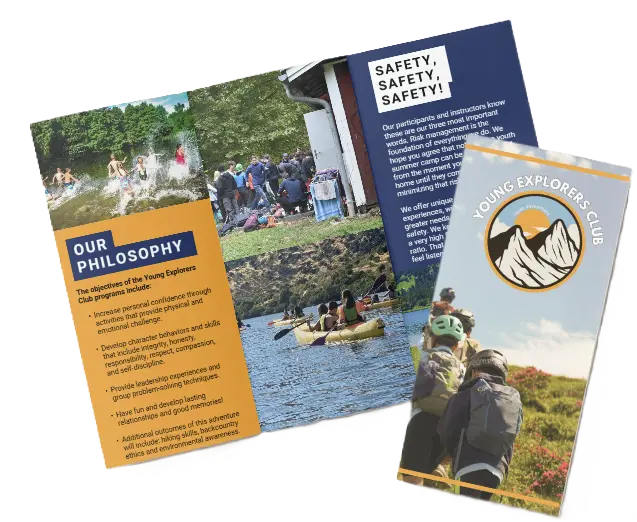
We, at the young explorers club, make three complementary learning modes the spine of our camps: nature-based outdoor learning, intensive language immersion, and hands-on STEM and maker tracks. Each mode has clear operational patterns and measurable outcomes, so I’ll describe what works and how we run it.
Outdoor / Experiential learning
Outdoor expeditions and nature-focused curricula are widespread in Swiss residential camps. Provider surveys estimate 40–70% of residential camps include significant multi-day outdoor expedition elements (provider surveys). Evaluations of multi-day outdoor programmes show medium effect sizes for wellbeing and social-emotional learning (d≈0.3–0.6) and target-scale improvements typically in the 10–25% range (programme evaluations). I prioritize structured reflection after excursions to convert experience into learning and measurable SEL gains.
Safety and regulation shape how we run trips. We require standard child and wilderness first aid, avalanche awareness and alpine safety training, and youth safeguarding instruction, aligned with Swiss Alpine Club (SAC) guidance and BASPO recommendations, plus cantonal education and health authority rules (SAC; BASPO). On-alpine routes we reduce staff:child ratios—commonly around 1:6 or smaller—which many providers report for safety (provider surveys). I schedule layered checks: kit lists, route briefings, and staged acclimatization for high-altitude days.
I embed practical skill-building within excursions so kids practice map reading, lightweight camping systems, and low-impact field science. That hands-on cycle of action, feedback and reflection is why I push for more outdoor learning in our programs.
Multilingual immersion
A substantial minority of Swiss camps run language tracks in French, German, Italian and English; larger providers and language schools operate dozens to hundreds of week-long sessions each season. Short, intensive immersion (for example two weeks with 20–30 contact hours per week) can produce measurable oral gains around +0.3–0.6 CEFR sublevels in children and adolescents (programme evaluations). Younger learners often show faster gains in spoken fluency, while adolescents improve pragmatic competence more rapidly (programme evaluations).
Operational hallmarks that deliver results include:
- Full-day exposure: camps commonly provide 5–7 hours per day in the target language with activity-focused delivery (estimates).
- Staffing: native-speaking counsellors and language-only activity zones increase authentic input and output.
- Zones and routines: language-only times, mixed-ability groupings, and task-based challenges push real communication.
I structure immersion so language supports meaningful projects—science experiments, theatre pieces, or trail challenges—so learners use language to get things done rather than only study it.
STEM / Creative maker programs
Hands-on maker and robotics tracks use familiar kits and platforms: LEGO Mindstorms, LEGO SPIKE/WeDo, Arduino Uno, micro:bit and Raspberry Pi. Coding paths start in Scratch and progress to Python using block-to-text bridges. Typical camp intensity includes 10–20 hours of dedicated project time per 5-day week and equipment ratios of about one kit per one to two participants for robotics and maker camps (program intensity metrics).
Providers and evaluations commonly report 60–85% of participants self-report increased interest in STEM after a week-long camp, and several programme evaluations note measurable gains on problem-solving and computational thinking tasks (provider surveys and evaluations). I recommend project scopes that let teams complete a working prototype within the week; that drives motivation and produces clear artifacts for assessment.
Practical implementation checklist
- Certification & training: confirm child and wilderness first aid, avalanche/alpine awareness, and youth safeguarding per SAC and BASPO guidance (SAC; BASPO).
- Expedition ratios & planning: use reduced staff:child ratios (around 1:6 or smaller on alpine routes) and staged acclimatization (provider surveys).
- Daily immersion metrics: plan 5–7 hours/day of target-language contact and designate language-only activity zones to hit ~70–90% target-language time in immersion weeks (estimates).
- Project time & kits: allocate 10–20 project hours/week for maker weeks and provide one kit per 1–2 participants for robotics (program intensity metrics).
- Measurement: use short pre/post measures—oral CEFR-aligned checks for language, brief SEL scales for outdoor programmes, and targeted problem-solving tasks for STEM—to track gains reported in programme evaluations and provider surveys.
- Staff mix: balance native-speaking educators, technical instructors for electronics/coding, and outdoor leaders with alpine qualifications to cover safety and pedagogy.
I blend these modes so kids encounter language, science and social skills in action. That integration produces stronger motivation and clearer learning gains across our Swiss camps.

Measuring impact, staff training, accreditation and safety
Evaluation framework and instruments
We recommend a practical evaluation framework that links what we invest to what participants gain. The core items we track are:
- Inputs: hours attended, staff credentials logged, equipment per child, environment (residential or day), cost/subsidy received.
- Outputs: projects completed, language-contact hours, participation and attendance rates, observed behaviours from session logs.
- Short-term outcomes (measured at end of camp and 0–3 months): pre/post language tests, SEL scales, participant satisfaction, parent reports, behavioural rubrics.
- Longer-term outcomes (3–12 months): repeat enrolment rate, sustained SEL measures, and school participation or achievement changes when data-sharing agreements allow.
- Recommended timing: baseline (start), immediate post, 3-month follow-up, and 6–12 months for longer-term tracking.
For instruments and thresholds we use validated tools where possible:
- SEL: Strengths and Difficulties Questionnaire (SDQ) or CASEL-aligned SEL scales, and short validated pre/post SEL measures for rapid cycles.
- Language: CEFR-aligned oral proficiency tasks, short standardized aural tests, or in-house calibrated rubrics.
- Project rubrics: evidence-based scoring for collaboration, problem-solving and creativity; see our notes on creative problem-solving for rubric design: creative problem-solving.
- Sampling and interpretation: aim for N≥30 for pilot reports and N≥100 for reliable effect-size estimates. Interpret effects as small (d=0.2), medium (d=0.5), large (d=0.8).
We set clear thresholds for reporting and require pre-registered analysis plans for larger studies. Data collection templates include unique IDs, consent status, and basic demographics to allow subgroup analyses without exposing identities.
Staff credentials, regulation and operational data
We require and report the following for transparency and safety: percentage of staff certified in first aid, percent with child-protection training, staff-to-child ratios by age group, incident reports and insurance coverage details. Mandatory certifications include standard first aid (child/adult), child protection/safeguarding training, and—where mountain or water activities are included—alpine leadership and safety awareness. Typical issuing bodies we recognise are Red Cross Switzerland, Swiss Alpine Club (SAC) and BASPO guidance for sports and youth activity. We log training hours and keep scanned certificates in staff records.
Accreditation, safety checklist and reporting visuals
We follow a checklist for accreditation: background checks for all staff, minimum training hours logged, emergency protocols, written evacuation and medical plans, public liability and accident insurance, and canton-level residential licensing when applicable. We remind organisers that canton-specific clauses vary; we advise consulting canton education or health codes for residential care and food/health compliance.
For reporting we use before/after bar charts for SEL and language scores, percentage-change tables for core outcomes (confidence, teamwork), and an evidence table with Study / Location / N / Outcome / Numeric result / Method notes. Keywords we include in reports: program evaluation, pre/post assessment, CEFR, SEL measurement, camp accreditation Switzerland, first aid certification, child protection.

Accessibility, cost, case studies and practical tips for parents
We break affordability down so parents can judge value and access quickly. Median weekly costs vary widely across programme type and location; provider listings and sample reviews show common ranges of CHF 350–800 per week depending on day versus residential formats, specialist instruction and canton (Provider listings and sample reviews). I use a simple affordability method you can replicate with official income data from the Swiss Federal Statistical Office (FSO).
Affordability method and an illustrative example
- Method: (median weekly camp cost × weeks used per year) ÷ monthly household income × 100 = share of monthly income.
- Illustrative example: if a family books four weeks at CHF 500/week, that’s CHF 2,000 annually; divide by a hypothetical monthly net income of CHF 6,500 to get roughly 30.8% (illustrative figures — replace the denominator with the FSO median for your chosen year to get an exact ratio). Always compare gross vs net figures consistently and check whether the camp cost is shown per week or per session.
Subsidies, reservations and barriers
Many municipalities, charitable foundations and youth organisations run subsidised places; municipal schemes in larger cities often reserve dozens to hundreds of subsidised spots annually. Exact national percent isn’t centrally published, and availability varies by canton. Transport, language and specialist‑needs accommodation are recurring barriers. Public data on what share of camps are fully equipped for children with disabilities is limited; some providers advertise inclusion services and adapted staff ratios. For help finding financial support and options for inclusion, see our guidance on subsidized camp places (subsidized camp places).
Case study micro-profiles
Case study A — Outdoor/adventure camp: 24 participants per session; 10-day sessions; lead staff hold alpine guide certification and staff are first-aid certified. Daily rhythm: morning skills, afternoon expedition legs, evening reflection and team tasks. Average cost: CHF 950 per 10-day session. Outcome: 78% reported increased confidence; 55% re-enrolled next season (provider report, N=24/session aggregated over year).
Case study B — Language immersion camp: 30 participants; two-week sessions; mix of native-speaking counsellors and trained pedagogues. Daily schedule: six hours target-language activities, afternoon cultural projects, evening language games. Average cost: CHF 1,200 per two-week session. Outcome: mean +0.3 CEFR sublevel oral gain on the provider’s pre/post speaking rubric; 65% parent-rated improvement in spoken confidence (provider evaluation, N≈120 across season).
Case study C — STEM/creative camp: 18 participants; week-long (5 days); STEM educators with maker experience; one kit per two children. Daily flow: morning coding block, afternoon build/testing, end-of-week demo. Average cost: CHF 500/week. Outcome: 82% reported increased interest in STEM; measured problem-solving improved by a small-to-medium effect (d≈0.3) in the provider’s pre/post pilot (provider’s pre/post pilot, N≈60).
Practical checklist and metrics to request
Use the checklist below when you call or email a provider — ask for numeric evidence where possible:
- Staff:child ratio by age; list of staff qualifications and percentage holding current first-aid and child-protection certificates.
- Curriculum balance and learning objectives; sample daily schedules and % outdoor time.
- Evidence of outcomes: anonymised pre/post assessments, repeat-enrolment rates, and participant testimonials or aggregated evaluation summaries.
- Safety details: insurance coverage, emergency plans, transport arrangements and staff vetting policies.
- Inclusion and accessibility: explicit policies, available adapted staff ratios, language support and transport assistance.
- Quick metrics to request explicitly:
- numeric staff:child ratio;
- average daily target-language contact hours (for language camps);
- % outdoor time;
- sample pre/post assessment results;
- repeat-enrolment rate.
- Suggested questions to ask:
- “What evaluation data do you collect and can you share anonymised results?”
- “What percentage of your staff hold current first-aid and child-protection certificates?”
- “What percentage of daily activity time is spent outdoors and/or in the target language?”
We at the Young Explorers Club recommend getting answers in writing and comparing a few programmes on the checklist above before you commit.
Sources
Swiss Federal Statistical Office — Household income in Switzerland
Swiss Federal Statistical Office — Education statistics
Swiss Conference of Cantonal Ministers of Education (EDK) — Education in Switzerland
OECD — PISA (Programme for International Student Assessment)
Swiss Federal Office of Sport (BASPO) — BASPO / Federal Office of Sport (English)
Swiss Alpine Club (SAC) — Swiss Alpine Club (English)
Council of Europe — Common European Framework of Reference for Languages (CEFR)
Journal of Experiential Education — Journal home (SAGE)
Journal of Adventure Education and Outdoor Learning — Current issue (Taylor & Francis)
Frontiers in Psychology — Journal home
Swiss Youth Hostels / Hostelling International Switzerland — Hostelling in Switzerland (English)