Language immersion in youth programs: a parent’s guide
Discover the vital role of language immersion in youth programs. Equip your child for fluent communication and adventure with our expert guide!
TL;DR:
- Effective bilingual programs focus on structured immersion that uses the target language for real activities and social interaction. Cognitive benefits depend on proficiency levels and manageable language switching, not just exposure hours, emphasizing quality over quantity. Combining outdoor adventure with language learning accelerates social-emotional growth, confidence, and practical communication skills in authentic settings.
Most parents assume that signing a child up for a bilingual program and waiting is enough. Drop them in, let the language wash over them, and fluency follows. The reality is more interesting and more useful to understand. The role of language immersion in youth programs is not simply about hours of exposure. It depends on program structure, how language switching is managed, and whether instruction is matched to your child’s current level. This guide breaks down what the research actually says and shows you what to look for when evaluating programs that combine language learning with outdoor adventure.
Table of Contents
- How language immersion works in youth programs
- Understanding bilingual cognitive effects: what the research says
- Comparing immersion program structures: time allocation and language switching
- How language immersion combined with outdoor adventure enhances youth development
- Choosing the right language immersion youth program for your child
- Why immersion’s cognitive benefits depend more on quality than quantity
- Explore language immersion and outdoor adventures with Young Explorers Club
- Frequently asked questions
How language immersion works in youth programs
Language immersion means more than just teaching vocabulary in a foreign language. A true immersion program uses the target language as the vehicle for all activities, conversations, and instruction rather than treating it as a subject in itself. Think of the difference between a French class and a rock-climbing session run entirely in French. Both involve the language. Only one builds fluency through real use.
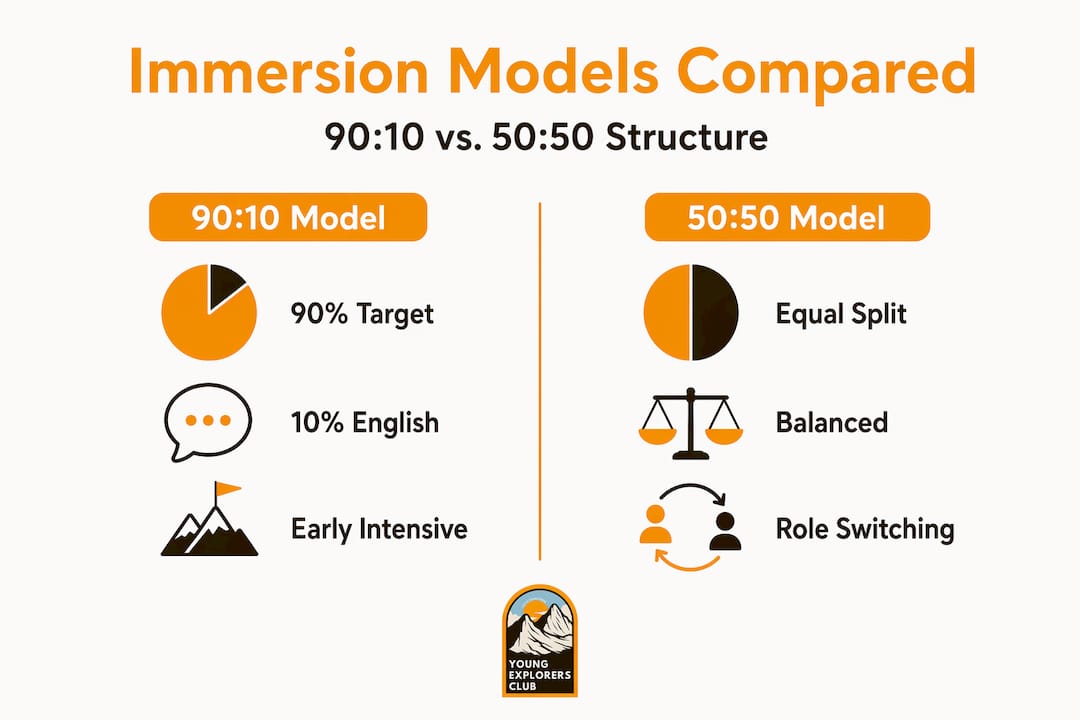
Most structured youth immersion programs follow one of two main models. The 90:10 model uses the target language for 90% of instruction early on, gradually shifting toward equal split. The 50:50 model, which is especially common in dual-language settings, splits instruction time evenly from the start. 50:50 time allocation models are common and support learners from both English-speaking and target language homes, making them well suited for international camps with mixed-nationality groups.
What makes immersion different from traditional language study is the social dimension. Children are not memorizing conjugations. They are navigating real situations with native-speaking peers and instructors. This forces the brain to retrieve and apply language under pressure, which is exactly how retention works best.
Key features of well-designed immersion programs include:
- Instruction delivered in both languages across real activities, not isolated grammar lessons
- Native-speaking instructors who model natural speech patterns and cultural expression
- Cultural programming woven into the daily schedule, not added as a bonus
- Balanced language exposure that gives children space to be both learners and language users
Understanding bilingual camp benefits helps you move past the surface level and ask sharper questions when evaluating programs.
Understanding bilingual cognitive effects: what the research says
Here is where the topic gets genuinely fascinating and where a lot of parental assumptions fall apart. The popular idea that bilingualism automatically gives children a cognitive edge, sharper attention, better multitasking, faster problem-solving, turns out to be more conditional than the headlines suggest.
Recent research reveals that bilingual cognitive advantages depend on learner proficiency and the intensity of language switching. A child who is just beginning to learn French does not get the same executive function boost as a child who is already at an intermediate level and regularly managing two languages in real time. The brain benefit appears most strongly when managing two languages requires genuine cognitive effort, not when one language overwhelms the other.
“The size and consistency of bilingual cognitive advantages vary by age and task, highlighting the importance of nuanced program design.”
What this means for parents is significant. Pushing a beginner into a high-intensity switching environment does not accelerate their development. It creates friction. The gains appear when language demands are calibrated to the child’s actual level.
The key findings worth knowing:
- Intermediate-level learners show the clearest executive function benefits from switching-intensive tasks
- Younger children (8 to 11) may benefit more from immersive exposure than intensive switching
- Teens with some base proficiency respond well to structured switching that challenges without overwhelming
- Cognitive gains are often subtle and show up in efficiency and flexibility rather than raw test scores
This nuance matters enormously when overcoming language barriers in a camp setting. Programs that treat every participant the same regardless of background are missing the point entirely. Learning why language camps boost kids’ skills requires understanding this proficiency-matching principle first.
Comparing immersion program structures: time allocation and language switching
Understanding the differences between program models helps you ask the right questions before enrolling. Here is a side-by-side look at the two most common structures:
| Feature | 90:10 model | 50:50 model |
|---|---|---|
| Language split | 90% target, 10% English at start | Equal split throughout |
| Best for | Heritage speakers or strong beginners | Mixed-proficiency groups |
| Switching intensity | Low initially, builds over time | Moderate and consistent |
| Risk | Can feel isolating for true beginners | May under-challenge advanced learners |
| Ideal setting | Long academic programs | Camps, short-term intensives |
50:50 models balance instruction equally in both languages, allowing participants to function as both learners and language models for each other. This peer modeling effect is especially powerful in diverse groups where children come from different language backgrounds.
Language separation (keeping each language in its own context or time block) works well for younger or lower-proficiency learners. Integrated switching, where a counselor or teacher shifts naturally between languages during one activity, is better suited for intermediate and advanced learners. Switching intensity should match learner proficiency to avoid cognitive friction and maximize benefits.
Pro Tip: Before choosing a program, have your child assessed honestly. Many camps offer placement evaluations. Use them. A child placed in the wrong intensity band will either coast without growing or struggle without support.
When choosing the right bilingual camp, time allocation models should be one of your first questions. The summer camp bilingual guide for 2026 provides a practical framework for comparing programs side by side.
How language immersion combined with outdoor adventure enhances youth development
This is where programs like those in Switzerland offer something that classroom-based immersion simply cannot replicate. When language learning happens while a child is navigating a mountain trail, setting up camp, or working through a climbing challenge with peers from three different countries, the stakes are real. That urgency accelerates language retention in ways that no worksheet can match.
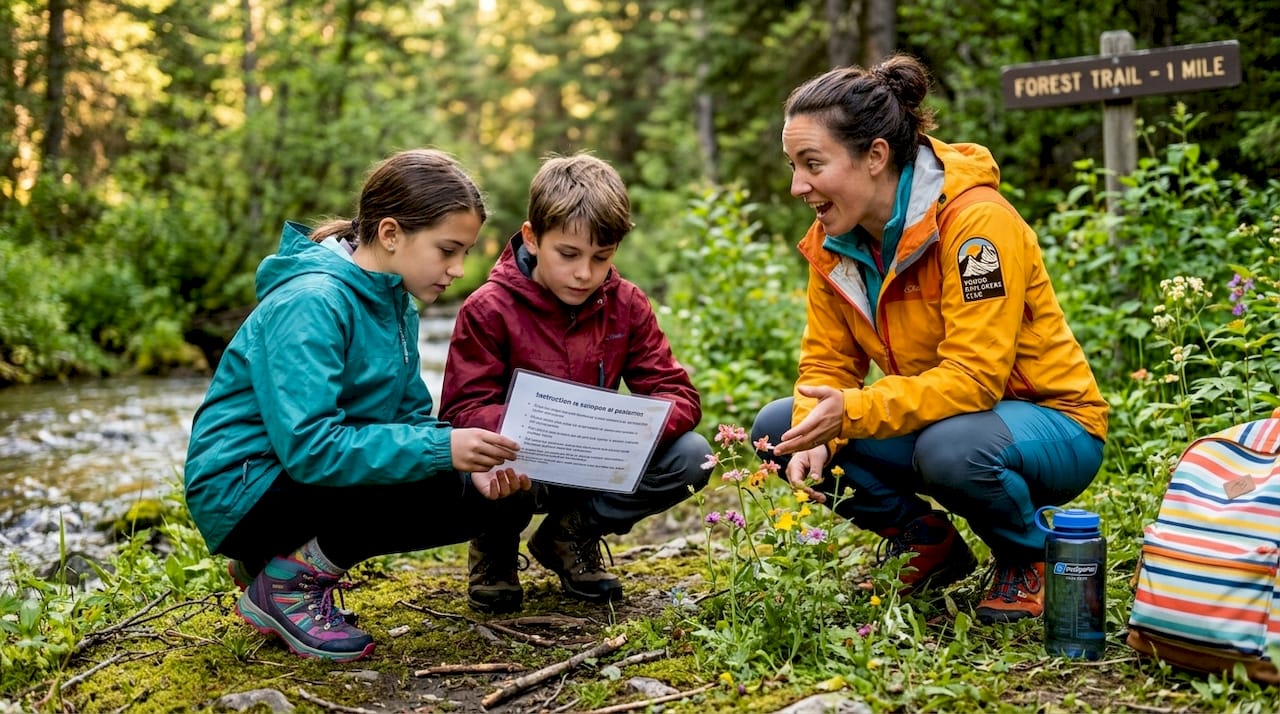
Immersion programs support academic skills while fostering curiosity, confidence, and empathy in social contexts. Outdoor adventure amplifies every one of those effects. A child who has to communicate in French to complete a team survival challenge is not just practicing vocabulary. They are building the nerve to try, fail, adapt, and try again. That is a skill that transfers far beyond language.
The social-emotional benefits are just as significant:
- Empathy and cultural appreciation develop when children share difficult or joyful experiences with peers from different backgrounds
- Confidence grows when a child successfully navigates a new language in a high-stakes but safe environment
- Adaptability becomes second nature when unfamiliar situations (a rope course, a new bunkmate, a meal in another language) become normal
- Teamwork and communication are tested and strengthened through shared physical challenges
Pro Tip: When evaluating programs, ask specifically whether native-speaking instructors lead the outdoor activities or whether language instruction is separated from the adventure component. The most effective programs weave language into every part of the day, not just scheduled lesson blocks.
Understanding why outdoor activities matter for youth gives parents useful context for evaluating how physical challenge and language learning reinforce each other. Programs built on an adventure-based learning philosophy treat the outdoor environment as the classroom, which is exactly where immersive language learning thrives.
Choosing the right language immersion youth program for your child
Strong language immersion programs leave nothing to chance. Quality programs emphasize placement, ongoing proficiency monitoring, and differentiated language scaffolds. The best ones also invest in aligned curricula, teacher support, and family engagement to maintain quality across the full duration of the program.
Five key factors to evaluate:
- Language proficiency placement Does the program assess your child before arrival and group participants by level?
- Program structure Is the time allocation model clearly explained and justified for the age group?
- Teacher qualifications Are instructors native speakers with training in working with youth language learners?
- Cultural integration Is culture embedded in activities or treated as an add-on?
- Support services What happens if a child is struggling linguistically or emotionally mid-program?
| Quality indicator | What to look for | Expected outcome |
|---|---|---|
| Placement assessment | Written and oral evaluation before start | Child placed at correct challenge level |
| Scaffolded switching | Gradual increase in language demands | Reduced frustration, better retention |
| Native-speaking instructors | Daily interaction with fluent speakers | Natural language acquisition |
| Cultural programming | Local excursions, traditions, food | Genuine cultural appreciation |
| Family communication | Regular progress updates | Informed parents, consistent home support |
Pro Tip: Ask the program coordinator how they handle a child who is clearly placed too high or too low after arrival. Programs with flexible placement protocols are the ones that actually prioritize learning over logistics.
Use this checklist before making your final decision:
- Does the program explain its language model clearly in writing?
- Can you speak with a current or former family about their experience?
- Is there a certified language educator on staff, not just a native speaker?
- Does the outdoor adventure component involve language use, not just recreation?
- Does the program offer follow-up resources for continued learning at home?
When selecting a bilingual camp, these questions will separate programs that have thought carefully about language learning from those that simply advertise bilingual as a selling point. For further guidance, the boosting kids’ confidence through camps resource shows how the right program environment shapes long-term outcomes.
Why immersion’s cognitive benefits depend more on quality than quantity
Here is something most articles on this topic will not tell you: more hours of immersion is not a reliable proxy for a better outcome. Parents are often drawn to programs that advertise intensive language environments as a feature. Total immersion. All day. Every interaction in the target language. It sounds rigorous. In practice, it can actively harm progress for beginners.
Outcomes are sensitive to individual differences and task demands, which means differentiated instruction matters far more than maximizing exposure. A child who is submerged in a language they barely understand does not acquire the language faster. They shut down. They stop attempting to produce language at all because the risk of failure feels too high.
Programs pushing heavy switching too early can cause cognitive friction for beginners, and that friction does not resolve itself with more time. It requires a structural response: a skilled teacher who reads the room, adjusts the demand level, and gives each child the foothold they need to climb further.
The neural evidence is subtle but important. Bilingual cognitive efficiency gains often do not show up in immediate test scores. They show up over years, in how a child approaches ambiguous problems, manages competing demands, and stays calm when the rules change. These are life skills, not test metrics. Choosing a program that prioritizes scaffolded, learner-centered immersion over brute-force exposure is how you invest in those long-term gains.
Choosing quality immersion programs means asking harder questions than “how many hours a day is the program in French?” Ask instead: how do instructors adapt when a child is frustrated? How are proficiency differences managed within a group activity? The answers reveal whether a program is genuinely designed for learning or just designed to look impressive in a brochure.
Explore language immersion and outdoor adventures with Young Explorers Club
Now that you understand what makes a language immersion youth program genuinely effective, you can evaluate your options with real criteria in hand. The Young Explorers Club brings together bilingual instruction, qualified native-speaking instructors, and outdoor adventure in one of the world’s most naturally compelling settings: the Swiss Alps.
Programs are designed around proficiency-matched language use, with English and French woven through every activity from mountain biking to survival skills challenges. Children build language skills the same way they build physical confidence: by doing real things in real contexts, supported by instructors who know when to push and when to provide a foothold. Whether your child wants to learn German at summer camp or join a diverse community through international summer camps in Switzerland, the program offers language growth grounded in genuine adventure.
Frequently asked questions
What age range benefits most from language immersion youth programs?
Children aged 8 to 17 can benefit from language immersion, especially when programs match instruction intensity to their proficiency development stage rather than applying a single approach to all age groups.
Does more language immersion time always mean faster fluency for kids?
Not necessarily. Effectiveness depends on program quality and scaffolding because outcomes depend on individual differences and task demands, not simply the number of hours a child spends in an immersive environment.
How do immersion programs support confidence and social growth?
They create authentic language use with native speakers and culturally rich shared experiences. Immersion programs support curiosity, confidence, and social-emotional growth in ways that traditional classroom settings rarely can.
What should parents look for to ensure quality in an immersion program?
Prioritize language proficiency placement, scaffolded switching tasks, qualified teachers, and cultural integration. Quality programs emphasize placement, curricular alignment, and ongoing professional development for instructors.
Can outdoor adventure enhance the language learning experience?
Absolutely. Outdoor experiences give language real stakes and social urgency. Outdoor experiences complement immersion by fostering problem-solving, adaptability, and collaboration in contexts where language has to be used, not just practiced.