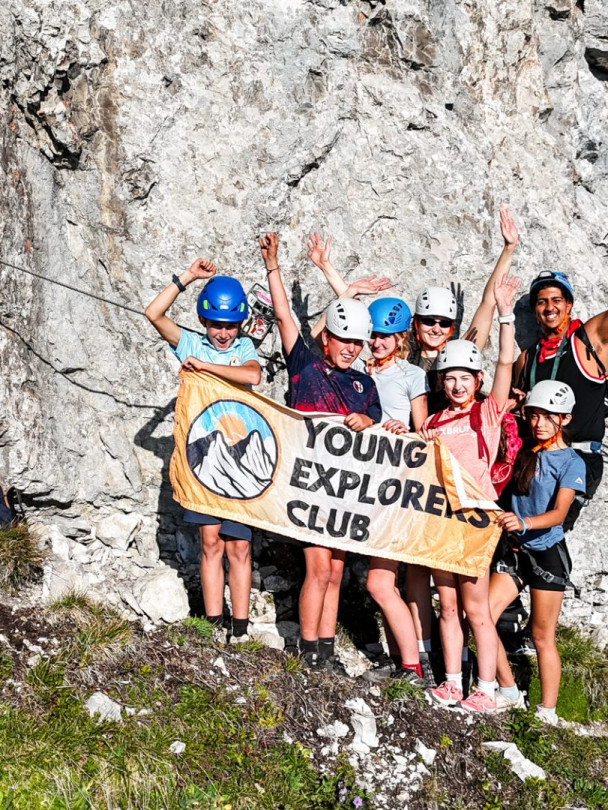
Young Explorers Club — Adventure Summer Camps
We, at the Young Explorers Club, run multi-activity adventure summer camps across the Swiss Alps. Camps mix climbing, hiking, via ferrata, canyoning, mountain biking and watersports. The program focuses on progressive technical skills and on building outdoor confidence. Sessions run from 7 to 21 days and deliver clear, measurable learning outcomes. Certified instructors lead every program and IFMGA guides join for technical days. Multiple safety layers sit in place across activities. Typical base elevations range from 600–1,600 m. We’re active late June through early September.
Key Takeaways
Multi-activity curriculum
The curriculum runs in progressive skill blocks so participants develop competence and confidence over time. Activities include climbing, hiking, via ferrata, canyoning, mountain biking and watersports. Each block has clear, measurable outcomes.
- Outcomes include:
- Belay competency
- Navigation
- Top-rope climbs
- First-aid tasks
- Group leadership
Session formats and costs
We offer multiple session lengths and pricing options to suit different needs.
- Lengths: 7, 10, 14 and 21-day options.
- Typical residential fees: around CHF 700–1,500 for 7 days; for 14 days fees usually range CHF 1,400–3,000+.
- Additional options: Day-camp and specialist add-on pricing varies by site and instructor ratio.
Age, group size and staffing
Programs are structured by age cohorts to keep activities age-appropriate and safe.
- Ages: Target 8–17 with cohorts 8–11, 12–14 and 15–17.
- Group sizes: Typically 8–16 participants per group.
- Staffing ratios: Aim for about 1:6 on high-risk activities and 1:10 on lower-risk days.
- Qualifications: Staff hold certified guide qualifications and WFA/first-aid credentials.
Locations, elevation and seasonality
Programs run in key alpine regions and account for daily altitude and weather patterns.
- Regions: Bernese Oberland (Interlaken/Grindelwald), Valais (Zermatt/Saas‑Fee) and Graubünden (Davos).
- Daily activity elevations: typically range from 800–3,000 m.
- Base elevations: typically 600–1,600 m.
- Season: Peak months are July and August; afternoons often bring convective storms so we adapt plans and follow lightning-aware procedures.
Safety, logistics and preparation
Safety and clear logistics are central to every program.
- Medical forms: You must complete medical forms before arrival.
- Insurance: Provide proof of travel/medical insurance that covers adventure activities.
- Emergency procedures: We publish emergency and evacuation procedures for every camp.
- Packing: Pack layered clothing, sturdy boots, waterproofs, a sleeping bag if required, and a 1–2 L water bottle. Many camps provide harnesses, helmets and ropes.
 Watch on YouTube
Overview & Quick Facts
We, at the young explorers club, run multi-activity adventure summer camps in the Swiss Alps that focus on climbing, hiking, via ferrata, canyoning, mountain biking and watersports. Camp programming mixes technical skill progression with outdoor confidence building. Families who want a quick primer can check our adventure summer camp Switzerland page for session dates and locations.
Durations and how they compare
- 7-day taster: a rapid skills introduction and orientation. Campers sample 2–3 core activities. This format suits first-timers and families on a budget. Typical 7-day residential fees range roughly CHF 700–1,500.
- 14-day progression: allows real skill consolidation, multi-day hikes or overnight stays, and stepwise climbing progression (for example, top-rope to multi-pitch practice). This delivers higher value and usually higher cost-intensity. Typical 14-day residential fees sit around CHF 1,400–3,000+.
- Additional session lengths: 10-day blocks for focused skills work and 21-day sessions for intensive leadership and alpine experience.
Ages and grouping
We target ages 8–17 with common cohorts split into 8–11, 12–14 and 15–17. Grouping matches both developmental stage and technical ability. Coaches adapt challenge levels so younger campers build confidence while older teens get tougher routes and longer treks.
Group size and staffing
Typical group sizes run between 8–16 campers. Staff-to-camper ratios commonly fall between 1:6 (for higher-risk activities) and 1:10 (for lower-risk programming). We maintain layered safety systems, certified instructors, and on-site emergency plans that scale with activity risk.
Popular regions and hubs
Camps operate across classic Alpine hubs to match activities with terrain and weather windows. We schedule locations to maximize safety, reduce transit time, and deliver a genuine Swiss mountain experience.
- Bernese Oberland (Interlaken, Grindelwald, Jungfrau region) — ideal for varied climbing and high-alpine hikes.
- Valais/Wallis (Zermatt, Saas-Fee, Verbier) — sustained ridgelines and glacier approaches for advanced sessions.
- Graubünden/Davos — technical trails and mountain-biking terrain.
Quick-scan bullets
- Durations: 7 / 10 / 14 / 21 days
- Age groups: 8–11, 12–14, 15–17
- Staff ratios: 1:6 (high-risk) to 1:10 (lower-risk)
- Group size: 8–16
- Sample regions: Interlaken, Zermatt, Bernese Oberland, Valais
- One-sentence parent hook: Structured, certified supervision plus layered safety systems = confident skills progression and authentic Alpine adventure.
https://youtu.be/4yjhBlgkw1U
Activities, Skill Levels & Sample Itineraries
I outline each core activity with the skill goals we measure and the practical outcomes campers will reach. We, at the Young Explorers Club, run progressive sessions so skills build logically and safely.
-
Rock climbing — Outdoor sport routes and top-rope instruction focus on ropework and belaying fundamentals. Campers learn secure belay technique, knot proficiency and set achievable climb grade targets (UIAA III–VII / French ~4–6a). Measurable outcome: safe top-rope belay and completion of a target-grade climb.
-
Hiking — Day hikes and multi-day treks teach route planning, pacing and group leadership rotation. Typical metrics are 6–15 km per day with 300–1,200 m ascent. Campers learn to plan a route and manage energy across varied terrain.
-
Via ferrata — Secured climbing on fixed cables and rungs gives controlled exposure to vertical terrain. We train safe use of via ferrata lanyards and route assessment. Youth routes are usually graded K2–K4 and focus on confident, clipped movement.
-
Canyoning — Guided descents through water gorges combine scrambling and controlled abseils. Skills include wet-environment ropework, partner checks and on-the-spot risk assessment.
-
Mountain biking / e-biking — Trail sessions teach uphill pacing, downhill control and basic bike maintenance. Outcomes include safe cornering technique and the ability to fix a puncture or adjust brakes.
-
Kayaking / paddleboarding — Flat-water technique and safety drills cover strokes, balance and buddy rescue. Campers practice re-entry and build confidence in calm alpine lakes.
-
Navigation & orienteering — Map and compass exercises progress to independent route-finding. Expected outcome: navigate a 5–10 km route using map and compass without direct supervision.
-
Ropes course / zipline — Team tasks build trust, communication and leadership. We measure growth by observed leadership during group challenges.
-
Alpine skills — Map reading, weather awareness and basic mountain safety are woven into every activity. Campers learn practical decision-making and hazard recognition relevant to mountain trips.
-
Cultural activities — Local village visits and cheese/dairy demonstrations give regional context and casual language exposure, helping campers connect with the environment and community.
Progression and session structure are explicit so parents and campers know what to expect. A 7-day session gives an introduction plus one skills milestone (for example: basic belay and a 6–8 km hike). Fourteen-day sessions add consolidation and a second milestone, such as top-rope mastery followed by lead-transition drills or a multi-pitch approach. Twenty-one-day sessions deepen technical refinement and include leadership roles and multi-day expeditions. Activity blocks run 3–4 hours for half-day skills or full-day hikes and combined-activity days.
We list measurable learning outcomes we test during sessions:
- Belay and ropework competency via a practical test.
- Independent navigation of a 5–10 km route with map and compass.
- Complete a top-rope climb at the assigned target grade.
- Perform basic wilderness first-aid tasks (apply a bandage, manage signs of hypothermia).
- Lead a small group on a planned route and demonstrate decision-making.
For parents wanting a quick overview of daily life and expectations, we recommend they read what kids should expect at a Swiss outdoor adventure camp.
Sample weekly itineraries (compact examples)
Here are three condensed sample weeks that show how skills and intensity progress.
-
Beginner week (7 days):
- Day 1: orientation and safety briefing.
- Day 2: top-rope climbing introduction.
- Day 3: half-day navigation + afternoon swim.
- Day 4: easy via ferrata (K2).
- Day 5: mountain biking skills.
- Day 6: full-day hike (~500 m ascent).
- Day 7: departure / rest.
-
Skills-progression week (14-day condensed):
- Day 1: orientation.
- Days 2–3: progressive climbing / top-rope & lead introduction.
- Day 4: navigation & map exercise.
- Day 5: canyoning introduction.
- Days 6–7: multi-day hike overnight.
- Days 8–13: focused technical days (multi-pitch practice, via ferrata K3, longer hike ~800–1,000 m ascent).
- Day 14: wrap-up and departure.
-
High-adventure week:
- Day 1: orientation.
- Day 2: crag climbing and belay tests.
- Day 3: full-day hike (~800 m ascent).
- Day 4: via ferrata (K2–K3).
- Day 5: canyoning.
- Day 6: multi-pitch / summit approach (non-glaciated) with guided descent.
- Day 7: rest & departure.
https://youtu.be/TxzJUThsDGE
Locations, Altitude, Trails & Best Time to Go
We run camps across Switzerland and rely on a massive trail network — roughly 65,000 km of marked hiking trails. Typical camp bases sit between 600 and 1,600 m, while daily activities commonly reach 800–3,000 m depending on the program. I plan routes with those ranges in mind so kids move from valley floors to high alpine meadows without surprise.
Switzerland has 48 peaks above 4,000 m. Youth multi-activity camps avoid sustained glaciated travel. If a glacier or summit day is offered, we only deliver it as an IFMGA‑guided specialist add‑on with experienced guides and extra gear.
Summer windows and weather
Late June through early September is the operating season, with July–August as peak months. July is often the wettest month in many Alpine areas. Summer afternoons commonly bring convective showers and thunderstorms; we schedule early starts for high ridges and keep flexible afternoon plans.
Expect these July temperature bands by elevation:
- 500 m: 18–25 °C
- 1,500 m: 8–18 °C
- 2,500 m: 0–12 °C
Night temperatures can fall below 0 °C above roughly 2,500 m, so I include warm sleeping layers for overnight treks.
How altitude changes planning
I build acclimatisation into multi‑day treks and higher activity days. Short, progressive gains in elevation reduce fatigue and headache risk. We use layered clothing as standard and pack contingency days for bad weather or slow groups. Avoiding high passes above ~2,500–3,000 m on tightly scheduled youth programs keeps risk and strain manageable. For mountain biking or via ferrata days in steeper valleys, I match route difficulty to the group’s recent altitude exposure.
Logistics and transport
Nearest transport hubs differ by region. Many camps offer station pick‑ups or meet at clearly defined rail stops to simplify travel for families. I plan transfers so arrival and first evening are low‑effort and focused on orientation, not long travel.
Notable regions and character (and what to expect)
Below I list the regions we use most and what each brings to the program:
- Jungfrau / Interlaken / Grindelwald: Central activity hub with easy access to valley crags, lakes and a dense trail network. Good for mixed programs that combine climbing, hiking and water activities.
- Zermatt: Iconic peak scenery and glacier approaches. Programs avoid glacier travel for younger groups unless an IFMGA team is booked.
- Saas‑Fee and Valais (Verbier, Saas‑Fee): Steep terrain, excellent via ferrata and technical mountain biking. Expect sustained climbs and dramatic descents.
- Graubünden / Davos: Large trail networks and high‑alpine access. This region suits longer ridge days and strong mountain‑bike infrastructure.
For a practical overview of camp routines and daily life, see what kids should expect at a swiss outdoor adventure camp — it helps families prepare for arrival and shows how we balance activity, rest and safety.

Safety, Staff Qualifications & Medical Requirements
Staff qualifications, ratios and credentials
We, at the young explorers club, require clear staff credentials and transparent ratios. Ask camps for the following and confirm the ratio of certified guides to campers:
- IFMGA/UIAGM-qualified mountain guides for technical alpine or summit days.
- Certified climbing instructors with national or regional instructor certificates and UIAA-aligned training where applicable.
- Wilderness First Aid (WFA) or Swiss first-aid certification for activity leaders.
- Child safeguarding and vetting checks for anyone working with minors.
- A published staff-to-camper ratio and the number of certified guides on each high-risk excursion.
I recommend parents check the camp description for specific names and copies of certificates. Also look at practical pages like what kids should expect to see typical staff roles and daily supervision levels. We insist on higher staffing as activity complexity, participant age, or environmental risk rises. Typical operational guidance is 1:6 for high-risk activities such as climbing, canyoning, and via ferrata, and 1:8–1:12 for lower-risk activities like day hikes or lake sports.
Medical requirements, insurance and emergency procedures
We require completed medical paperwork before arrival: signed parental consent, a detailed medical form, clear medication instructions, and emergency contact details. Routine vaccinations should be up-to-date. Camps often ask for travel or medical insurance that explicitly covers adventure activities and medical evacuation; provide proof if requested.
Camps must have defined emergency procedures and links with mountain rescue. REGA and local cantonal rescue teams operate throughout Switzerland, and camps should list nearest-hospital transfer times by region. We expect a simple parental contact and evacuation flowchart that runs like this:
- On-site incident
- Lead instructor assessment
- Camp medical response / REGA or ambulance
- Parent notified
- Hospital transfer if required
Helicopter evacuation protocols should be stated where applicable.
Plan for altitude sensibly. Altitude sickness is minimal below roughly 2,500 m but rises above about 3,000 m. Build gentle ascent profiles and schedule acclimatisation days for multi-day treks that reach higher elevations. We advise parents request the camp’s highest planned elevation and the acclimatisation plan for any route above these thresholds.

Accommodation, Food & Packing Essentials
We, at the young explorers club, arrange accommodation to match the itinerary and the learning goals. Chalet accommodation and youth hostels (Jugendherbergen) are common at base camps. Mountain huts appear on trek nights and offer more basic facilities. Dormitory-style rooms or school-type dormitories work well for larger groups. Typical room sizes are 4–8 campers. Shower and laundry arrangements vary by site, so I always remind parents to expect differences in comfort and privacy.
We design meal plans around three meals a day plus snacks. Menus focus on high-energy choices—pasta, rice, soups and regional Swiss dishes—and they cover dietary requirements and allergies. Where appropriate, I include cultural food activities like raclette or fondue demonstrations to give campers a taste of local traditions. Our staff communicate allergy handling clearly and keep separate prep routines for special diets.
We see shared bedding and communal life as part of the learning. Dorm rooms and shared cabins speed up group bonding and social skills. Some camps provide bedding; others ask campers to bring a sleeping bag for hut nights. I recommend weighing comfort against the pitch of wilderness immersion when choosing what to bring.
Packing checklist
Below I list essentials, optional extras and items usually provided so parents can create a clear packing list.
- Essentials:
- Layered clothing using a 3-layer system (base layer, insulating fleece, waterproof breathable shell)
- Sturdy hiking boots and trainers
- Waterproof jacket
- Sun hat and sunglasses
- Warm hat and gloves for higher-altitude days
- Swimwear
- Personal toiletries, labelled clothing and any prescribed medication
- Sleeping bag if requested by the camp
- Water bottle with 1–2 L capacity per camper
- Small daypack for hikes
- Technical gear / policy:
- We commonly provide harnesses, climbing helmets, ropes and belay devices.
- Campers may bring a personal harness or climbing shoes if they prefer their own fit.
- Trekking poles are optional but useful on longer ascents.
- Power banks are allowed; note limited charging in huts.
- Optional extras:
- Sunscreen and lip protection
- Lightweight towel
- Compact first-aid items (plasters, blister care)
- Extra zip-lock bags for wet or soiled clothing
We advise parents to label every item and split packing into essentials versus optional versus provided. I also recommend seasonal and high-altitude adjustments: add heavier insulation for early summer or alpine days and reduce bulky items for lower-elevation camps. For more on preparing kids, consult our outdoor skills checklist.
We also instruct parents on day-hike logistics. Send a packed lunch if required, and include energy snacks. We confirm allergy handling and any special meal needs before arrival.

Costs, Travel, Booking & Choosing the Right Camp
I’ll spell out typical costs and what they actually cover so you can compare offers quickly. Day camps and taster sessions generally run CHF 100–300 per day. Residential camps commonly cost CHF 700–1,500 for a 7-day session and CHF 1,400–3,000+ for a 14-day program. Typical inclusions are accommodation, meals, instruction, and a standard safety kit (helmets, harnesses, ropes), plus most on-program activities. Typical exclusions are travel to camp, personal technical gear, travel/medical insurance, and optional extras such as helicopter transfers or specialist guided glacier days. We, at the young explorers club, recommend checking the fine print on inclusions before you pay.
Price pressure often comes from specialty services. IFMGA-guided alpine days, helicopter or remote transfers, small private groups, included international transfers, and glacier or summit days push prices up. IFMGA guides command higher fees because of their specialist training and legal responsibility; heli or guided glacier days can add several hundred to several thousand CHF depending on logistics and location. Factor those add-ons into your total budget rather than assuming “all in.”
Travel and logistics matter for timing and cost. Major international airports are Zurich (ZRH), Geneva (GVA), Basel (BSL) and Bern-Belp (BRN); regional options include Sion and Saanen for Valais and the Bernese Oberland. Switzerland’s SBB rail network and regional postbuses handle most onward travel, and many camps offer station pick-up. Typical transfer examples: Zurich → Interlaken is about 2 hours by train; Geneva or Zurich → Zermatt takes roughly 3–4 hours with the final leg by train since Zermatt is car-free. If you want a program focused on alpine technique, read the program description for a clear breakdown of guided days; a true mountain sports camp will list how many IFMGA-led days are included. For more on program types, see this guide to a mountain sports camp.
Booking windows and cancellation realities. Early-bird booking windows typically run November–March for the next summer. Late bookings are often accepted up to June if spaces remain. Expect a deposit of about 20–30% at booking. Cancellation policies vary widely; many camps operate tiered refunds based on how far in advance you cancel, and some offer credits or flexibility for COVID or medical contingencies. Always confirm the exact refund schedule and whether the camp requires or offers travel/medical evacuation insurance.
Ten-point comparison checklist
Use this checklist when you compare programs — I recommend running each camp against every item below before signing.
- Accreditation & insurance: confirm the provider’s public liability and adventure activity coverage.
- Staff qualifications and IFMGA/UIAGM presence: how many IFMGA or equivalent guides are included and on which days.
- Safety protocols and emergency plans: written procedures, local emergency contacts, and evacuation routing.
- Staff-to-camper ratios by activity: separate ratios for climbing, canyoning, and overnight alpine days.
- Sample itineraries and progression plan: clear daily goals and skill progression for beginners to advanced.
- Price transparency and inclusions: what’s covered, what’s extra, and a full list of optional add-ons.
- Medical & evacuation arrangements: on-site medical care, nearest hospital, and medevac policies.
- Accommodation & food standards: allergen handling, menu examples, and sleeping arrangements.
- Parent communication policy and incident reporting: planned updates, emergency contact protocol, and incident logs.
- Cancellation terms and contingency planning: refund tiers, transferability, and policy for bad weather or closures.
We, at the young explorers club, also suggest asking the three core questions below before you book:
- How many IFMGA guides are included and on which days?
- What is the staff-to-camper ratio on high-risk days (climbing/canyoning/via ferrata)?
- What insurance do you require or provide, and does it cover medical evacuation and adventure activities?
If you want insight into what to expect on-site, read our short note on what kids should expect at a Swiss outdoor adventure camp.