Benefits of international camps: confidence, language & friends
Discover the research-backed benefits of international summer camps, from confidence and language skills to global friendships, plus tips for choosing the right program.
Not all summer camps are created equal. When you’re weighing options for your child or teen, the difference between a local day camp and a well-designed international program can be enormous. Research consistently shows that 70-90% of campers at international camps report meaningful gains in confidence and independence. These aren’t just feel-good numbers. They reflect real shifts in how young people see themselves and the world around them. This article breaks down the evidence-backed benefits of international camps and gives you practical tools to choose the right one.
Table of Contents
- Key benefits of international camps for children and teens
- Building self-confidence and independence through new experiences
- Cultural exchange and global friendships: opening young minds
- Language immersion and cognitive growth
- Resilience, reduced anxiety, and well-being
- What to look for in a high-quality international camp
- Potential challenges and solutions for families
- Explore international camps for your child
- Frequently asked questions
Key Takeaways
| Point | Details |
|---|---|
| Boosts confidence and independence | Most campers report strong gains in self-confidence and independent skills after attending international camps. |
| Fosters global friendships | International camps help kids build friendships across cultures, reducing prejudice and improving empathy. |
| Promotes language and cognitive growth | Immersive language experiences at camp accelerate language learning and expand thinking skills. |
| Strengthens resilience and well-being | Challenging activities and diverse environments help children handle setbacks and boost emotional health. |
| Key criteria for families | Choose accredited camps with qualified staff, strong immersion programs, and support for first-timers for the best outcomes. |
Key benefits of international camps for children and teens
International camps deliver a range of benefits that go well beyond a fun summer. The combination of adventure, cultural exposure, and structured independence creates conditions for genuine personal growth that’s hard to replicate anywhere else.
Here are the core benefits backed by research:
- Confidence: ACA studies show 70% of parents report their child gained self-confidence after attending camp.
- Positive self-image: 92% of campers report feeling good about themselves during and after the experience.
- Friendship: 96% of campers make new friends, many of whom become lasting connections across borders.
- Independence: Kids learn to manage daily routines, navigate new environments, and make decisions without parental input.
- Resilience: Facing challenges in an unfamiliar setting builds the mental toughness that carries into school and adult life.
- Peer skills: Teamwork, conflict resolution, and empathy develop naturally in a multicultural group setting.
These outcomes aren’t accidental. They’re the result of intentional program design. Confidence and independence at camp grow because children are placed in situations where they must rely on themselves and each other. Global camp friendships form because shared adventure breaks down social barriers faster than any classroom exercise.
Pro Tip: When evaluating camps, ask specifically about staff qualifications, counselor-to-camper ratios, and whether language immersion is built into daily activities or treated as an optional add-on.
Building self-confidence and independence through new experiences
Confidence and independence are at the heart of camp experiences, but how exactly do international camps foster these qualities? The answer lies in a stepwise progression of responsibility.
Here’s how that progression typically unfolds:
- Arrival and orientation: Kids navigate a new environment, often in a second language, with staff support close by.
- Daily decision-making: Choosing activities, managing personal gear, and organizing their schedule builds real autonomy.
- Group challenges: Adventure activities like climbing or survival skills require kids to lead, follow, and communicate.
- Reflection: Structured group discussions help campers recognize their own growth, reinforcing confidence.
- Increasing independence: By the final days, most campers are operating with far more self-direction than when they arrived.
This scaffolded approach is why 70-90% of campers report major improvements in confidence. Staff don’t just supervise. They coach. They create just enough challenge to stretch a child without overwhelming them. Personal growth at camp happens because the environment is designed for it.
“Camp is one of the few places where children are free to fail, try again, and succeed on their own terms.” — Camp development research, ACA
Pro Tip: If your child is shy or anxious, consider starting with a shorter session or a hybrid program before committing to a full residential stay. A confidence boost in travel camps often begins the moment a child realizes they can handle something they thought they couldn’t.
Cultural exchange and global friendships: opening young minds
Beyond confidence, another core benefit emerges: the friendships and cultural skills campers gain when they share space with peers from dozens of countries.
Research supports what camp directors have observed for decades. Camps reduce anxiety and improve mood (Bowers, 2021), and the long-term effects on leadership and teamwork persist well after the summer ends. International friendships also reduce prejudice through what researchers call the contact hypothesis: when people from different backgrounds work and play together, stereotypes break down naturally.
Typical cultural activities at international camps include:
- Cultural nights: Campers share food, music, and traditions from their home countries.
- Language exchange: Informal conversations in multiple languages happen organically during meals and activities.
- Collaborative challenges: Mixed-nationality teams solve problems together, building empathy and communication skills.
- Celebrations: International holidays and customs are recognized, broadening every camper’s frame of reference.
| Outcome | Reported improvement |
|---|---|
| Reduced anxiety | Significant (Bowers, 2021) |
| Improved mood | Consistent across studies |
| Leadership skills | Long-term persistence (ACA) |
| Reduced prejudice | Supported by contact hypothesis research |
| Cross-cultural friendships | 96% make new friends (ACA) |
Friendships across cultures formed at camp are often among the most meaningful relationships young people develop. They also teach something no textbook can: how to connect with someone whose background is completely different from your own.
Language immersion and cognitive growth
International camps aren’t only fun. They’re a prime opportunity for language and brain development. When a child spends two or three weeks communicating in a second language during meals, hikes, and team activities, the learning is qualitatively different from a classroom lesson.
The benefits of immersive language environments include:
- Faster vocabulary acquisition through real-world context
- Improved cognitive flexibility and problem-solving
- Greater comfort with ambiguity and unfamiliar situations
- Stronger academic performance in language-related subjects
However, not all camps deliver the same depth of immersion. Research on L2 exposure shows that low-intensity environments produce minimal cognitive gains. The cultural and language edge of international camps only materializes when language is woven into every part of the day, not just a one-hour lesson.
| Camp type | Language exposure | Cognitive benefit |
|---|---|---|
| Local day camp | Minimal | Low |
| International camp (low immersion) | Moderate | Moderate |
| International camp (full immersion) | High | High |
If language learning is a priority for your family, look at programs like learning German at camp or explore language camp options that integrate French, English, or German into outdoor activities from morning to evening.
Resilience, reduced anxiety, and well-being
Along with new skills, international camps play a powerful role in children’s emotional well-being. The combination of physical challenge, social connection, and distance from everyday pressures creates a unique environment for mental health growth.
Signs that camp is building resilience in your child:
- They talk about a problem they solved without adult help
- They describe a moment of failure followed by trying again
- They mention a friend from a different country or background
- They express pride in completing a physical or creative challenge
- They seem more comfortable with uncertainty when they return home
Camps reduce anxiety and improve mood across multiple studies, with Bowers (2021) noting consistent positive effects on emotional regulation. The ACA confirms that leadership and teamwork skills developed at camp persist long-term, suggesting the benefits aren’t just a summer high.
“Children who experience manageable challenges in supportive environments develop the coping skills that protect them throughout life.” — ACA research summary
Activities like mountain biking, climbing, and survival challenges, which are central to programs focused on outdoor activities and mental health, teach kids that discomfort is temporary and that they are more capable than they thought. Adventure and self-esteem are deeply connected in the research literature.
What to look for in a high-quality international camp
Ready to choose a camp? Here are key features to consider before enrolling your child.
- Accreditation: Look for ACA accreditation or a comparable national standard. ACA-accredited camps meet rigorous safety and quality benchmarks that unaccredited programs may not.
- Staff-to-camper ratios: Lower ratios mean more individual attention. Ask for specific numbers, not vague assurances.
- Progressive challenges: Quality programs build difficulty gradually so children grow without being overwhelmed.
- Language immersion depth: Ask whether language is integrated into all activities or limited to scheduled lessons.
- Cultural programming: Look for structured opportunities for cross-cultural exchange, not just proximity to international peers.
- Logistics support for first-timers: Good camps have clear arrival procedures, orientation programs, and staff trained to support children who have never traveled internationally.
Before you book, review how to prepare for camp in Switzerland so your child arrives ready to engage from day one.
Pro Tip: For younger children or first-time campers, start with a shorter session of one to two weeks. This reduces the risk of homesickness and gives your child a successful experience to build on.
Potential challenges and solutions for families
Even with all these benefits, families may face challenges or doubts. Here’s how to overcome them.
Common barriers and practical solutions:
- Cost: International camps require a real financial commitment. Look for early-bird discounts, sibling rates, or scholarship programs. Some camps also offer payment plans.
- Homesickness: This is normal and manageable. Choose a camp with trained staff and a clear communication policy so you stay informed without undermining your child’s independence.
- Language readiness: Kids don’t need to be fluent before attending. Most international camps are designed for mixed language levels. However, low-intensity immersion produces fewer gains, so verify how language is used throughout the day.
- Shyness or anxiety: Shy kids often thrive at camp once they settle in. Prepare them with role-play conversations, discuss what to expect, and consider a shorter first session.
- Immersion depth concerns: Ask the camp director directly how many hours per day campers are actively using the target language.
For families unsure about the social side, understanding how camps foster team spirit without pressure or competition can ease concerns about whether your child will fit in.
Explore international camps for your child
You now have the research, the selection criteria, and the practical tools to make a confident decision. The next step is finding the right program for your child’s age, interests, and goals.
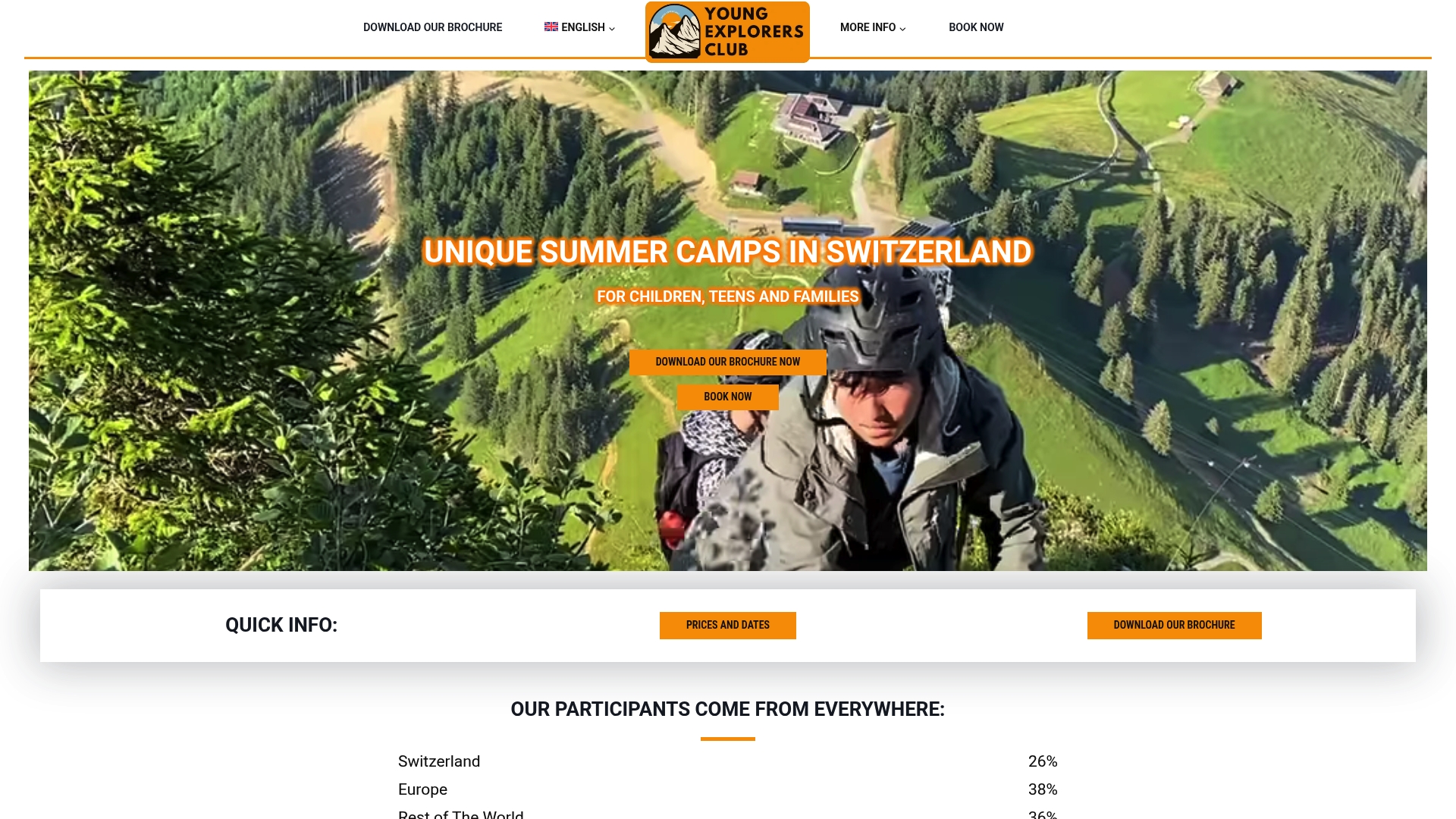
At Young Explorers Club, we run accredited international summer camps in Switzerland that combine adventure, language immersion, and cultural exchange in one experience. Whether your child wants to learn German at summer camp, build friendships across borders, or push their limits on a mountain trail, we have a program designed for them. Explore our global community summer camps to find the right session, age group, and activity focus. Registration is straightforward, and our team is available to answer every question before you commit.
Frequently asked questions
How do international camps help shy or anxious kids?
Structured routines, trained staff, and gradual social exposure give shy or anxious kids a safe framework to build confidence. 70-90% of campers report meaningful improvements, including children who started the session feeling nervous.
Are international summer camps safe?
Accredited programs follow strict safety standards, maintain appropriate staff ratios, and train counselors for a wide range of situations. Always verify ACA accreditation or an equivalent national standard before enrolling.
What age is best for a first international camp experience?
Children as young as 8 to 10 can benefit from international camps, especially with shorter sessions. Starting with one to two weeks reduces pressure and sets your child up for a positive first experience.
How do camps manage homesickness and cultural adjustment?
Trained staff use group activities, structured routines, and regular check-ins to help children adjust. Camps consistently reduce anxiety and improve mood, even among children who struggle in the first few days.
Do kids really learn a new language at camp?
Progress depends on how deeply language is integrated into daily life at the camp. Full-immersion programs produce the strongest results, while low-intensity environments deliver more modest gains. Ask the camp director for specifics before you decide.
Recommended
- Camps That Encourage Kids To Try New Things | Young Explorers Club Switzerland
- How Camps Foster Team Spirit Without Competition | Young Explorers Club Switzerland
- Summer Camp Switzerland | International Camp And Travel
- How International Summer Camps Boost Confidence And Independence | Young Explorers Club Switzerland