How to Support Bilingual Campers: Strategies That Work
Discover how to support bilingual campers with effective strategies. Boost language skills and cultural identity for a transformative camp experience!
TL;DR:
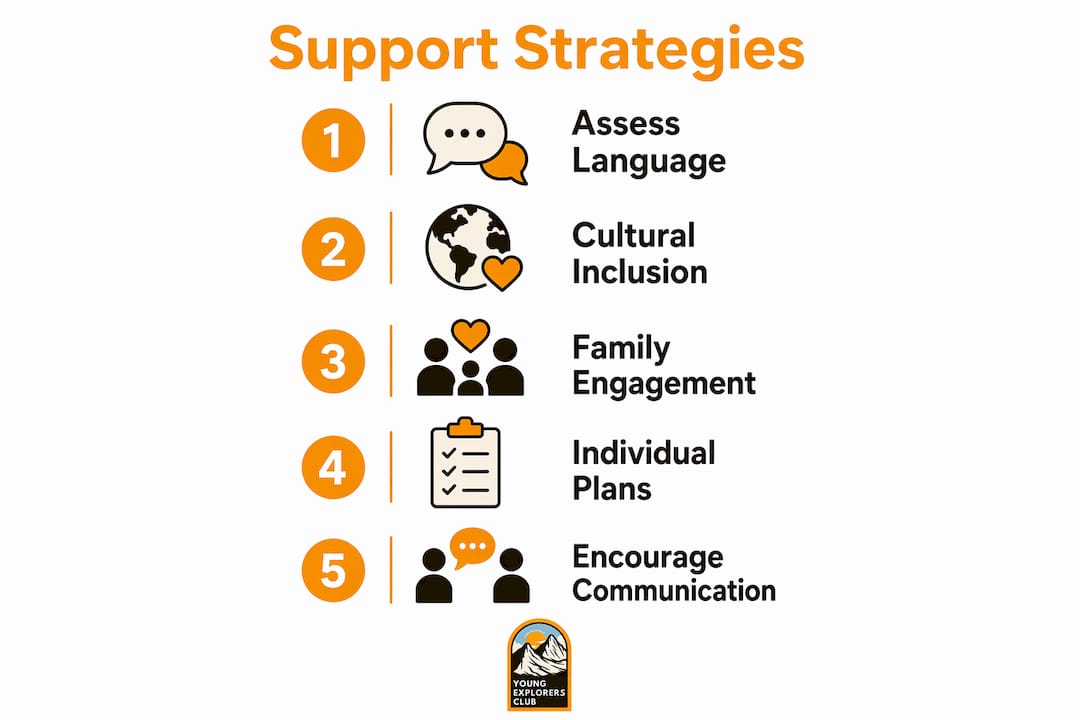
- Supporting bilingual campers involves proficiency-based grouping, cultural inclusion, and individualized plans to enhance language skills and confidence. Daily multisensory routines, family engagement, and a safe environment for mistakes foster natural language development and social belonging. Emphasizing cultural identity and positive staff interactions help campers thrive linguistically and emotionally.
Supporting bilingual campers means designing every aspect of camp life to build language confidence and social belonging at the same time. The term “dual language learner support” covers the full range of methods educators and camp staff use to meet multilingual youth where they are. Done well, it accelerates second-language acquisition, deepens cultural identity, and turns the outdoor setting into a powerful classroom. This article gives parents and educators a practical framework covering assessment, daily engagement strategies, cultural inclusion, individualized planning, and common challenges for bilingual campers.
How to support bilingual campers from the very first day
Effective support starts before a camper unpacks their bag. The first step is a language proficiency assessment, typically a home language survey combined with a brief staff evaluation during intake. These tools identify where each child sits on the proficiency spectrum and flag any gaps between receptive understanding and spoken output. Without this baseline, staff risk placing campers in groups that are either too advanced or too passive for real growth.
Once you have that picture, gather the right resources:
- Bilingual printed materials in both the camp language and the camper’s home language
- Visual supports such as labeled diagrams, picture schedules, and color-coded activity boards
- Trained bilingual staff or counselors who can bridge communication during transitions
- Specialist partnerships with organizations like Neurodiverse Resource, whose clinician-led collaborations build individualized linguistic strategies without reducing a child to a diagnostic label
The table below maps each resource to its primary function:
| Resource | Primary function |
|---|---|
| Home language survey | Establishes proficiency baseline at intake |
| Visual supports | Reduces anxiety by making instructions multimodal |
| Bilingual staff | Provides real-time comprehension bridges |
| Specialist partnership | Enables customized plans for complex language profiles |
Understanding a camper’s cultural background matters as much as knowing their language level. A child who speaks Portuguese at home and English at school carries a specific set of code-switching habits, emotional associations with each language, and family expectations. Staff who recognize that context build trust faster and avoid the common mistake of treating silence as disengagement.
What daily strategies actually engage bilingual kids at camp
Grouping campers by language proficiency rather than age is the single most effective structural change a camp can make. Campers assessed on language skills join instruction groups that match their current level, while social activities remain age-based so peer bonding stays natural. This separation of academic and social grouping prevents the frustration of being academically under-challenged or socially isolated.
From there, build a daily routine that uses multiple sensory channels:
- Morning circle with bilingual songs and call-and-response. Repetition with movement locks vocabulary into procedural memory faster than written drills.
- Visual and auditory instruction pairing. Every verbal direction gets a gesture or a picture card. Structured sensory repetition is proven to accelerate natural language acquisition in immersive settings.
- Buddy system during transitions. Pair a more proficient speaker with a developing one for walks between activities. The social pressure is low, the speaking opportunity is real.
- Language games woven into outdoor activities. Daily language games and partner talk increase speaking opportunities and natural practice, which accelerates bilingual skill development faster than structured lessons alone.
- Reflection time in the home language. Giving campers five minutes to journal or debrief in their first language reduces cognitive fatigue and consolidates what they learned in the second.
Pro Tip: Celebrate every attempt, not just correct output. When a camper tries a new phrase and gets it wrong, respond to the meaning, not the error. Welcoming mistakes as part of confidence-building reduces anxiety and measurably improves speaking competence over time.
Staff should also watch for passive bilingualism, where a child understands everything but refuses to speak. The fix is not more pressure. It is more low-stakes speaking moments: whisper partners, small group games, and one-on-one check-ins where the counselor models imperfect language first.
What role do cultural inclusion and family engagement play?
Cultural inclusion is not a decoration added to a bilingual program. It is the structural foundation. Programs that embed cultural identity as a core component show greater social participation and pride in heritage among multilingual youth. A camper who sees their home culture reflected in stories, songs, food, and games feels that their full self belongs at camp, not just the version that speaks the dominant language.
Practical ways to embed culture into camp activities include:
- Rotating “culture spotlight” moments where campers share a song, game, or phrase from home
- Using culturally relevant texts and picture books during quiet reading time
- Inviting families to contribute recipes, crafts, or short video messages that get shared with the group
- Displaying multilingual welcome signs and labeling common spaces in multiple languages
Family engagement extends the support beyond camp hours. Inviting families to share stories and songs at home increases a camper’s motivation and reinforces the message that their home language is an asset, not an obstacle. A simple weekly message to parents with two or three vocabulary words to practice at home creates continuity between camp and family life.
Treating bilingualism as an asset empowers children to advocate for their own learning needs and take pride in their cultural identity. Programs that build this critical consciousness produce campers who are not just more fluent. They are more confident across every area of camp life.
How to create individualized success plans for bilingual campers
No two bilingual campers arrive with the same profile. One child may be academically fluent in English but struggle with informal peer conversation. Another may be a confident speaker who cannot yet read in either language. Individualized success plans address this by starting from a strengths-based lens rather than a deficit model.
The intake process should capture:
- Dominant and secondary language proficiency levels
- Social and emotional readiness for group activities
- Any specialist recommendations from school or therapy providers
Individualized camper success plans work best when they integrate language, social, and emotional supports, designed collaboratively with families and specialists. That means the plan is not written by staff alone. It is co-created with the family during a brief pre-camp consultation and reviewed at the midpoint of the session.
Pro Tip: Build a simple one-page “camper profile” that every counselor reads before the session starts. Include the child’s preferred name, home language, two communication strengths, and one area to watch. This replaces lengthy briefings and gets every staff member aligned in under three minutes.
Progress monitoring does not need to be formal. A counselor noting that a camper initiated a conversation in the second language for the first time is meaningful data. Weekly check-ins with a lead staff member, combined with a brief family update, keep the plan responsive rather than static.
| Plan element | Without specialist input | With specialist input |
|---|---|---|
| Language goals | Generic fluency targets | Proficiency-matched milestones |
| Social goals | Group participation only | Peer interaction strategies tailored to temperament |
| Emotional support | Reactive (address issues as they arise) | Proactive (anticipate transitions and triggers) |
What are the common challenges for bilingual campers and how to fix them?
The most frequent challenge is language anxiety. A camper who fears judgment will go silent, withdraw from group activities, and appear disengaged when they are actually processing intensely. The solution is environmental, not instructional. Staff must model imperfect language use themselves, laugh at their own errors, and make it clear that trying is the only standard.
Other recurring challenges include:
- Age-only grouping. Placing a child with peers who are two years ahead in language proficiency creates frustration on both sides. Proficiency-based grouping for language activities solves this without disrupting social bonds.
- Overreliance on translation. Translating everything removes the productive struggle that builds real acquisition. Use translation as a bridge, not a crutch.
- Ignoring the home language. Suppressing a child’s first language to accelerate the second is counterproductive. Research consistently shows that strong first-language literacy supports second-language learning.
- Inconsistent staff behavior. If one counselor celebrates mistakes and another corrects them sharply, the camper receives mixed signals. Staff alignment through brief daily huddles prevents this.
The outdoor setting is one of the most powerful language-learning environments available. Movement, novelty, and real stakes create the conditions where language sticks. The job of camp staff is to protect that environment from anxiety, not to fill it with drills.
Encouraging language diversity in camps also means resisting the pressure to make every moment a teaching moment. Some of the best language acquisition happens during free play, shared meals, and campfire conversations where no one is keeping score.
Key takeaways
Supporting bilingual campers requires proficiency-based grouping, cultural inclusion, family partnership, and individualized planning working together as a system, not as isolated tactics.
| Point | Details |
|---|---|
| Assess before you group | Use home language surveys and staff evaluations to place campers by proficiency, not age. |
| Use multisensory routines | Songs, gestures, and visual supports accelerate natural acquisition in immersive settings. |
| Embed cultural identity | Programs that reflect campers’ home cultures show stronger social participation and confidence. |
| Co-create success plans | Involve families and specialists to build plans that address language, social, and emotional needs together. |
| Normalize mistakes | A safe environment for trial and error produces measurably better speaking outcomes over time. |
Why bilingualism at camp is a strength worth protecting
I have worked with multilingual youth in outdoor programs long enough to know that the biggest mistake camps make is treating bilingualism as a problem to manage rather than a skill to build on. When a child arrives speaking three languages and staff respond by focusing only on what they cannot yet do in the camp language, you lose the most powerful motivator available: pride.
The camps that get this right share one trait. They train staff to see a bilingual camper’s home language as evidence of cognitive flexibility, not a gap to close. I have watched a 10-year-old who barely spoke during the first week become the most confident communicator in the group by week three, simply because one counselor spent five minutes each morning asking about her home country in broken Spanish. That investment cost nothing. The return was visible to everyone.
Family partnerships are underused in most camp contexts. Parents of bilingual children often worry that their home language is “getting in the way.” The most useful thing a camp can do is send a clear message early: your language is welcome here. That single shift changes how families engage, and it changes how campers show up.
Staff training is where most programs fall short. Reading a briefing document is not enough. Counselors need to practice responding to errors without correcting them, to ask open questions that invite more than a yes or no, and to recognize the difference between a quiet child who is processing and one who is genuinely lost. Those skills are learnable. They just require deliberate practice before the session starts.
— Guillem
Discover bilingual camp programs at Youngexplorersclub
Youngexplorersclub runs its international summer camp in Switzerland with a bilingual English and French environment built into every activity, not added as an optional extra. Staff are trained in proficiency-based grouping, cultural inclusion, and individualized support, so every camper arrives into a structure designed for their success.
Whether your child is a confident second-language speaker or just beginning to find their voice in a new language, Youngexplorersclub offers programs that meet them at their level. From immersive language options to multicultural outdoor adventures, the camp combines real language practice with the kind of social experiences that make it stick. Explore the full range of programs and find the right fit for your child this summer.
FAQ
How do you assess a bilingual camper’s language level at intake?
Use a home language survey combined with a brief staff evaluation during the first day. This identifies proficiency in both languages and guides grouping decisions for language-focused activities.
What is the best grouping strategy for bilingual campers?
Group campers by language proficiency for instruction and language activities, but keep social and recreational activities age-based. This approach improves learning pace without disrupting peer bonding.
How can families support bilingual campers at home during camp?
Families can reinforce camp vocabulary by sharing songs, stories, and simple phrases in both languages at home. Family involvement directly increases a camper’s language confidence and cultural connection.
What should staff do when a bilingual camper goes silent?
Silence usually signals language anxiety, not disengagement. Create low-stakes speaking moments such as whisper partners or one-on-one check-ins, and model imperfect language use yourself to reduce the pressure.
How does cultural inclusion improve language outcomes at camp?
Embedding a camper’s home culture into activities increases social participation and self-esteem, which in turn creates the psychological safety needed for stronger language acquisition in a second language.