

TL;DR:
- Mentorship at Swiss summer camps is crucial for fostering personal development through structured guidance, reflection, and emotional support. Research indicates that these programs benefit disadvantaged children most, with tailored approaches enhancing growth for all. Parents should prioritize camps that invest in qualified training, targeted matching, and outcome tracking to ensure meaningful camper development.
Sending your child to a summer camp in Switzerland feels like an obvious win. Beautiful mountains, outdoor adventure, new friends, a bilingual environment, and a team of mentors ready to guide the way. But here is a reality that most camp brochures never mention: not every child automatically walks away transformed just because a mentor was present. New research on mentoring programs reveals a more nuanced picture, and understanding it will help you make a far smarter decision for your child this summer.
Key Takeaways
| Point | Details |
|---|---|
| Mentorship isn’t one-size-fits-all | The value of camp mentoring depends on fit with your child’s needs and the camp’s approach. |
| Outdoor activities amplify growth | Mentors use adventure to teach resilience, leadership, and teamwork far beyond the classroom. |
| Ask about mentor selection | Parents should request details on mentor training, assignment, and camper outcomes for true insight. |
| Research supports targeted mentorship | RCT studies show the biggest benefits for children who need support most, especially when matched thoughtfully. |
| Swiss camps offer diverse mentorship | Families can choose from language, sports, arts, and outdoor camps in Switzerland where mentorship is central. |
Why mentorship is at the heart of great camp experiences
When families start researching Swiss summer camps, personal development consistently appears near the top of their wish list. They are not just looking for babysitting in the Alps. They want their child to come home more confident, more resilient, and better equipped for the real world. That hope almost always centers on one thing: mentorship.
In the camp setting, a mentor is not simply a counselor who keeps kids safe. A mentor is a trusted, trained adult who guides, challenges, and supports a young person through experiences they would never encounter in a classroom. Mentors at youth camps play at least four distinct roles at any given moment. They model positive behavior under pressure. They provide emotional support when a challenge feels too big. They teach practical skills through doing rather than lecturing. And they actively facilitate the formation of healthy peer relationships that often outlast the camp itself.
The core promise of mentorship is safe risk-taking. A child who has never trusted their own body on a climbing wall learns something profound when a well-trained mentor stands beside them, offers honest encouragement, and celebrates incremental progress rather than just the summit. That lesson about self-trust travels home in the child’s backpack long after the summer ends. And mentoring is widely viewed as crucial for positive youth outcomes in educational and activity settings worldwide.
“The best mentors we have ever met at camp were not the loudest or the most decorated. They were the ones who noticed what a child needed before the child did.” — Parent of a Young Explorers Club alumni, reflecting on two summers in Switzerland.
What makes the Swiss camp environment particularly powerful is the combination of structured outdoor challenge and intentional adult guidance. A mentor does not just supervise an activity. They debrief it. They ask questions that help a child articulate what they felt, what they overcame, and what they want to try next. That reflective practice is where real growth is locked in.
How mentors shape personal growth in outdoor adventure camps
Let’s move from the why to the how. In practice, mentors at adventure-focused Swiss camps shape personal growth through specific, repeatable moments built into the daily schedule. Here is what that actually looks like across common outdoor activities:
-
Ropes course and high elements. A camper reaches a platform fifteen meters above the ground and freezes. The mentor does not push. They ask, “What does your body need right now?” That one question teaches self-awareness, emotional regulation, and trust in adult support. The camper who descends successfully carries a lived experience of overcoming fear.
-
Mountain biking on alpine trails. A mentor riding at the back of the group watches for the child who keeps letting others pass. They ride alongside, not to correct technique immediately, but to build rapport first. Skill coaching follows once trust is established. The result: a child who associates challenge with support rather than judgment.
-
Survival skills and navigation. When a team gets their map-reading assignment wrong and adds two kilometers to a hike, a skilled mentor lets the natural consequence play out for a moment before stepping in. The debrief becomes a lesson in accountability, problem-solving, and bouncing back without shame.
-
Team sports and group challenges. Mentors observe and intervene in peer dynamics. When one child consistently takes over, the mentor creates a structure where roles rotate. When a quieter child gets overlooked, the mentor redirects group attention. These micro-interventions over two or three weeks build genuine leadership capacity.
Mentoring programs focused on building soft skills and life readiness through outdoor activities consistently show the strongest outcomes when mentors are present during both the activity and the reflection afterward.
Pro Tip: When reviewing camp websites, look for specific language about mentor training in youth development, not just outdoor safety certifications. A certified rock-climbing instructor and a trained youth development mentor are not the same person, though ideally your child’s camp employs both in one.
You can also explore camp counselor perspectives to understand how experienced staff at quality programs define their role, and look for camps that prioritize team spirit at camp through cooperative rather than purely competitive frameworks.
Does every child benefit equally? What research and experience reveal
Here is the part most camp marketing glosses over. Mentorship is not equally transformative for every child. Research using randomized controlled trials (a method where participants are randomly assigned to receive mentoring or not, giving us reliable cause-and-effect data) reveals something both encouraging and sobering.

A major study found that mentoring benefits were significant for severely disadvantaged youth but were not statistically significant for less disadvantaged youth. In other words, children facing the greatest challenges at home, in school, or socially saw the most measurable gains. Children who were already thriving showed smaller gains, at least in the measurable outcomes researchers tracked.
This does not mean mentorship is useless for well-supported kids. It means the type and depth of mentorship need to match the child’s actual situation.
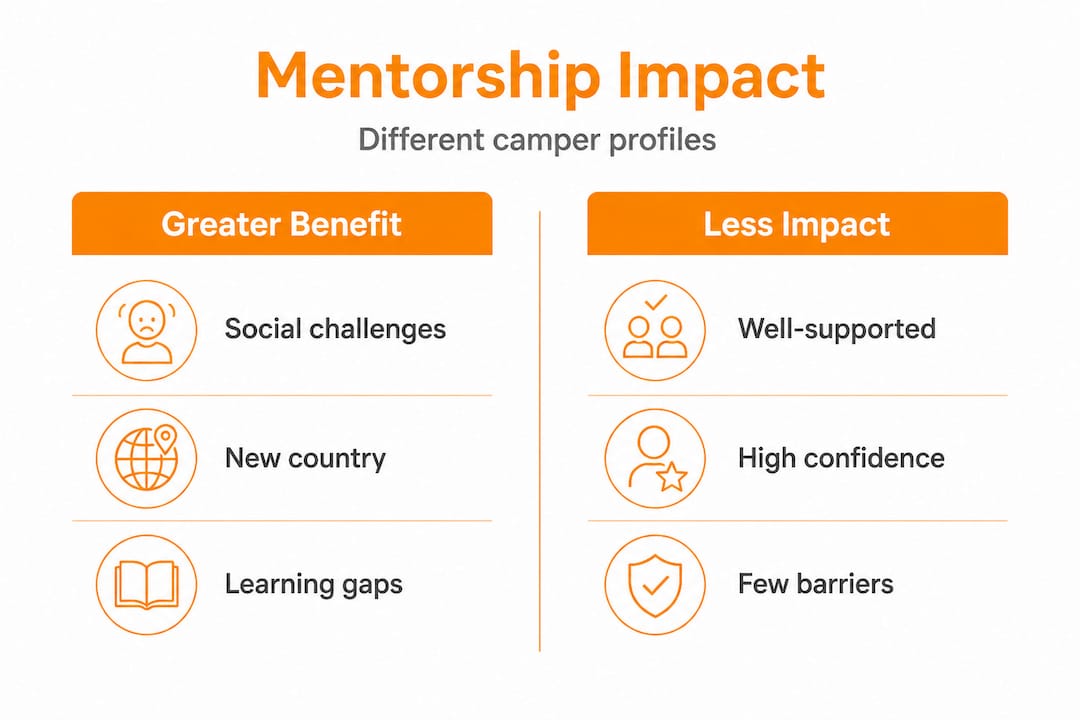
| Camper profile | Expected mentorship benefit | What matters most |
|---|---|---|
| Child facing social challenges | High: measurable confidence and peer skill gains | Consistent one-on-one attention, emotional support focus |
| Child from a supportive home | Moderate: skill and exposure gains | Skill-building mentors, stretch challenges |
| Child with previous camp experience | Moderate to high: leadership emergence | Autonomy with accountability |
| Child new to adventure activities | High: confidence and resilience gains | Patient, trained mentor with activity expertise |
| Child navigating language barriers | High: social and language integration | Bilingual mentors with cultural sensitivity |
The practical takeaway for parents: the concept of “fit” matters far more than the mere presence of mentors. A camp where every child receives the same mentorship approach, regardless of their background or needs, will see uneven results. Camps that invest in effective mentoring at camps by tailoring their approach to individual camper profiles will see consistent, meaningful growth across a wider range of children.
Switzerland’s international camp culture adds another layer here. When children arrive from dozens of different countries, the variation in background, family support, and prior experience with outdoor challenges is enormous. Camps that account for this diversity in their mentor assignments and strategies are the ones that genuinely deliver on the growth promise.
What to ask and look for: Choosing a camp with meaningful mentorship
Knowing that fit and targeting matter, the natural question becomes: how do you evaluate a camp’s mentorship program before your child arrives? Here is what to look for and what to avoid.
Green-light signs of meaningful mentorship:
- Mentors receive formal training in youth development, not just activity safety
- The camp tracks camper growth over the session and shares feedback with parents
- Staff-to-camper ratios are clearly published and kept low (ideally no more than 1 mentor to 6 campers for core activity groups)
- Mentors stay with the same group throughout the session rather than rotating constantly
- The camp has a clear philosophy about how mentors handle conflict, fear, and peer dynamics
Red-flag signs to watch for:
- Mentorship is described only in terms of “fun” or “enthusiasm” rather than development
- Staff qualifications list only activity certifications with no mention of youth development training
- The camp cannot explain how they match mentors to campers or account for different personalities
- No parent feedback mechanism exists beyond a closing ceremony or newsletter
- Marketing focuses entirely on activities and locations without mentioning the human side of the experience
Pro Tip: Ask the camp director directly: “What is your mentor-to-camper ratio during activity time, and how do you measure whether your mentorship approach is working?” Strong programs answer with specifics. Weaker programs answer with stories that feel warm but tell you nothing about outcomes.
| Question to ask | What a strong answer sounds like |
|---|---|
| How are mentors selected and trained? | “We hire for youth development background and provide 40+ hours of pre-camp training.” |
| How do you match mentors to campers? | “We review registration forms and use intake conversations to assign mentor-camper pairs.” |
| How do you measure growth? | “We track specific goals set with each camper at intake and debrief with parents at close.” |
| What happens when a camper struggles emotionally? | “Our mentors are trained in supportive listening and escalate to our wellbeing coordinator when needed.” |
Research confirms that mentoring outcomes are strongest when mentor selection is intentional and targeted. Before committing to any program, explore their past camp experiences and look for any information about positive attitude training done with campers before arrival, which is a strong signal that the program thinks carefully about individual preparation rather than one-size-fits-all delivery.
Our view: The truth parents miss about mentors at camp
We have worked alongside hundreds of families choosing camps for their children, and we see the same pattern repeatedly. Parents read “expert mentors” in a camp description and mentally check the box. Mentorship secured. Growth guaranteed. Done.
That assumption is the most expensive mistake you can make in camp selection, not financially, but in terms of your child’s experience.
Here is the honest truth: mentorship is not a blanket solution, and the research backs this up clearly. The evidence shows that mentoring is not a magic solution for all children. Fit and targeting play crucial roles in determining whether a child actually grows from a mentorship relationship or simply tolerates it.
What we have observed over years of working with Swiss camps is that the programs producing the most consistently impressive outcomes are not the ones with the most impressive brochures. They are the ones investing heavily in three areas: mentor selection criteria that go beyond outdoor skills, structured training in adolescent psychology and group dynamics, and a deliberate process for pairing campers with mentors who match their specific developmental stage and personal challenges.
There is also a self-reflection piece that parents often skip. Before you ask what a camp’s mentorship effectiveness looks like, ask yourself: what does my child actually need this summer? A child who needs to build social confidence requires a different mentor approach than a child who needs to take physical risks or learn to collaborate. Getting honest about your child’s real needs, not the growth you hope they will achieve, is the starting point for finding a truly good fit.
Camps that have this right will welcome your specific questions. They will not deflect with general enthusiasm. They will tell you about their intake process, their mentor training hours, and their outcome tracking. That specificity is the signal you are looking for.
Explore camps where mentorship makes the difference
You have now got a sharper lens for evaluating what mentorship at a summer camp actually means versus what it is marketed to mean. The next step is finding a program that lives up to the standard.
At the Young Explorers Club, we design our Swiss summer camps around the principles you have read about here: intentional mentor selection, structured youth development training, and thoughtful camper-mentor matching. Our programs include specialized tracks in outdoor adventure, multisport, and language and mentorship camps that combine French or German immersion with the personal growth framework we believe every child deserves. As part of a thriving international camp community, your child joins peers from across the world, guided by mentors trained to navigate that diversity with skill and genuine care. Explore our programs and reach out to talk through the right fit for your child.


