Outdoor Leadership Skills Checklist for Youth Programs
Discover the essential outdoor leadership skills checklist for youth programs. Enhance preparation and ensure safety on every adventure!
TL;DR:
- Effective outdoor youth leadership requires structured checklists, nature-inspired roles, and phased skill development to ensure safety and resilience. Preparation, including comprehensive gear, clear roles, and anticipatory planning, minimizes risks during unpredictable scenarios. Developing soft skills through repeated practice builds confident leaders capable of managing challenges and fostering resilient teams.
Leading a group of teens through mountain terrain, a river crossing, or a multi-day wilderness camp requires more than enthusiasm. It demands a specific set of skills, clear preparation, and a structured plan for every scenario. An outdoor leadership skills checklist gives educators, youth leaders, and parents a concrete framework to verify readiness before any adventure begins. This article breaks down the core competencies, nature-inspired leadership frameworks, gear essentials, and progression strategies that define effective outdoor youth leadership in 2026.
Table of Contents
- Key takeaways
- 1. Your outdoor leadership skills checklist starts here
- 2. Nature-inspired leadership roles that build resilient teams
- 3. Gear and administrative preparation checklist
- 4. Three-phase progression model for youth leadership development
- 5. Common challenges and how preparation overcomes them
- My honest take on what actually builds outdoor leaders
- Take your program further with Youngexplorersclub
- FAQ
Key takeaways
| Point | Details |
|---|---|
| Use a structured checklist | A pre-trip checklist covering gear, roles, and skills dramatically reduces risk and leader stress. |
| Build soft skills alongside technical ones | Empathy, adaptability, and situational awareness matter as much as map-reading for youth groups. |
| Progress youth through phases | Structure leadership development across three age-based phases to match skill with responsibility. |
| Adopt nature-based roles | Ecological leadership roles like stabilizer and pioneer help leaders adapt and build team cohesion. |
| Preparation beats reaction | Leaders who prepare thoroughly make better decisions under pressure and model resilience for youth. |
1. Your outdoor leadership skills checklist starts here
Before reviewing gear or group dynamics, recognize that the phrase “outdoor leadership skills checklist” describes what the outdoor education field formally calls competency-based leadership preparation. The distinction matters because a true competency framework covers technical skills, interpersonal abilities, environmental knowledge, and administrative readiness simultaneously. Think of the checklist as your audit tool for all four.
The foundation of any outdoor youth program rests on navigation, communication, safety protocol, and group management. Miss one of these, and the whole structure weakens.
Navigation and communication:
- Map reading, compass use, and GPS familiarity
- Ability to route-plan for mixed-ability youth groups
- Clear verbal briefings using simple, age-appropriate language
- Simple language and nonverbal cues for diverse youth groups, including regular check-ins and active listening
Safety and group management:
- First-aid certification with pediatric protocols
- Emergency response plans shared with all adult staff
- Group size capped at 10 participants per Leave No Trace guidelines
- Pre-trip environmental behavior training matched to activity level
Pro Tip: When briefing youth groups, use the “show, tell, do” method. Demonstrate the skill, explain it out loud, then have participants try it before you move on. Retention goes up and anxiety goes down.
For a deeper overview of how these competencies translate to youth confidence, the outdoor leadership skills guide from Youngexplorersclub is worth bookmarking.
2. Nature-inspired leadership roles that build resilient teams
One of the most underused frameworks in outdoor adventure leadership comes from ecology. A 2026 IUCN report on nature-based leadership roles identifies seven ecosystem-inspired roles that help leaders operate adaptively and strengthen team dynamics, much the way different species maintain a healthy ecosystem.
“Nature-based leadership reframes leaders as ecosystem contributors balancing multiple roles to create adaptive, resilient teams.” — IUCN Guide to Nature-Based Leadership
The seven roles translate directly to youth outdoor programs:
- Pollinator: Connects ideas and people across the group, spreading enthusiasm and cross-pollinating skills between participants
- Stabilizer: The calm, steady presence that manages group stress when weather turns or plans change
- Pioneer: Takes calculated risks and models courage, especially valuable on a first climb or unfamiliar trail
- Decomposer: Breaks complex challenges into manageable steps so the group does not feel overwhelmed
- Cultivator: Nurtures quieter youth voices and builds long-term confidence over the duration of a program
- Migrator: Reads when the group needs a change of pace, activity, or energy and guides that transition
- Anchor: Holds the group’s values and purpose steady when distractions or frustrations arise
Most experienced leaders naturally cycle between three or four of these roles in a single day. Naming them gives you self-awareness and gives your co-leaders a shared vocabulary for dividing responsibilities without conflict.
The soft skills underneath all seven roles are empathy, patience, adaptability, and situational awareness. These are the leadership skills in nature settings that no technical course alone can teach. They develop through practice, reflection, and honest feedback from peers.
3. Gear and administrative preparation checklist
A leadership skills checklist would be incomplete without physical gear and organizational infrastructure. The Ten Essentials system remains the backbone of safe outdoor programming in 2026, organized into ten gear categories.
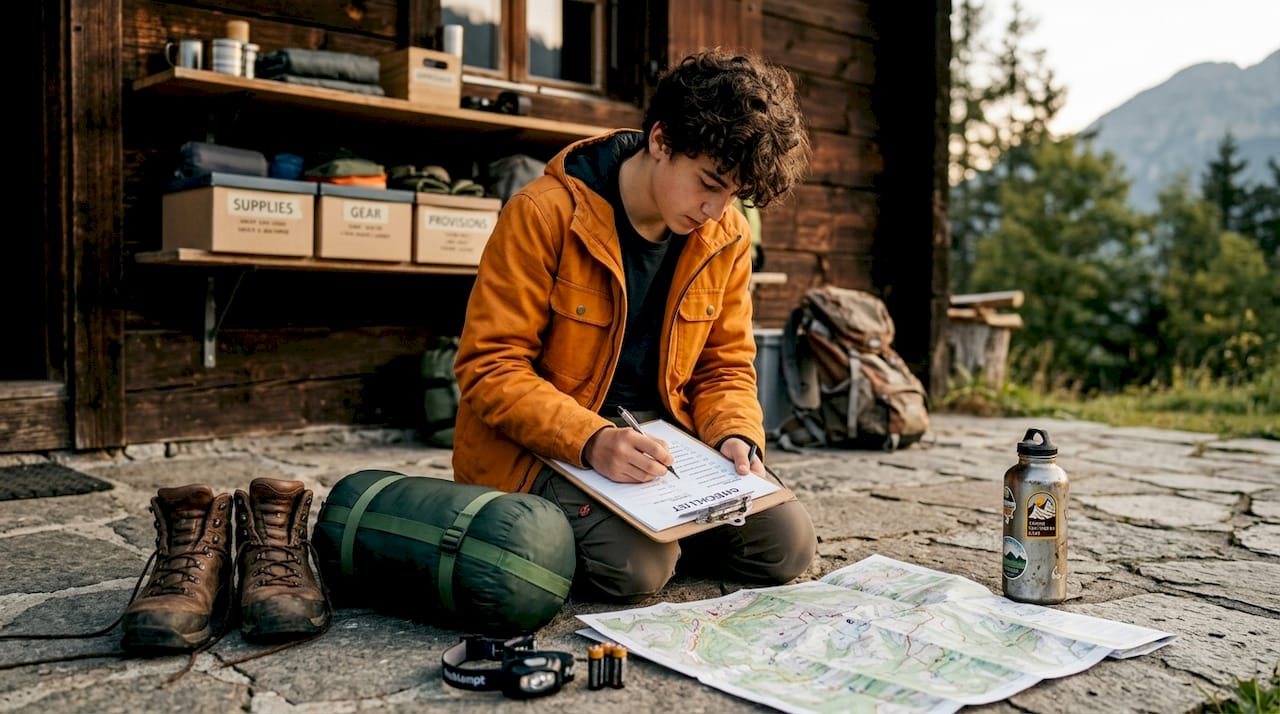
| Gear Category | Key Items | Purpose |
|---|---|---|
| Navigation | Map, compass, GPS device | Route planning and orientation |
| Sun protection | Sunscreen SPF 50+, sunglasses, hat | Prevent sunburn and heat exhaustion |
| Insulation | Extra layers, rain jacket, gloves | Temperature regulation |
| Illumination | Headlamp, spare batteries | Low-light and emergency use |
| First aid | Full kit with pediatric supplies | Immediate medical response |
| Fire | Lighter, waterproof matches, fire starter | Emergency warmth and signaling |
| Repair kit | Duct tape, multi-tool, cord | Field repairs to gear and equipment |
| Nutrition | Extra day’s food, high-energy snacks | Sustained energy and emergency reserve |
| Hydration | Water bottles, filtration system | Prevent dehydration |
| Emergency shelter | Bivy sack, space blanket | Unexpected overnight or weather event |
Beyond gear, youth programs require clearly assigned administrative roles. A solid checklist for outdoor leaders includes 12 administrative roles. The non-negotiable ones for youth programs are:
- Event Manager: oversees the full program schedule and staff coordination
- Safety Officer: monitors hazards and manages emergency protocols
- Logistics Lead: handles transport, permits, gear inventory, and food supply
- First Aid Lead: carries the medical kit and has current certification
- Communications Officer: manages parent contact and emergency notification systems
Pro Tip: Laminate your gear checklist and your administrative roles sheet. Keep both in a waterproof pouch at the top of your pack. Leaders who can pull up a reference in 30 seconds make faster, safer decisions than those searching their phone under stress.
You can cross-reference Youngexplorersclub’s equipment list for youth programs when building your own customized preparation list.
4. Three-phase progression model for youth leadership development
Skills for leading outdoor groups should not be dumped on youth all at once. A phased model structures development across age bands, matching challenge level to psychological and physical readiness.
Research from the Mayhew youth development program provides a practical three-phase framework:
Phase 1 (Ages 9 to 12): Foundations and adaptation
- Focus: basic survival skills, environmental awareness, group norms
- Activities: short day hikes, fire safety workshops, simple navigation games
- Leadership goal: follow instructions reliably and contribute to group tasks
Phase 2 (Ages 13 to 16): Advanced challenge and peer leadership
- Focus: multi-day expeditions, problem-solving scenarios, peer mentoring
- Activities: overnight camps, technical skills like rope work or mountain biking, group debriefs
- Leadership goal: lead a small team through a defined task with minimal adult intervention
Phase 3 (Pre-graduation): Community leadership and service
- Focus: designing and running activities for younger participants
- Activities: co-facilitating sessions, project planning, community service integration
- Leadership goal: model all seven nature-based roles for a group and self-assess performance
Aligning your program structure with this progression prevents the two most common errors in youth outdoor programming: under-challenging older teens and overwhelming younger ones. Both kill motivation fast.
Teaching teens about environmental responsibility alongside skills development also deepens their investment in the program. Youth who understand why they are protecting a trail or watershed become more engaged participants, not just rule-followers.
5. Common challenges and how preparation overcomes them
Every outdoor leader faces the same recurring set of problems. The difference between a smooth program and a crisis usually comes down to how thoroughly the leader prepared, not how skilled they were at improvisation.
| Challenge | Risk Without Preparation | How a Checklist Helps |
|---|---|---|
| Environmental hazards | Undetected weather shifts, unsafe terrain | Pre-trip route assessment and weather protocols |
| Group dynamics conflict | Disengagement, bullying, safety risks | Defined group norms and daily check-in structure |
| Equipment failure | Stranded group, delayed evacuation | Repair kit and redundant gear in checklist |
| Decision-making under pressure | Poor judgment, panic | Pre-assigned roles so no one wonders who leads |
Consider a hypothetical example. Two groups set out on the same alpine trail. Group A has a leader who packed intuitively and briefed participants verbally. Group B followed a written outdoor team management protocol covering gear assignments, role assignments, emergency communication, and group behavior expectations. When an unexpected thunderstorm arrives mid-afternoon, Group A’s leader spends critical minutes figuring out who has the emergency shelter. Group B’s Safety Officer already has it unpacked and everyone knows where to go.
Preparation does not eliminate surprises. It shrinks the gap between surprise and response.
Adaptive leadership in outdoor settings involves reading early environmental and social signals before they become crises. Leaders who practice this skill routinely make better calls because they respond rather than react.
My honest take on what actually builds outdoor leaders
I have worked with youth in outdoor settings long enough to know that the leaders who fall apart are rarely the ones who forgot a piece of gear. They are the ones who never practiced being uncomfortable.
Real wilderness leadership skills grow through repeated exposure and reflection, not a single wilderness first aid course. I have watched technically strong leaders freeze during a minor group conflict because they had never been trained to regulate their own stress response, only to use a compass.
The best advice I can offer is this: practice sequencing under low stakes before you need it under high ones. Prioritizing survival sequence means fire and shelter before water, water before food. Leadership sequencing works the same way. Calm the leader first. Assess the group. Then address the problem. In my experience, leaders who reverse this order make the situation worse nine times out of ten.
I also think we undervalue the “stabilizer” role. Every youth group needs someone who does not visibly panic when plans change. That person does not need to be the most experienced. They just need to have practiced staying steady when things go sideways. You can train that quality deliberately, and the checklist is where it starts.
— Guillem
Take your program further with Youngexplorersclub
If you are building an outdoor youth leadership program and want a tested model to work from, Youngexplorersclub runs structured adventure camps in Switzerland designed precisely for this. Programs integrate technical outdoor skills, peer leadership, and experiential team challenges across age-appropriate cohorts.

Teens attending summer camp in Switzerland through Youngexplorersclub develop navigation, resilience, and group communication skills within a multilingual, international community. For families wanting to combine leadership development with language immersion, the German language camp program pairs outdoor adventure with structured language learning. Whether you are an educator building a school program or a parent preparing your teen for independent challenge, Youngexplorersclub offers the structure and environment where these skills take root.
FAQ
What should an outdoor leadership skills checklist include?
A strong checklist covers the Ten Essentials gear categories, key administrative roles like safety officer and logistics lead, communication protocols, and group behavior expectations. It should be customized to the specific activity, environment, and age group.
How many youth can one outdoor leader safely manage?
Leave No Trace guidelines recommend a maximum of 10 participants per group to maintain safety and minimize environmental impact. More participants require additional certified adult leaders.
What soft skills matter most for leading youth outdoors?
Empathy, situational awareness, patience, and adaptability consistently outperform technical skills when it comes to managing group dynamics and keeping youth engaged through challenges.
At what age can teens start leading outdoor groups?
Phase 2 of most youth development models (ages 13 to 16) is when teens can begin peer leadership roles with adult supervision. By the pre-graduation phase, they can co-facilitate activities for younger groups with structured support.
How does preparation reduce outdoor leadership risk?
Pre-assigned roles, written gear checklists, and pre-trip briefings shrink response time during unexpected events. Leaders who have rehearsed their roles make calmer, faster decisions because they are executing a plan rather than improvising from scratch.