How adventure shapes teen growth and resilience
Discover how adventure-based camps build resilience and confidence in teens, with research showing 36% resilience gains and expert tips for choosing the right program.
TL;DR:
- Adventure programs offer social-emotional benefits that surpass traditional youth activities.
- Repeated progressive challenges and mentorship build resilience, confidence, and emotional regulation.
- Choosing well-structured camps with reflection, mentorship, and increasing difficulty maximizes growth.
Most parents think of adventure camp as a reward, a fun break from school before fall rolls around. But the research tells a very different story. Adventure activities involving novelty, challenge, and small-group mentorship produce social-emotional benefits that outperform many traditional youth programs. This article walks you through exactly why adventure-based experiences accelerate your teen’s development, what the science says about resilience and confidence, and how to choose a program that actually delivers lasting results.
Table of Contents
- Why adventure matters for teen development
- How adventure experiences build resilience and confidence
- Edge cases: When does adventure do the most good?
- Adventure camps in practice: What to expect and how to choose
- Why conventional wisdom about teen adventure is incomplete
- Finding the right adventure program for your teen
- Frequently asked questions
Key Takeaways
| Point | Details |
|---|---|
| Adventure fuels growth | Adventure programs deliver superior social and emotional benefits for teens compared to traditional activities. |
| Resilience needs real challenge | Progressive exposure to risk and novelty under caring mentorship builds confidence and stress-coping skills. |
| Consistency is crucial | Lasting impacts require repeated adventure experiences, not one-off events. |
| Choose camps carefully | Look for evidence-based structure, skilled mentors, and a focus on both safety and challenge. |
Why adventure matters for teen development
Adventure, in the context of teen development, is not simply about excitement. It means placing a young person in a situation that involves genuine novelty, a manageable level of risk, real challenge, and a trusted mentor nearby. That combination is what makes adventure different from a class trip or a weekend sports tournament.
Researchers have found that outdoor adventure education supports every major element of well-being described in positive psychology’s PERMA model: Positive emotion, Engagement, Relationships, Meaning, and Accomplishment. These are not abstract concepts. They translate directly into teens who feel better about themselves, connect more deeply with peers, and approach problems with greater confidence.
“Adventure education does not just build skills. It builds the internal architecture teens need to handle life’s real pressures.”
What separates adventure from other youth programs is the quality of its social-emotional impact. Greater social-emotional benefits have been documented in adventure programs compared to service learning or mentoring alone. That is a significant finding for parents weighing their options.
Camps that function as a safe space for growth are intentionally designed to let teens stumble, recover, and grow stronger. The key advantages of well-run adventure programs include:
- Lasting resilience built through repeated exposure to challenge and recovery
- Real-world decision making practiced in low-stakes but high-engagement environments
- Deep social connection formed through shared struggle and team-based problem solving
- Emotional regulation strengthened by navigating fear, frustration, and success
- Self-trust developed when teens discover they can handle more than they thought
For parents exploring building confidence through adventure, understanding these mechanisms is the first step toward choosing the right experience for your teen.
How adventure experiences build resilience and confidence
Having established adventure’s benefits, let’s look at the mechanisms behind resilience and confidence building. The process is more structured than most parents realize.
Adventure education follows what psychologists call the Kolb experiential learning cycle. A teen faces a real challenge, reflects on what happened, draws a lesson from it, and then tests that lesson in the next challenge. This loop, repeated across days or weeks, rewires how teens respond to stress and uncertainty. It is not magic. It is repetition with reflection.
The physiological data backs this up. Orienteering camp participants showed improved heart rate variability, reduced cortisol levels, increased positive affect, and stronger resilient profiles after their experience. These are measurable changes in how a teen’s body and brain handle pressure.
| Outcome measured | Improvement observed |
|---|---|
| Resilience score | +36% |
| Overall well-being | +23% |
| Cortisol (stress hormone) | Significant reduction |
| Heart rate variability | Notable improvement |
| Positive affect | Increased meaningfully |
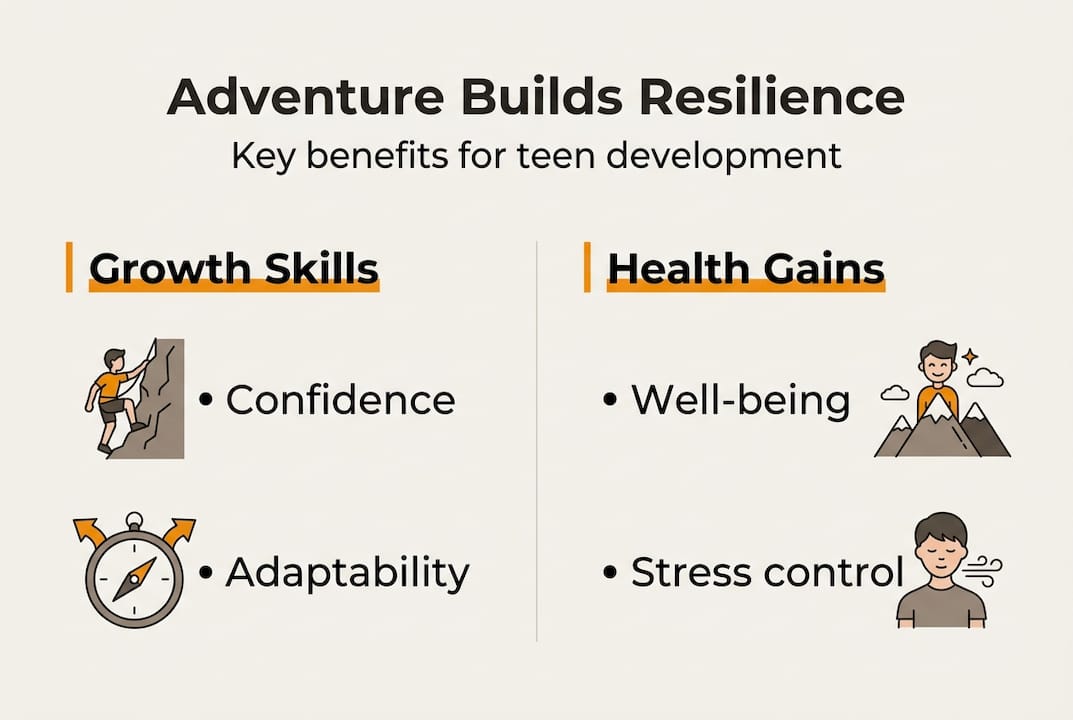
Mentorship multiplies every one of these gains. When a trained adult guide is present to debrief the experience, ask the right questions, and encourage reflection, teens internalize lessons far more deeply. Small groups amplify this further because peers witness each other’s courage and growth.
Risky outdoor play in residential adventure trips has been shown to increase both teen well-being and resilience in ways that controlled, risk-free environments simply cannot replicate. The discomfort is part of the design.
Parents can learn more about this process through resources on how adventure builds confidence and understanding adventure education before committing to a program.
Pro Tip: Look for programs that layer difficulty progressively over the course of the camp. A single challenging day produces a memory. A week of escalating challenges produces a transformed mindset.
Edge cases: When does adventure do the most good?
Building on the foundations of growth, it is crucial to know when and how adventure programs produce the best results. Not every outdoor experience delivers the same outcome.
One-off adventures rarely produce lasting change. A single ropes course on a school field day is exciting, but it does not rewire resilience. Frequent, progressive exposure is what drives real development. Overprotection, ironically, is one of the biggest barriers. When programs remove all risk, teens never get the chance to discover what they are capable of. They leave feeling entertained, not transformed.
The balance between good stress and social support is everything. A teen pushed too hard without mentorship can shut down. A teen coddled without real challenge never grows. The sweet spot is a structured environment where risk is real but managed, and where a trusted adult is close enough to support but far enough to let the teen work through it.
Here are warning signs that a camp may not deliver meaningful growth:
- Activities are entirely optional with no encouragement to stretch
- No structured reflection or debriefing after challenges
- Staff lack formal training in youth development or outdoor education
- Group sizes are too large for individual mentorship
- The program has no progression of difficulty across the session
Camps that teach accountability naturally through their structure tend to avoid all five of these pitfalls. They build responsibility into the daily rhythm rather than lecturing teens about it.
Pro Tip: Before enrolling, ask the program director: “How does challenge increase over the course of the session?” If they cannot answer clearly, that tells you something important.
Adventure camps in practice: What to expect and how to choose
Equipped with a sense of what works best, let’s translate theory into action by examining what makes a camp effective.
The strongest adventure camps share three core features: small-group mentorship that allows for individual attention, a progressive challenge structure that builds week by week, and a genuine focus on skill development rather than just activity completion. These are not marketing claims. They are the variables that research consistently links to outcomes.
A confidence-building curriculum in adventure camps resulted in 80% of participants reporting meaningful skill gains, with 90% recommending the program to peers. A scoping review of 40 studies conducted between 2015 and 2025 confirmed consistent positive associations between adventure education and resilience, confidence, and well-being across age groups.
| Program type | Resilience gains | Confidence gains | Social-emotional growth |
|---|---|---|---|
| Adventure camp | High | High | High |
| Traditional camp | Moderate | Moderate | Moderate |
| Service/academic program | Low to moderate | Low | Moderate |
When evaluating a camp, focus on these questions:
- How are staff trained in both outdoor skills and youth development?
- What is the approach to risk: managed, eliminated, or ignored?
- Are debriefs and reflections built into the daily schedule?
- How does the program handle a teen who wants to quit a challenge?
- What outcomes do past participants and families report?
Camps that focus on international camp outcomes often add the benefit of cross-cultural exposure, which deepens social skills further. Programs that encourage new experiences and build non-competitive team spirit tend to produce teens who are more open, more collaborative, and more self-aware by the end of the session.
Why conventional wisdom about teen adventure is incomplete
Most parenting advice frames adventure as a nice-to-have, something to consider once academics are covered. We think that framing gets it backwards.
The real risk is not a scraped knee on a mountain trail. The real risk is raising a teenager who has never been allowed to fail in a safe environment, who has never had to push through fear with a mentor watching, who reaches adulthood without the internal resources to handle setbacks. That is the outcome overprotection actually produces.
We have seen it repeatedly: teens who arrive at camp reluctant, even resistant, and leave with a fundamentally different relationship to challenge. Not because something dramatic happened, but because they were given the space to struggle and the support to get through it. The impact of outdoor activities on teen development is not a side effect of adventure. It is the entire point.
Most guides underestimate how much teens need failure, discomfort, and recovery in a mentored setting. Safety without challenge does not prepare teens for life. It just delays the moment when life asks something of them and they do not know how to respond.
Finding the right adventure program for your teen
You now have the research, the framework, and the questions to ask. The next step is finding a program that actually puts all of this into practice.

At Young Explorers Club, we run Swiss teen summer camps built around exactly the principles this article describes: progressive challenge, small-group mentorship, structured reflection, and activities designed to build real confidence. Our international summer camps bring together teens from around the world in the Swiss Alps for an experience that goes far beyond a typical vacation. We also offer custom group camps for schools and organizations looking for evidence-based outdoor development programs. Reach out to our team with your questions about structure, approach, and outcomes. We are happy to walk you through exactly what your teen can expect.
Frequently asked questions
What types of adventure activities help teens develop most?
Outcomes are strongest with activities that combine novelty, manageable risk, and small-group mentorship. Type 2 challenging fun like ropes courses, orienteering, and multi-day expeditions consistently produces the most meaningful results.
How does outdoor adventure improve teen confidence and resilience?
Adventure challenges push teens beyond their comfort zones, and when supported by mentors and structured debriefs, those experiences translate into lasting self-confidence and adaptability. 80% of participants in adventure-oriented confidence programs reported meaningful skill gains.
Is there a risk that adventure camps are too dangerous or stressful?
Well-run programs use a “Challenge by Choice” model, where risks are real but managed, ensuring teens grow without being pushed past their capacity to cope.
How many sessions or exposures are needed for teens to benefit?
Single events create memories, but repeated, progressive exposure across a camp session or multiple programs produces the strongest and most lasting gains in resilience and confidence.
What questions should I ask before choosing an adventure camp?
Ask about staff training, risk management philosophy, mentorship ratios, how challenge is structured across the program, and what reflection practices are built in. Well-designed programs prioritize all five of these elements consistently.