

TL;DR:
- Personal development for youth emphasizes building strengths, such as confidence and social skills, using frameworks like the Five Cs. Engaging in structured programs with supportive adults and peer collaboration fosters resilience and emotional regulation essential for lifelong success. Creating consistent environments and mentorship relationships significantly enhances young people’s capacity to thrive, beyond mere participation in activities.
Personal development for youth is defined as a strengths-based process that builds competencies, confidence, and social skills young people need to thrive across every stage of life. The field’s most widely used framework, Positive Youth Development (PYD), shifts the focus from fixing problems to building on what young people already do well. The Five Cs model, covering Confidence, Character, Connection, Contribution, and Competence, gives parents and educators a concrete map of the outcomes worth pursuing. Understanding this framework is not just reassuring. It is the first step toward choosing programs, activities, and environments that actually move the needle for the young people in your care.
What is personal development for youth?
Personal development for youth is the deliberate process of building the internal capacities and external supports that allow young people to grow into capable, connected, and purposeful adults. The Five Cs framework — Confidence, Character, Connection, Contribution, and Competence — is the most widely cited outcome model in youth development research. Each “C” represents a domain of growth that reinforces the others. A teen who builds competence through a new skill gains confidence, which strengthens their connection to peers and mentors.
USAID’s PYD framework adds a fourth structural dimension by organizing youth development into Assets, Agency, Contribution, and Enabling Environment. This model shifts focus from problems to protective factors, recognizing that youth thrive when their strengths are activated alongside supportive relationships and communities. The practical implication for parents and educators is clear: the environment you create matters as much as the activities you choose.
Youth development skills include self-efficacy, emotional regulation, communication, problem-solving, and the ability to collaborate under pressure. These are not soft extras. They are the competencies that predict academic persistence, career readiness, and mental health resilience across adolescence and into adulthood.
What key competencies define youth development skills?
The competencies at the center of youth personal growth fall into three broad categories: intrapersonal skills, interpersonal skills, and civic engagement capacities. Each category builds on the last, and none develops in isolation.
Intrapersonal skills include self-efficacy, emotional intelligence, and autonomy. Self-efficacy is a young person’s belief that their effort produces results. Teens with high self-efficacy attempt harder challenges, recover faster from setbacks, and report higher well-being. Emotional intelligence covers recognizing, labeling, and managing emotions in real time, a skill that directly reduces anxiety and impulsive behavior.
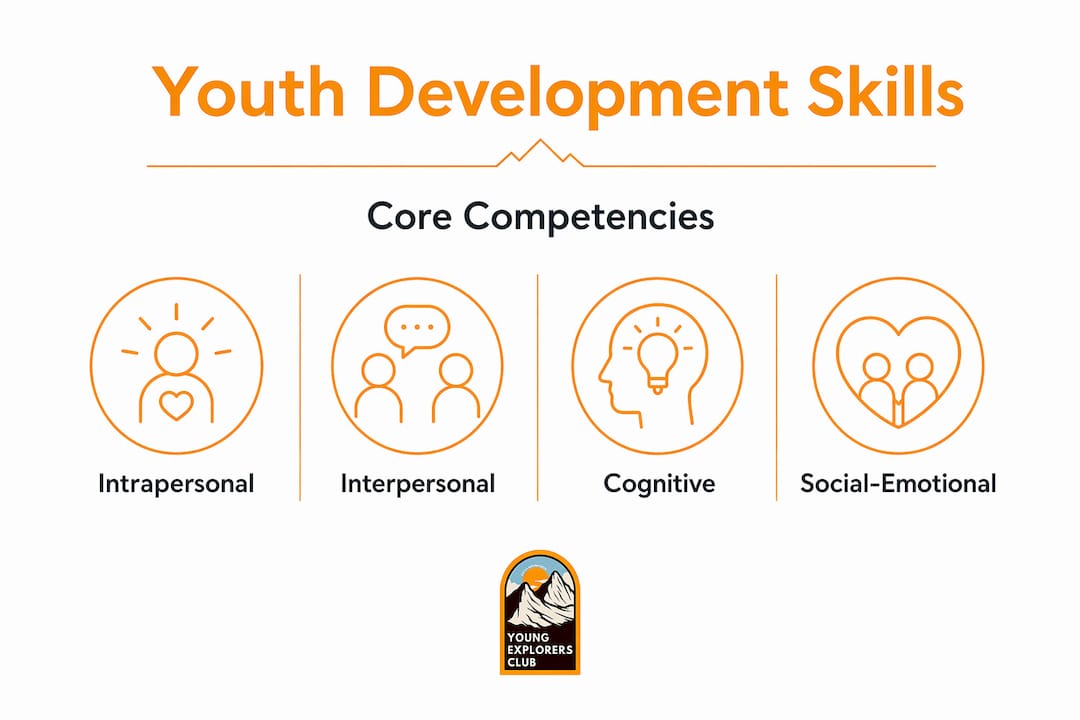
Interpersonal skills cover communication, active listening, conflict resolution, and collaboration. These are the competencies that make teamwork possible. A teen who can listen without interrupting and disagree without shutting down is far better prepared for group projects, team sports, and eventually, professional environments.
Civic engagement capacities include contribution and connection, two of the Five Cs. When young people feel they belong to something larger than themselves, whether a sports team, a community project, or a school club, their motivation and resilience increase measurably.
- Self-efficacy: the belief that personal effort leads to real outcomes
- Emotional regulation: managing feelings without suppressing them
- Communication: expressing ideas clearly and listening actively
- Collaboration: working toward shared goals with peers and adults
- Contribution: taking meaningful roles in family, school, or community
Pro Tip: When evaluating a youth program, ask specifically which competencies it targets and how it measures progress. Programs that cannot answer this question are likely relying on motivation alone, which research shows does not sustain development over time.
Social-emotional learning (SEL), as practiced in schools through frameworks like the Collaborative for Academic, Social, and Emotional Learning (CASEL), operationalizes many of these competencies in classroom settings. The adventure activities for teens offered through outdoor programs complement SEL by giving youth a physical, real-stakes environment to practice these skills.
How do evidence-based programs support youth personal development?
Research on personal development programs for teens consistently points to the same design principles: structured skill practice, supportive adults, and group formats that create genuine peer connection. Programs that check all three boxes produce measurable improvements in mental health and resilience.
The WHO and UNICEF’s EASE program (Early Adolescent Skills for Emotions) is one of the most rigorously designed interventions available. It targets 10 to 15-year-olds experiencing distress and is delivered through 80 hours of helper training alongside caregiver involvement. The program’s structure reflects a core truth: you cannot train emotional skills in a single session. Depth and repetition are required.
A systematic review and meta-analysis of strength-based capacity-building interventions found that short-term resilience improvements are achievable when programs are delivered in schools or group settings with psychoeducation and cognitive training components. The key qualifier is fidelity. Programs that cut corners on structure or skip caregiver involvement see weaker results. This is not a minor footnote. It is the difference between a program that changes behavior and one that produces a good week.
“Programs structured around interpersonal growth and positive development create meaningful changes.” — Positive Youth Development Group Intervention Study
The table below summarizes three major evidence-based frameworks and what each prioritizes:
| Framework | Core focus | Best setting |
|---|---|---|
| Positive Youth Development (PYD) | Five Cs: Confidence, Character, Connection, Contribution, Competence | Schools, community programs, camps |
| USAID PYD Model | Assets, Agency, Contribution, Enabling Environment | Community and international development contexts |
| WHO/UNICEF EASE | Emotional skills for distressed early adolescents | Group delivery with trained helpers and caregivers |
The experiential learning approach used in adventure-based programs aligns closely with PYD principles by combining structured skill practice with real-world challenge and adult mentorship.
What role do social connections play in youth personal growth?
Social support is not a background condition for youth development. It is one of its most powerful active ingredients. A 2026 study of 2,002 adolescents in urban high schools found that higher social support is significantly linked to lower trauma symptoms, depression, anxiety, and alcohol use. The sense of community a young person feels in a group setting directly reduces anxiety. That finding carries real weight for how parents and educators design daily environments.
Mentorship is the most direct way to build that social support. The Cornell/JRA study found that consistent mentor meetings correlate with teens feeling purposeful on a day-to-day basis, not just after a motivational event. Purpose stability, in turn, links to higher self-esteem and well-being. This means a weekly check-in with a trusted adult is more valuable than an annual leadership retreat.
Here is how parents and educators can build enabling environments that strengthen social connection:
- Create recurring touchpoints. Weekly one-on-one time between a teen and a trusted adult, whether a parent, coach, or teacher, builds the relational consistency that sustains purpose.
- Choose group programs intentionally. Programs that use peer-to-peer formats, where teens work through challenges together, build interpersonal skills that solo activities cannot replicate.
- Normalize belonging. Teens who feel they are a valued part of a group, a sports team, a camp cohort, or a school club, show stronger resilience when facing individual setbacks.
- Involve caregivers in skill-building. Programs like EASE explicitly include caregiver components because parental reinforcement at home multiplies the impact of group training.
- Reduce isolation after difficult experiences. Social support moderates the impact of trauma on mental health outcomes. Keeping a struggling teen connected to peers and mentors is a clinical-grade protective factor.
Pro Tip: If a teen resists group activities, start with a structured skill-based program rather than an open social setting. Competence builds confidence, and confidence makes social connection feel safe rather than threatening.
How can parents and educators practically foster personal development?
The importance of personal development becomes concrete when you move from frameworks to daily decisions. The most effective personal growth strategies for youth combine structured skill-building, adult mentorship, and enough agency for teens to feel ownership over their development.

Selecting the right program is the highest-leverage decision a parent or educator can make. High-quality personal development programs for teens include three non-negotiable components: youth agency and skill-building activities, structured practice opportunities, and supportive enabling environments with consistent adult mentors. Programs that offer only inspiration or motivation, without structured practice and relational support, produce short-term enthusiasm and little lasting change.
The comparison below helps parents and educators distinguish between program types:
| Program type | Strengths | Limitations |
|---|---|---|
| Adventure and outdoor camps | Builds resilience, teamwork, and confidence through real challenge | Requires follow-up to sustain gains after the program ends |
| School-based SEL programs | Reaches all students; integrates with academic goals | Varies widely in quality and fidelity of delivery |
| One-time motivational events | High energy and initial inspiration | Research shows minimal long-term impact without follow-up |
| Ongoing mentorship programs | Sustains purpose and self-esteem over time | Requires consistent adult commitment and matching quality |
- Look for programs that name specific competencies they build, not just general “confidence” or “leadership.”
- Prioritize programs with trained, consistent adult mentors rather than rotating staff.
- Choose formats that include peer collaboration, not just individual achievement.
- Ask whether caregivers are involved in reinforcing skills at home.
- Favor ongoing engagement over single-event participation.
The personal development activities guide from Youngexplorersclub offers a practical starting point for parents looking to match specific activities to development goals. For teens ready for an immersive experience, teen camp programs that combine outdoor challenge with peer collaboration and skilled mentorship represent one of the most evidence-aligned formats available.
Key takeaways
Personal development for youth requires structured skill-building, consistent mentorship, and enabling social environments working together — no single element produces lasting growth alone.
| Point | Details |
|---|---|
| Five Cs framework | Confidence, Character, Connection, Contribution, and Competence are the core outcomes of effective youth development. |
| Social support is protective | Higher social support directly reduces anxiety, depression, and trauma symptoms in adolescents. |
| Ongoing purpose beats one-time inspiration | Consistent mentor engagement sustains day-to-day purpose and self-esteem far better than single events. |
| Program quality markers | Look for youth agency, structured practice, and supportive adults — not motivation alone. |
| Environment shapes outcomes | The enabling environment a parent or educator creates is as important as the activities they choose. |
Why I think we underestimate the environment
After working closely with youth development programs for years, the pattern I keep seeing is this: parents and educators invest heavily in finding the right activity and almost nothing in designing the right environment around it. A teen can attend the best adventure camp in Switzerland and return home to a setting with no follow-up, no mentor, and no peer group that shares the experience. Within three weeks, the gains are largely gone.
The research backs this up. Strength-based interventions show short-term resilience gains when delivered with fidelity, but those gains require an environment that reinforces them. The USAID model is explicit: the enabling environment is one of the four core domains, not an afterthought. Yet most program evaluations focus entirely on the activity content.
What I find most underused is the mentor relationship. Not a formal counselor or a once-a-year advisor. A consistent adult who shows up weekly, asks real questions, and reflects purpose back to the teen. The Cornell/JRA research on purpose stability is some of the most practically useful data in this field, and most parents have never heard of it. If you take one thing from this article, make it this: find your teen a consistent mentor and protect that relationship like it matters. Because it does.
— Guillem
Build real skills through adventure at Youngexplorersclub
Youngexplorersclub runs an international summer camp program in Switzerland designed around exactly the principles this article describes: structured skill-building, consistent adult mentorship, and peer collaboration through real outdoor challenge. Activities like mountain biking, climbing, survival skills, and multisport adventures are not just fun. They are the practical arena where confidence, teamwork, and resilience get built and tested.
The program operates in a bilingual English and French environment, adding a language development layer to the personal growth experience. Whether you are a parent looking for a summer program or an educator seeking a model for experiential learning, Youngexplorersclub offers a format grounded in the same evidence-based principles covered here. Visit Youngexplorersclub to explore camp options, download the brochure, and find the right program for your teen.


