

How to choose the best multisport camp for kids
Learn how to choose the best multisport camp for your child with this step-by-step guide covering adventure, bilingual immersion, safety, and experiential learning.
TL;DR:
- Choose camps aligned with your child’s goals, age, and personality for meaningful growth.
- Prioritize programs with structured skill progression, certified staff, and emphasis on reflection.
- Ensure safety protocols and support systems are in place for a positive, risk-aware experience.
Scrolling through dozens of camp websites at midnight, comparing prices, activity lists, and vague promises of “personal growth” is a frustrating experience most parents know too well. You want something real: a program that gets your child outdoors, builds genuine confidence, and maybe even sharpens their French or English along the way. The good news is that finding the right multisport camp does not have to feel like guesswork. This guide walks you through a clear, step-by-step process to match your child’s personality, readiness, and goals with a camp that actually delivers on its promises.
Table of Contents
- Clarify your goals and your child’s readiness
- Evaluate adventure and experiential learning features
- Prioritize language immersion and cultural exchange
- Check safety, staff quality, and support systems
- A fresh perspective: Why experiential camps transform more than summer
- Discover more with Young Explorers Club Switzerland
- Frequently asked questions
Key Takeaways
| Point | Details |
|---|---|
| Know your child’s needs | Tailor your camp search to your child’s readiness, interests, and independence level. |
| Vet adventure and learning | Look for camps with proven outdoor skill programs and experiential reflection practices. |
| Insist on bilingual immersion | Prioritize camps offering true English/French language integration and cultural exchange. |
| Demand safety and support | Ask about staff training, safety records, and camper support systems for peace of mind. |
| Transformation over price | The greatest value lies in the growth and confidence your child brings home, not just the camp’s cost. |
Clarify your goals and your child’s readiness
Once you recognize how daunting camp selection can be, the first crucial step is to reflect on your family’s goals and your child’s comfort level. Before you compare any programs, get specific about what you actually want this summer to accomplish.
Most parents are looking for some combination of the following:
- Outdoor adventure and physical challenge (hiking, climbing, mountain biking)
- Language improvement, especially in a bilingual English/French setting
- Personal growth, including resilience, independence, and decision-making
- Social skills and the ability to connect with kids from other cultures
Once you have your priorities ranked, the next question is whether your child is ready for the type of camp you have in mind. Age and temperament matter enormously here. First-time campers start with intro levels, younger children aged 8 to 10 tend to thrive in day camp settings, while teens aged 15 to 17 are often ready for counselor-in-training programs. Allergy policies, homesickness protocols, and weather contingency plans should also factor into your decision early.
Session length is another practical filter. Day camps typically run $300 to $700 per week and are ideal for younger or first-time campers who benefit from returning home each evening. Overnight camps, which range from one to four weeks, tend to cost more but offer a deeper immersive experience. The longer your child is away, the more independence they build, but the more important it becomes that the camp has strong emotional support structures in place.
Temperament matters just as much as age. A shy 12-year-old may need a smaller, more structured camp before jumping into a large international program. A confident 10-year-old who already loves the outdoors might be ready for something more challenging. Reading about encouraging kids to try new things can help you gauge where your child sits on that spectrum.
Pro Tip: Ask any camp you are considering to share a sample daily schedule. A well-structured day that balances activity, reflection, and free time tells you far more about a camp’s philosophy than any brochure ever will.
Evaluate adventure and experiential learning features
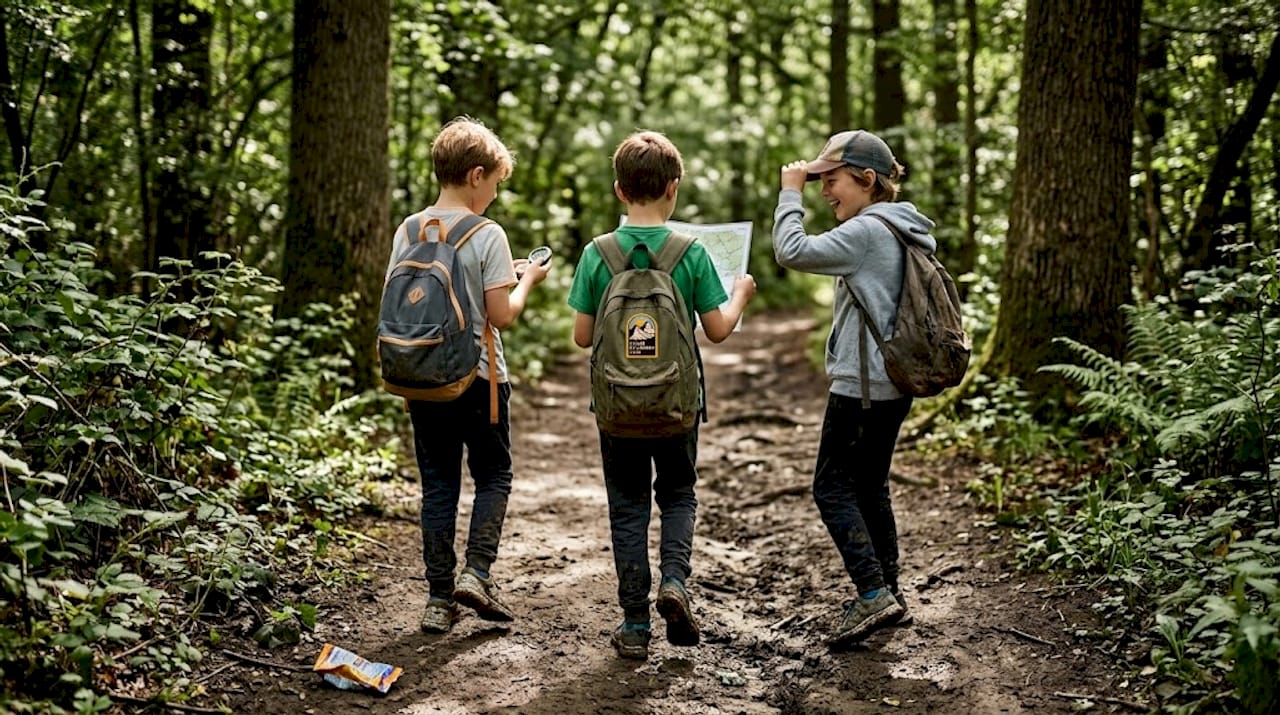
With your goals in mind, you can now zero in on the adventure and learning ingredients that turn a summer into a life-changing experience. Not all “adventure camps” are created equal. Some offer a menu of activities with no real skill progression. Others build campers from beginner to confident outdoor athlete over the course of a session.
Here is a quick comparison of what separates surface-level adventure from genuine experiential learning:
| Feature | Basic activity camp | Experiential learning camp |
|---|---|---|
| Activity variety | Wide but shallow | Focused with skill tiers |
| Instructor credentials | General staff | Certified outdoor educators |
| Daily debrief | Rare or informal | Structured reflection sessions |
| Skill progression | None tracked | Clear beginner to advanced path |
| Parent communication | Weekly updates | Detailed progress reports |
For outdoor multisport camps, prioritize programs with adventure elements like canoeing, hiking, and climbing in natural settings, and always request specific itineraries and skill progression frameworks before committing.
Here is a simple process to vet any camp’s adventure offerings:
- Request the daily itinerary for a typical week, not just a highlight reel.
- Ask about instructor certifications in activities like rock climbing, kayaking, or mountain biking.
- Find out how debrief sessions work. Do counselors guide kids to reflect on what they learned, or does the day just end?
- Check for skill tiers. Can your child advance from beginner to intermediate during their session?
- Look at the adventure camp activities guide to understand what a well-rounded program looks like in practice.
Advanced adventure programs, especially those combining multiple outdoor disciplines, typically run $1,500 to $4,000 per week. That price range reflects real infrastructure: certified staff, quality equipment, and safety systems. The benefits of adventure camps go well beyond physical fitness, touching on emotional regulation, risk assessment, and teamwork that kids carry into school and adult life.
Pro Tip: Camps that are serious about experiential learning will openly share their skill-building frameworks. If a camp cannot explain how a child progresses, that is a red flag worth taking seriously.
Prioritize language immersion and cultural exchange
Beyond adventure, many parents seek camps that double as language accelerators and cultural gateways. A bilingual camp done well does not feel like school. It feels like life, where English and French are simply the tools kids use to make friends, solve problems, and navigate their day.
Here is how leading bilingual camps typically structure immersion:
| Camp type | Language approach | Key activities | Age range |
|---|---|---|---|
| Residential bilingual | Full immersion, bilingual staff | Outdoor sports, evening programs | 10 to 17 |
| Day camp bilingual | Structured language blocks | Multisport, arts, team games | 8 to 14 |
| Travel camp | Immersion through experience | Hiking, cultural visits | 12 to 17 |
Bilingual English/French multisport camps like YMCA Kanawana and Camp Ouareau combine canoe trips, teamwork activities, and bilingual staff to create natural, pressure-free language learning for kids aged 8 to 17.
When evaluating any bilingual program, ask these specific questions:
- What percentage of staff are fluent in both languages?
- How is language use structured during activities versus free time?
- Are there formal language sessions, or is it purely immersive?
- How do they support kids who are stronger in one language?
- What cultural exchange activities go beyond just speaking a second language?
Cultural exchange at the best camps is woven into everything, from cooking traditions to evening storytelling to collaborative problem-solving with kids from different countries. Understanding the multisport camp benefits helps frame why this combination of language and outdoor activity is so powerful for development. For families looking at variety across disciplines, multi-sport camps for young athletes offer structured pathways that keep kids engaged across the full session.
Check safety, staff quality, and support systems
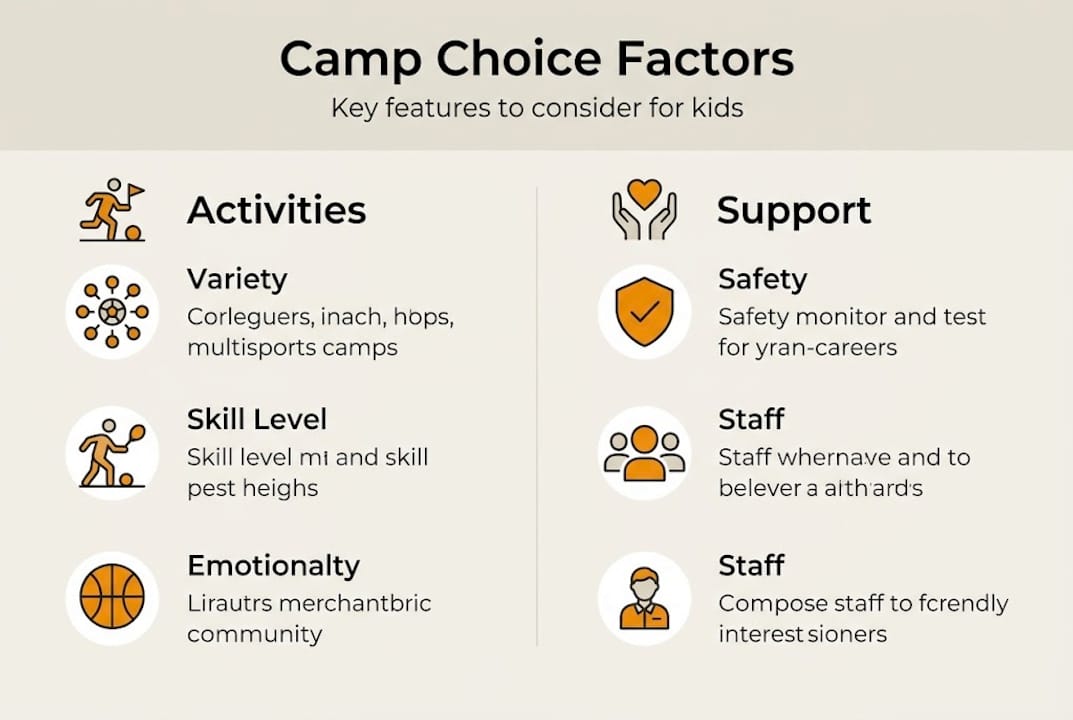
With enriching activities and language opportunities noted, you will want to make sure the camp continually puts your child’s well-being first. Safety is not just about emergency procedures. It is about the daily culture of care that experienced staff create.
Here are the key questions to ask every camp you are seriously considering:
- What are the staff-to-camper ratios for different activities?
- What certifications do activity instructors hold (first aid, wilderness training, lifeguard)?
- How are allergies managed, including cross-contamination in meal preparation?
- What is the protocol for a camper who is struggling emotionally or feeling homesick?
- How does the camp handle severe weather or activity cancellations?
- What is the communication plan if something goes wrong?
“ACA-accredited camps report injury rates of 575 per 100,000 camper days, with parent satisfaction consistently tied to staff quality, activity variety, and confidence-building outcomes.”
Those numbers put risk in perspective. Well-run camps are statistically very safe, but the difference between a good and great camp often comes down to staff. Counselors who genuinely invest in each camper’s growth, who notice when a kid is struggling and step in with warmth rather than pressure, are the real engine of transformation. Look at mountain sports camp growth to see how structured outdoor challenges, when led by skilled staff, build the kind of resilience that lasts far beyond summer.
For a broader look at how outdoor programs approach risk management, the safety tips for outdoor camps resource is a practical starting point for parents new to evaluating these programs.
A fresh perspective: Why experiential camps transform more than summer
Having broken down the tactical steps, let us pull back and look at what truly matters in the bigger journey. There is a widespread assumption that the most expensive camp, or the one with the most impressive activity list, will produce the best outcomes. In our experience, that is simply not true.
The camps that change kids are the ones where counselors slow things down long enough for campers to actually notice what they just did. A child who summits a ridge and immediately runs to the next activity learns far less than one who sits for ten minutes and talks about what was hard, what surprised them, and what they would do differently. That reflection practice is where real growth happens. It is also where language learning accelerates, because kids are processing genuine emotion in a second language.
Skill-building and independence are often more impactful than any single sport or language result. A teen who learns to manage frustration on a difficult climb carries that skill into every classroom and relationship afterward. Look for outdoor activities for growth that are designed with this kind of intentional reflection built in.
Pro Tip: Ask camps how counselors are trained to facilitate reflection. If the answer is vague, the camp may be strong on adventure but weak on the learning part.
Price is a poor proxy for quality. A mid-range program with deeply trained staff and a clear developmental philosophy will outperform an expensive camp that prioritizes Instagram-worthy moments every time.
Discover more with Young Explorers Club Switzerland
Ready to turn insight into action? The next step is finding a program that checks all the boxes you have just mapped out.
Young Explorers Club offers international summer camps in Switzerland built around exactly what this guide describes: bilingual adventure, experiential learning, certified outdoor staff, and a genuine culture of growth. Whether your child is drawn to climbing, survival skills, or multisport challenges, our programs are designed to stretch comfort zones safely. Explore our global camp community to see how kids from around the world come together each summer, or check out our German language camps if you want to add a third language to the mix.
Frequently asked questions
How much do adventure-based multisport camps typically cost?
Adventure-based multisport camps generally cost between $1,500 and $4,000 per week depending on activities, location, and camp reputation. Programs that include backcountry treks or kayaking tend to sit at the higher end of that range.
What is the best age for day camps vs. overnight camps?
Day camps suit ages 8 to 10 for readiness and comfort, while overnight camps are best for older or more independent kids aged 11 and up. First-time campers of any age often benefit from starting with a shorter day camp session.
How can I verify a camp’s safety and staff qualifications?
Check for staff certifications, emergency protocols, low camper-to-counselor ratios, and clear safety statistics. ACA camps report injury rates of 575 per 100,000 camper days, which gives you a useful benchmark for comparison.
How is bilingual immersion implemented at top camps?
Leading camps use daily routines, activities, and staff fluent in both languages to create natural immersion. Programs like YMCA Kanawana and Camp Ouareau combine canoe trips, teamwork, and bilingual staff for immersive, pressure-free language learning.
What support exists for campers with allergies or homesickness?
Most camps provide allergy and homesickness protocols including allergy-safe diets, emergency contacts, and weather contingency plans. Ask specifically how staff are trained to recognize and respond to emotional distress early in a session.
