

Outdoor leadership explained: building skills & confidence
Discover how outdoor leadership programs build confidence, teamwork, and resilience in children aged 8-17 through adventure-based summer camps in Switzerland.
TL;DR:
- Outdoor leadership programs teach kids critical skills like communication, decision-making, and emotional regulation through experiential activities.
- Structured reflection and gradual challenges are essential for lasting leadership development beyond just fun outdoor experiences.
- Longer, diverse, and intentionally designed camps produce the most significant growth in youth leadership and confidence.
Youth who spend time in structured outdoor programs show greater gains in self-management, social skills, and confidence than peers in traditional settings. That single fact should shift how you think about summer camp. Most parents picture campfires and canoe races. But the best adventure-based programs are doing something far more intentional: they are teaching kids to lead, communicate under pressure, and recover from setbacks in ways that no classroom can replicate. If you have a child between 8 and 17, understanding what outdoor leadership really means could be the most valuable research you do this year.
Table of Contents
- What is outdoor leadership?
- Core benefits of outdoor leadership for youth
- How summer camps build outdoor leadership
- Challenges and what parents should look for
- A fresh perspective: Beyond recreation, real leadership for kids
- Explore adventure-based camps for outdoor leadership
- Frequently asked questions
Key Takeaways
| Point | Details |
|---|---|
| Outdoor leadership defined | It means guiding kids through challenging outdoor activities to build skills, confidence, and character. |
| Benefits are research-backed | Studies show youth gain self-management, social skills, and leadership confidence from these programs. |
| Camp structure matters | Leadership development needs structured reflection and follow-up, not just fun and games. |
| Choosing the right camp | Parents should seek camps with intentional leadership focus and sustained engagement. |
| Skills transfer to life | With the right approach, outdoor leadership helps kids thrive in school and daily challenges. |
What is outdoor leadership?
Now that you’ve seen the impact, let’s unpack what outdoor leadership means and why it’s more than just guided outdoor fun.
Outdoor leadership is the practice of guiding groups through outdoor activities to develop technical skills, leadership abilities, and environmental ethics. That definition matters because it separates outdoor leadership from simple recreation. A recreational camp keeps kids busy and safe. An outdoor leadership program uses the environment as a deliberate teaching tool.
Think of it this way: when a group of twelve-year-olds has to navigate a trail together, someone needs to read the map, someone needs to manage the pace, and someone needs to notice when a teammate is struggling. Those are real leadership moments. They happen naturally outdoors in ways that a classroom exercise simply cannot manufacture.
The core skills that outdoor leadership programs target include:
- Communication: expressing ideas clearly under physical and emotional stress
- Decision-making: weighing options quickly with incomplete information
- Risk management: identifying hazards and making safe group choices
- Environmental ethics: respecting natural spaces and understanding sustainability
- Emotional regulation: staying calm when conditions change unexpectedly
Typical activities that build these skills include hiking, rock climbing, camping, canoeing, mountain biking, and survival challenges. Each activity is chosen because it creates natural pressure points where leadership instincts emerge and can be coached in real time.
“The outdoors is not a backdrop for leadership training. It is the teacher itself. Challenge, consequence, and community are built into every trail and summit.”
The difference between a recreational outing and a leadership development experience comes down to intentionality. A well-designed program structures each activity with clear learning goals, guided group reflection afterward, and progressive challenges that build on previous sessions. You can explore some of the top outdoor activities that accomplish exactly this kind of layered development.
Outdoor leadership is also deeply social. Kids learn to read group dynamics, support teammates who are afraid or frustrated, and celebrate shared success. These are the foundations of emotional intelligence, and they are far easier to develop when the stakes feel real, even if they are managed and safe.
Core benefits of outdoor leadership for youth
Having defined outdoor leadership, let’s examine how it tangibly benefits youth in these programs.
Empirical data shows youth in outdoor programs have greater gains in self-management, social skills, and academic confidence compared to peers who do not participate. Those are not soft, feel-good outcomes. They are measurable shifts in how young people handle challenge, relate to others, and believe in their own ability.
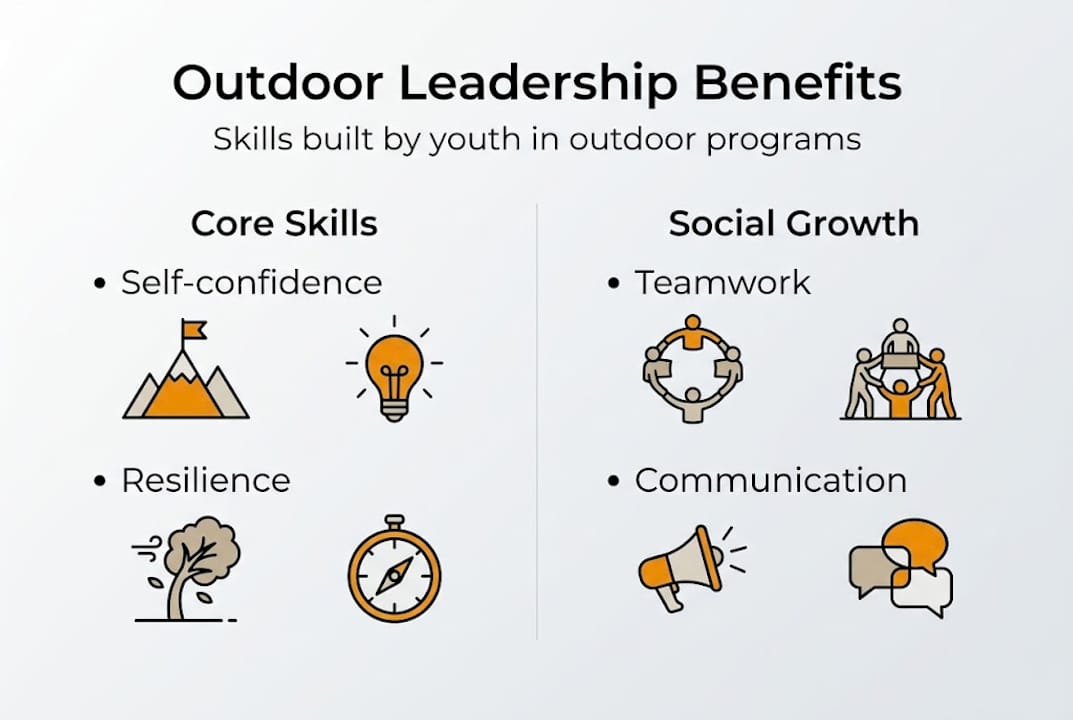
Here is a summary of the key benefits research consistently identifies:
| Benefit | What it looks like in practice |
|---|---|
| Self-confidence | Child volunteers for challenges, speaks up in groups |
| Resilience | Recovers from failure faster, tries again without prompting |
| Teamwork | Supports peers, shares responsibility, listens actively |
| Self-management | Manages frustration, follows through on commitments |
| Leadership identity | Sees themselves as capable of guiding others |
One of the most striking findings is how quickly these gains appear. Many programs report visible shifts within a single two-week session. Kids who arrived quiet and hesitant leave with a measurably different posture toward challenge.
The skills that grow fastest in outdoor settings include:
- Confidence under pressure: Completing a difficult climb or surviving a night outdoors creates a personal reference point that no certificate can replicate
- Social connection: Shared struggle builds trust between kids faster than almost any other experience
- Leadership in teens develops most strongly when teens are given real responsibility, not just participation trophies
Research on team challenges and resilience confirms that group problem-solving activities are particularly effective at building the kind of resilience that transfers to school and home life.
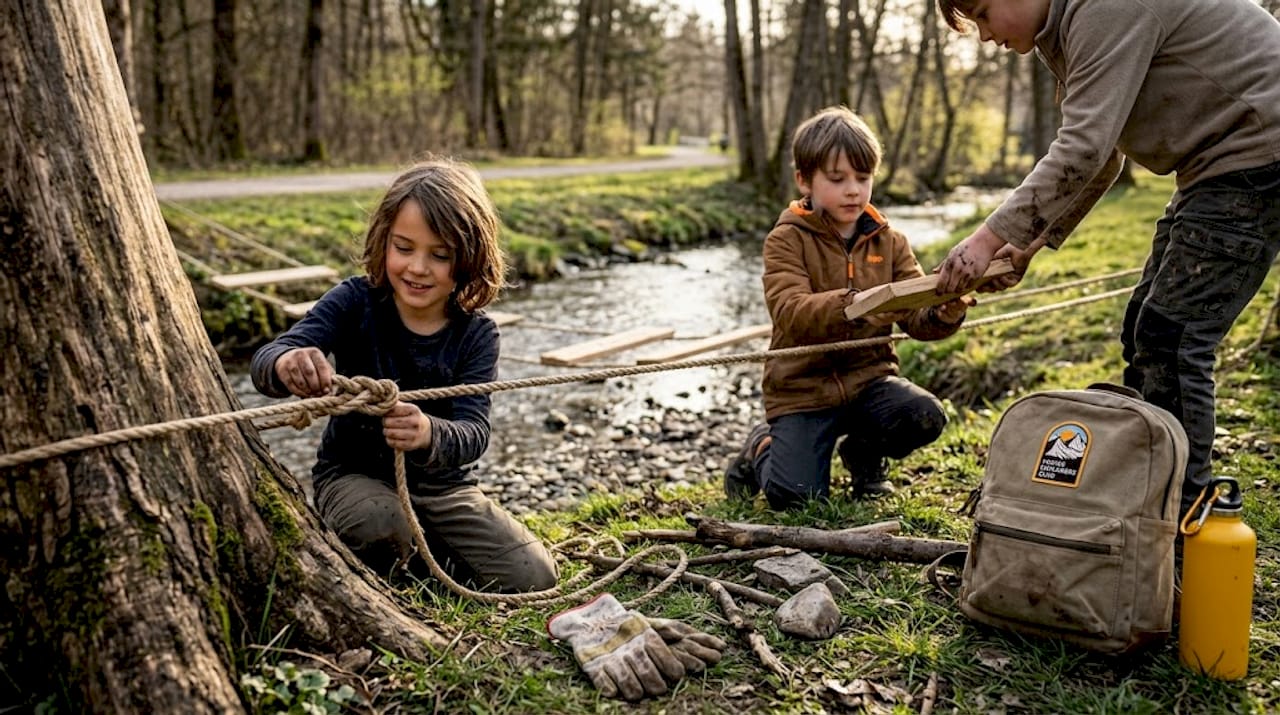
80% of youth in structured outdoor leadership programs report meaningful gains in confidence and leadership ability within a single program cycle. That number should make every parent pause.
The social dimension is equally important. When kids from different countries, backgrounds, and languages work together to solve a challenge, they develop a global perspective that is almost impossible to teach in a traditional setting. International and bilingual camps amplify these benefits significantly because the communication challenges are real, not simulated.
How summer camps build outdoor leadership
Understanding the benefits, let’s see how well-designed camps put those principles into action and truly develop leadership.
Not every camp that advertises outdoor activities actually builds leadership. The design of the program matters enormously. Sustained gains are most likely when programs include structured follow-up and reflection after each activity, not just the activity itself.
Here is a comparison of what separates a recreational camp from a leadership-focused one:
| Feature | Recreational camp | Leadership-focused camp |
|---|---|---|
| Activity goal | Fun and participation | Skill development and reflection |
| Debrief sessions | Rare or absent | Built into every activity |
| Progressive challenge | Optional | Intentionally sequenced |
| Peer responsibility | Minimal | Central to program design |
| International diversity | Uncommon | Actively encouraged |
The most effective teen leadership programs use a four-step cycle for every major activity:
- Brief: Set clear goals and expectations before the activity begins
- Challenge: Run the activity with real stakes and minimal adult intervention
- Reflect: Guide the group through a structured debrief to identify what worked and why
- Apply: Connect the lesson to real-life situations at school, home, or in future activities
Bilingual and international settings add another layer of leadership development. When a child must communicate a plan to a teammate who speaks a different language, they develop patience, creativity, and empathy at the same time. These are exactly the skills that custom camps and schools design their programs around.
Some camps lack leadership depth unless structured reflection is built into the program design. This is the single biggest gap between a camp that feels good and one that actually changes a child.
Pro Tip: Ask any camp director to describe their debrief process. If they cannot explain how they help kids reflect on what they learned after each activity, the program is likely recreational rather than developmental.
Challenges and what parents should look for
Despite the advantages, it’s crucial to address the real-world challenges and help parents choose camps with lasting impact.
The outdoor leadership space has a real quality problem. Many programs use the language of leadership and personal development in their marketing without delivering the structured experience that actually produces those outcomes. As a parent, you need to look past the brochure photography.
Research notes limited transfer to daily life without structured reflection, and recommends programs with long-term follow-up to ensure skills stick beyond the camp experience.
The most common pitfalls parents encounter include:
- Short sessions without follow-up: A three-day camp can be fun, but it rarely produces lasting leadership growth
- Activity-only programs: Camps that fill every hour with activities but never pause to help kids process what they learned
- No progressive challenge: Programs that repeat the same difficulty level rather than pushing kids further each session
- Homogeneous groups: Camps where every child comes from the same background, limiting the social complexity that drives real leadership growth
- Vague outcomes: Programs that cannot describe specific skills children will develop or how they measure progress
“The best indicator of a quality outdoor leadership program is not the list of activities. It’s the quality of the conversations that happen after those activities.”
When evaluating a program, ask specific questions. How do they handle a child who refuses a challenge? What does a typical debrief look like? How do they support accountability at camp and help kids carry lessons home?
Pro Tip: Request references from past participants’ families, not just testimonials on the website. A five-minute conversation with another parent will tell you more than any brochure.
The length of the program also matters. Two weeks is generally the minimum for meaningful leadership development. Longer residential programs that include language learning and international peer groups consistently produce the strongest outcomes.
A fresh perspective: Beyond recreation, real leadership for kids
Bringing all these threads together, here’s why true outdoor leadership goes far beyond traditional summer camp fun.
We have worked with hundreds of families over the years, and the pattern is consistent: parents who choose a camp based on activities alone are often disappointed. Parents who choose based on program design and reflection quality come back every year.
The uncomfortable truth is that most outdoor programs are recreational experiences with a leadership label attached. Real outdoor leadership is rare because it is hard to design and harder to deliver consistently. It requires trained facilitators, intentional sequencing, and a genuine commitment to each child’s growth rather than a smooth, comfortable experience.
What we believe most strongly is this: challenge is not a side effect of outdoor leadership. It is the point. A child who never struggles at camp never discovers what they are capable of. The adventure camp philosophy we follow is built on the conviction that managed discomfort, paired with skilled reflection, produces the kind of confidence that lasts long after summer ends.
The bilingual and international dimension amplifies this further. When your child navigates a real communication barrier with a peer from another country, they are practicing leadership in its most authentic form.
Explore adventure-based camps for outdoor leadership
If you’re ready to help your child grow as a leader, these adventure-based camps provide the next step.
At Young Explorers Club, we design every session around the principles covered in this article: progressive challenge, structured reflection, bilingual community, and genuine personal development. Our Switzerland summer camp brings together children from across the world in one of Europe’s most spectacular outdoor environments.
Whether your child is 8 or 17, our international camps offer the kind of leadership experience that recreational programs simply cannot match. For families interested in combining adventure with language learning, you can also explore options to learn German at camp as part of a full outdoor leadership program. Real growth happens when challenge, community, and reflection come together in the right environment.
Frequently asked questions
How does outdoor leadership differ from regular summer camp activities?
Outdoor leadership uses adventure and teamwork to teach communication, decision-making, and leadership, while regular camps typically focus on recreation and participation without structured developmental goals.
What age is best for developing outdoor leadership skills?
Children ages 8 to 17 benefit most, as these are the formative years when self-management and social skills develop most rapidly through structured challenge and peer interaction.
Do outdoor leadership programs work for both boys and girls?
Yes, both benefit significantly from outdoor leadership programs, though some studies suggest boys may show slightly greater gains in certain specific skill areas depending on program design.
What should parents look for in a camp that promises outdoor leadership?
Prioritize programs with proven debrief and reflection processes after each activity, since sustained gains depend on structured follow-up rather than activity volume alone.
Is outdoor leadership transferable to school and everyday life?
With structured reflection and sustained engagement, the skills developed outdoors can transfer to school, friendships, and future challenges, though limited transfer occurs without intentional follow-up built into the program.
Recommended
- Building Confidence Through Adventure Activities | Young Explorers Club Switzerland
- How Outdoor Sports Teach Kids Perseverance | Young Explorers Club Switzerland
- Custom Camps And Trips For Schools And Groups | Young Explorers Club Switzerland
- Helping Kids Build Confidence Through Adventure | Young Explorers Club Switzerland
- Camping & Angeln 2026: Der perfekte Outdoor-Mix mit dem Angelschein | Angelschein Online
