TL;DR:
- Personal development camps use evidence-based methods like the GROW coaching model, challenge calibration, and structured sessions to foster resilience and leadership in youth. Effective programs emphasize reflection, safe environments, and appropriate challenge levels for different ages, ensuring lasting behavioral change beyond the camp. The success of these strategies relies on skilled facilitation and post-camp follow-through to reinforce new skills and confidence.
Personal development camp strategies are structured, evidence-based methods that help children and teenagers aged 8–17 build resilience, leadership, and social competence through immersive outdoor experiences. Unlike classroom instruction, these approaches place youth in real environments where growth happens through doing, not listening. The most effective programs combine psychological frameworks like the GROW coaching model, tech-free analog challenges, and deliberate session design to produce lasting behavioral change. Understanding how these strategies work gives you the tools to choose or evaluate any camp with confidence.
What are the core frameworks behind personal development camps?
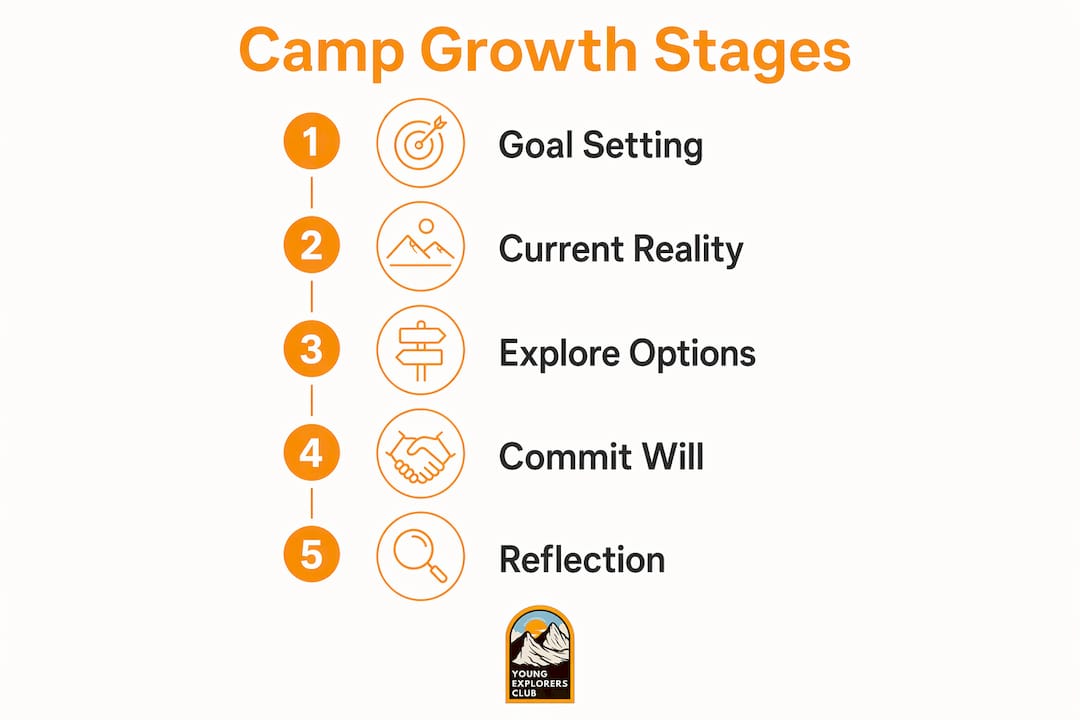
The GROW model is the most widely used coaching framework in youth camp settings. It guides campers through four stages: Goal, Reality, Options, and Will. The GROW model empowers campers to identify their own goals, explore available options, anticipate obstacles, and commit to specific actions. This approach builds ownership and critical thinking rather than dependence on adult direction.
Alongside GROW, the “stretch zone” model shapes how good camps calibrate challenge. Campers aged 8–17 grow most when they operate in a stretch zone balancing challenge and safety, which develops grit and social skills without triggering shutdown. Push a child too far and they freeze. Keep things too comfortable and nothing changes.
Tech-free design is not a gimmick. Removing technology entirely increases success in teaching practical competencies like budgeting and independent navigation among middle schoolers. Without screens, kids are forced to solve problems with the people around them, which is where real social development happens.
Session structure matters just as much as content. Research on 90-minute transformational workshops shows that splitting time among context-setting, grounding, challenge, insight, integration, and commitment produces specific, actionable outcomes. Participants leave with next steps they can actually use, not just a feeling of inspiration.
Here is a quick comparison of the two most common facilitation approaches used in personal growth workshop methods:
| Approach | Best For | Key Strength | Limitation |
|---|---|---|---|
| GROW Coaching Model | Leadership and goal-setting | Builds camper ownership | Requires trained facilitators |
| Experiential Challenge | Resilience and teamwork | Immediate, felt learning | Needs strong debrief structure |
Pro Tip: Ask any camp director how their staff are trained to facilitate reflection. A camp that trains counselors in questioning techniques rather than lecturing is operating at a significantly higher level.
How do you implement strategies that build resilience and independence?
Effective implementation starts with the environment. Psychological safety is the foundation. Campers will not take risks, admit confusion, or try unfamiliar behaviors unless they feel genuinely supported. Creating a safe space that acknowledges resistance is key for authentic development, because personal growth is non-linear and often uncomfortable.
Once the environment is set, the session flow determines everything. Follow these four stages for any group development activity:
- Grounding: Open with a brief physical or reflective activity that brings campers into the present moment. A two-minute breathing exercise or a simple check-in question works well for ages 8–12. Older teens respond better to journaling prompts. Youngexplorersclub uses journaling prompts for young campers as a regular grounding tool across age groups.
- Challenge: Introduce the core activity. Analog challenges like map-reading, group budgeting, or navigation tasks train the mental models that underlie real-world problem solving. Analog challenges like map-reading and budgeting build the independence and resilience that parents consistently report as the most visible post-camp gains.
- Reflection: This is where learning gets locked in. Facilitators ask open questions rather than explaining what just happened. Character is built by doing hard things together, and the debrief conversation is where frustration becomes insight.
- Commitment: Each camper names one specific thing they will do differently. This step transforms a good experience into a behavioral shift.
Observational learning also plays a major role. Peer modeling, where campers watch slightly older or more confident peers navigate challenges, reduces social anxiety and encourages participation. Positive reinforcement from counselors then creates a feedback loop that increases openness to future challenges.
Pro Tip: For children aged 8–11, keep challenge phases under 20 minutes. Attention and emotional regulation are still developing, and shorter cycles with more frequent reflection produce better results than long uninterrupted activities.

What mistakes undermine personal growth at camp?
The most common error in camp design is optimizing for performance rather than momentum. Performance-focused programming chases visible wins: photos, applause, and impressive activities. Momentum-focused programming asks a harder question: what will this child do differently next week? Designing for momentum rather than performance improves post-camp growth retention, and the difference lies in how clearly the program maps out post-camp next steps.
Watch out for these specific pitfalls:
- Telling instead of guiding. When counselors explain the lesson rather than asking questions, campers become passive. The goal is for each child to discover the insight themselves.
- Skipping the commitment stage. Ending a session with reflection but no specific commitment leaves growth at the feeling level. It does not translate into changed behavior.
- Ignoring emotional discomfort. Resistance and frustration are normal growth phases, not problems to solve. Camps that rush past discomfort miss the most important developmental moments.
- No post-camp follow-through plan. Clear, doable next steps post-camp are essential for sustaining behavior change beyond the camp environment. Without them, most gains fade within two weeks.
“Growth often feels uncomfortable. Frustration is a necessary learning phase, not a sign that something has gone wrong.” This reframe is one of the most useful things you can share with your child before they leave for camp.
As a parent, your role in follow-through is significant. Ask your child specific questions when they return, not “Did you have fun?” but “What was the hardest thing you did? What did you figure out?” Those questions signal that you value the growth, not just the experience.
How do you choose the right camp for your child’s age and needs?
Selecting a camp starts with matching the challenge level to your child’s developmental stage. The stretch zone looks different at 9 than it does at 15. A well-designed program for a 9-year-old focuses on group cooperation, basic navigation, and short reflection exercises. A program for a 15-year-old can handle multi-day leadership challenges, peer coaching, and complex problem-solving scenarios.
Use this comparison to evaluate programs by age group:
| Age Group | Appropriate Challenge Level | Key Growth Focus | Red Flag |
|---|---|---|---|
| 8–11 | Short tasks, high structure | Cooperation, basic confidence | Activities with no debrief |
| 12–14 | Moderate complexity, peer-led | Independence, social skills | Purely competitive programming |
| 15–17 | Multi-day, self-directed | Leadership, identity, resilience | Lecture-heavy facilitation |
Questions worth asking any camp organizer directly:
- How are counselors trained to facilitate reflection rather than lecture?
- What is the group size per facilitator?
- How does the program support campers who resist or struggle emotionally?
- What does the post-camp follow-through plan look like for families?
Successful camps blend new behaviors into youth identity without forcing children to abandon their core personality. That distinction matters. A camp that pressures kids to “be different” creates anxiety. A camp that creates conditions for kids to discover new strengths creates confidence.
Pro Tip: Look for programs that explicitly describe how they handle emotional difficulty. A camp that says “we push kids out of their comfort zone” without explaining the safety structure around that push is missing half the model.
For parents specifically interested in how summer camps build leadership in teens, the facilitation method matters more than the activity list. Rock climbing and map-reading are just vehicles. The real work happens in the debrief.
Key takeaways
The most effective personal development camp strategies combine the GROW coaching model, stretch zone calibration, and structured session design to produce lasting behavioral change in youth aged 8–17.
| Point | Details |
|---|---|
| Use the GROW model | It builds camper ownership by guiding goal-setting and commitment through questions, not instructions. |
| Design for momentum | Post-camp follow-through steps matter more than in-camp performance or visible wins. |
| Match challenge to age | Stretch zone calibration looks different at 9 versus 15; mismatched challenge causes shutdown, not growth. |
| Tech-free environments work | Removing screens forces real-world problem solving and produces measurable confidence gains. |
| Debrief is non-negotiable | Reflection converts experience into learning; skipping it leaves growth at the feeling level only. |
What i have learned watching kids grow at camp
I have watched hundreds of children arrive at camp guarded, phone-dependent, and uncertain of themselves. By day three, something shifts. Not because of any single activity, but because the environment removes the usual escape routes and replaces them with people who ask good questions.
The biggest mistake I see parents make is expecting transformation to be visible immediately. Real growth is quiet. It shows up six weeks later when your teenager navigates a conflict differently, or your 10-year-old packs their own bag without being asked. Those moments trace back to a specific debrief conversation, a moment of frustration that was held rather than fixed, a counselor who asked “what do you think you should do?” instead of telling them.
The camps that get this right share one quality: they treat the process as seriously as the content. How a child feels during an activity shapes what they learn from it. A technically perfect ropes course with a dismissive facilitator teaches less than a simple navigation challenge with a counselor who genuinely listens.
My honest advice to parents is this: stop evaluating camps by their activity lists. Evaluate them by their facilitation philosophy. Ask about training. Ask about debrief methods. Ask what happens when a child refuses to participate. The answers will tell you everything about whether the program is built around real youth personal development or just outdoor entertainment.
Small wins sustained over time beat dramatic breakthroughs that fade. Design for momentum. Trust the process.
— Guillem
Ready to see these strategies in action?
Youngexplorersclub runs structured outdoor programs in Switzerland specifically designed around the frameworks described in this article. Programs for ages 8–17 use tech-free environments, trained facilitators, and deliberate session design to build confidence, independence, and leadership.
Whether you are looking for a summer camp for teens focused on leadership and resilience, or weekly outdoor activities closer to home, Youngexplorersclub offers programs built around real personal growth methods, not just adventure tourism. Every activity is designed with a clear developmental purpose, and counselors are trained to guide rather than tell. Explore the full program range and find the right fit for your child’s age, personality, and goals.