

TL;DR:
- Building confidence in teens involves fostering self-belief, emotional resilience, and willingness to face challenges independently. Extracurricular activities, family support, and school strategies are key factors in developing lasting self-efficacy that improves mental health and academic success. Consistent small risks, trusted guidance, and patience shape resilient teens equipped for lifelong growth.
Confidence building in teens is the process of developing self-belief, emotional resilience, and the internal drive to take on challenges without constant external validation. The role of confidence building in teens extends far beyond classroom performance. It shapes mental health, social relationships, and long-term success. Adolescence is the most critical window for this work. Research from 2026 shows teens have near-adult cognition but unstable identities, making targeted confidence interventions more effective now than at any other stage. The three pillars that drive this development are extracurricular participation, family support, and school-based strategies.
How does confidence impact teens’ mental health and academic success?
Self-confidence in adolescents is a direct predictor of mental health outcomes and academic performance. Teens who believe in their ability to succeed, a quality psychologists call self-efficacy, show greater persistence, lower anxiety, and stronger academic results. This is not a soft skill. It is a measurable psychological asset.
High self-efficacy protects teens against emotional distress and builds resilience when they face setbacks. That protection matters because adolescence is when anxiety disorders and depression most commonly emerge. Teens with strong self-belief are less likely to avoid challenges and more likely to recover from failure.
The academic connection is equally clear. Teens who feel capable approach difficult material with more effort. They ask for help sooner and give up less often. The result is a compounding effect where confidence leads to better performance, which in turn reinforces confidence.
Key mental health and academic benefits of strong teen self-confidence include:
- Reduced anxiety and emotional distress when facing academic or social pressure
- Greater persistence in difficult subjects, sports, or creative pursuits
- Stronger social skills built through the confidence to initiate and maintain relationships
- Higher resilience after failure, because confident teens reframe setbacks as temporary
- Better stress management, since self-efficacy reduces the perceived threat of challenges
Pro Tip: If a teen in your life avoids new situations consistently, treat that avoidance as a confidence signal, not a personality trait. Avoidance is the most visible symptom of low self-efficacy.
What role do extracurricular activities play in building teen confidence?
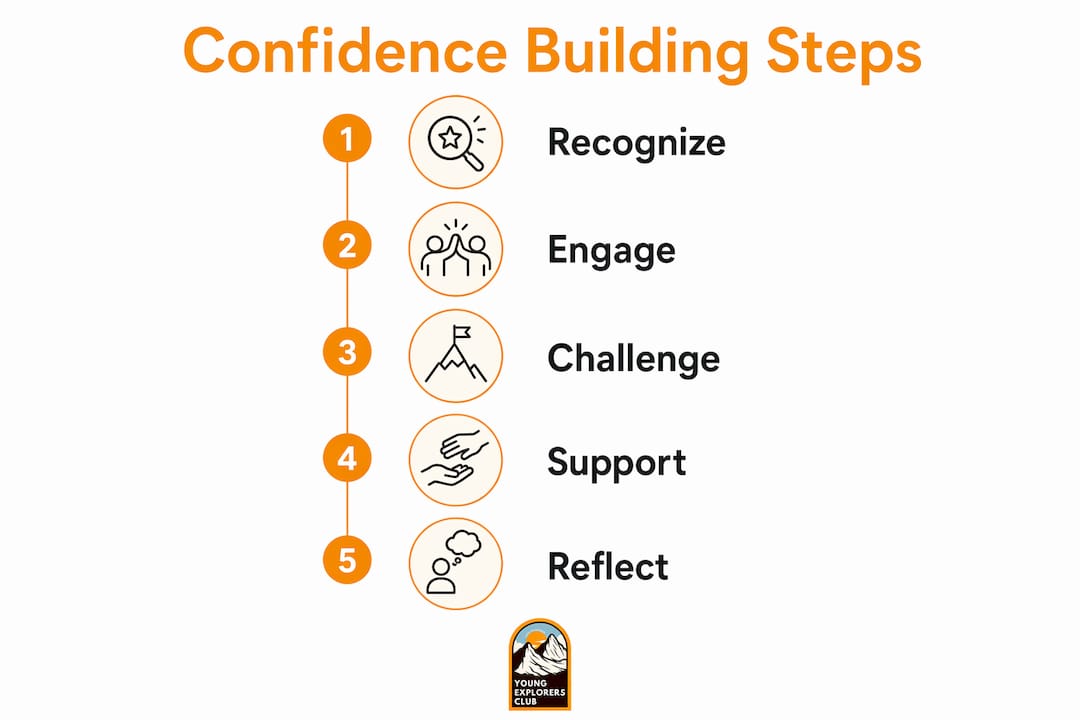
Extracurricular activities are one of the most reliable methods to boost teen confidence because they provide structured, low-stakes environments for skill development and social connection. A December 2025 study confirmed that teens who participate in extracurriculars show significantly higher self-confidence than inactive peers. The mechanism is straightforward: activities create repeated opportunities to try, fail, improve, and succeed.
The types of activities that produce the strongest confidence gains include:
- Team sports like soccer, basketball, or rowing, which build confidence through shared goals, peer accountability, and physical achievement
- Performing arts like theater, choir, or dance, which require teens to take public risks and receive feedback in real time
- Leadership programs like student government or debate, which develop the ability to speak, decide, and influence
- Outdoor adventure programs like climbing, survival skills, or mountain biking, which build confidence through physical challenge and resilience
- Community service projects, which build purpose and identity alongside practical skills
The psychological mechanism behind all of these is the same. Teens experience manageable difficulty, push through it, and internalize the evidence that they are capable. That internalized evidence is what confidence actually is. It is not a feeling someone gives you. It is a conclusion you reach about yourself through experience.
Pro Tip: When choosing activities for a teen, prioritize consistency over variety. One activity practiced weekly for six months builds more confidence than five activities sampled once each.

How does family support influence confidence development in teenagers?
Family support is the single most powerful environmental factor in building self-esteem in adolescents. A March 2026 study confirmed that emotional warmth, validation, and encouragement from family members significantly increase teen self-worth. The parenting style that produces the best outcomes is called autonomy-supportive parenting, a term from developmental psychology that describes parents who guide without controlling.
Autonomy-supportive parents do three things consistently:
- They validate emotions without immediately trying to fix them. When a teen says “I’m terrible at math,” the response is “That sounds frustrating. What part is hardest?” not “You’re not terrible, stop saying that.”
- They encourage independent problem-solving. They ask questions instead of giving answers, which builds the teen’s belief in their own judgment.
- They celebrate effort explicitly. Praising the process, “You worked really hard on that,” produces more lasting confidence than praising the result, “You’re so smart.”
The contrast with harmful family dynamics is sharp. High levels of family conflict and psychological control, where parents use guilt, criticism, or conditional love, consistently predict lower teen self-esteem. Teens in these environments learn to doubt their own perceptions and avoid risk.
“Parents need to care for their own well-being and social support to avoid relying emotionally on teens for validation.” — Dr. Lisa Damour
That insight from Dr. Lisa Damour is often overlooked. When parents are emotionally depleted, they unconsciously place their own need for reassurance onto their teenagers. The teen then spends energy managing the parent’s feelings instead of developing their own identity.
What educational strategies effectively promote confidence in adolescents?
Schools are the second most influential environment for teen confidence after the family. Integrating efficacy education into classroom teaching, through goal visualization, precise feedback, and role model demonstration, produces measurable improvements in both confidence and academic outcomes.
The table below compares the most effective school-based strategies with their specific mechanisms:
| Strategy | Mechanism | Outcome |
|---|---|---|
| Goal visualization | Teens picture specific success steps, not just end results | Builds belief that the path is achievable |
| Precise feedback | Feedback targets specific behaviors, not general ability | Teaches teens what to change, not who to be |
| Peer modeling | Teens observe similar peers succeeding at challenges | Raises belief that “if they can, I can” |
| Growth mindset framing | Mistakes are labeled as learning data, not failure | Reduces fear of trying new things |
| Manageable challenge exposure | Tasks are set just above current ability | Creates repeated small wins that compound |
The growth mindset approach, developed by Stanford psychologist Carol Dweck, is the most widely adopted of these strategies. The core idea is that ability is not fixed. When teachers frame difficulty as a sign of learning rather than a sign of inadequacy, teens become more willing to persist.
Pro Tip: Teachers: replace “good job” with specific feedback like “You caught your own mistake and corrected it. That’s exactly what strong writers do.” Specific praise builds self-awareness, not just good feelings.
What practical steps can parents and educators take to build teen confidence?
The most effective approach combines consistent small actions with patience. Confidence builds incrementally through repeated try-fail-reflect cycles. There is no shortcut, and overprotection is as damaging as neglect.
Practical steps that work in daily life include:
- Create safe opportunities for manageable risk. Let teens make decisions with real but limited consequences, choosing a course, planning a trip, managing a budget. Each decision they survive builds trust in their own judgment.
- Praise effort, not talent. Praising effort leads to persistence; praising innate ability creates fragility. A teen told “you’re naturally gifted” stops trying when things get hard, because difficulty threatens their identity.
- Validate emotions without over-reassuring. Saying “I understand why that felt hard” is more useful than “Don’t worry, you’ll be fine.” Over-reassurance teaches teens their feelings are problems to be dismissed.
- Reframe mistakes as data. When a teen fails a test or loses a game, ask “What did you learn?” rather than “What went wrong?” The language shift is small but the effect on self-talk is significant.
- Know when to involve outside support. When confidence issues involve chronic avoidance, persistent negative self-talk, or withdrawal from all social activity, a school counselor or therapist is the right next step.
Pro Tip: Act as a secure base, not a safety net. Let teens attempt challenges independently, then be present to debrief afterward. That combination of freedom and support is what builds lasting self-belief.
Key takeaways
Teen confidence is built through repeated experience, not reassurance, and the adults who create consistent opportunities for manageable challenge produce the most lasting results.
| Point | Details |
|---|---|
| Self-efficacy drives outcomes | Teens with strong self-belief show better mental health, academic persistence, and social skills. |
| Extracurriculars are proven tools | A 2025 study confirms active teens show significantly higher confidence than inactive peers. |
| Family style shapes self-worth | Autonomy-supportive parenting with emotional warmth is the strongest predictor of teen confidence. |
| Schools can teach confidence | Goal visualization, precise feedback, and growth mindset framing produce measurable gains in class. |
| Small risks beat big reassurances | Confidence grows through try-fail-reflect cycles, not through constant encouragement or protection. |
What i’ve learned after years of watching teens grow
The biggest mistake I see parents and educators make is treating confidence as something you can give a teenager. You cannot. You can only create the conditions where they discover it themselves.
The teens I have watched grow the most are not the ones who were praised the most. They are the ones who were trusted with real challenges and supported through the discomfort of not knowing if they would succeed. That discomfort is not a problem to solve. It is the actual mechanism of growth.
I have also seen the damage that overprotection does. A teen who is never allowed to fail in a low-stakes environment will eventually face failure in a high-stakes one, with no internal resources to handle it. The parent who removes every obstacle is not building confidence. They are building fragility.
The other pattern I notice consistently is that confidence is contagious within peer groups. When one teen in a group takes a risk and survives it, the others become more willing to try. This is why group activities, whether outdoor adventures, team sports, or collaborative projects, accelerate individual confidence faster than solo practice. The peer modeling effect is real, and it is underused.
Finally, patience is not optional. Confidence built over months through consistent small steps is far more durable than any single breakthrough moment. The adults who understand this stop looking for the magic experience and start building the daily environment instead.
— Guillem
Build real confidence with Youngexplorersclub
Youngexplorersclub puts the research into practice through weekly outdoor activities and international summer camps based in Switzerland. The programs are designed around exactly the principles this article covers: manageable challenges, peer group support, real skill development, and reflection.

Teens who join the summer camp for teens experience mountain biking, climbing, survival skills, and multisport adventures in a bilingual environment that builds both confidence and language ability. These are not passive experiences. They are structured to produce the try-fail-reflect cycles that create lasting self-belief. The Club Young Explorers weekly program in the Vaud region offers the same approach year-round for families who want consistent development, not just a summer boost.


