

TL;DR:
- Cultural exchange fundamentally fosters lasting cognitive, emotional, and social development in teens by immersing them in unfamiliar environments. It enhances intercultural competence, emotional intelligence, and global awareness through direct engagement, reflection, and relational experiences. Preparing and supporting teens before, during, and after exchange maximizes these transformative developmental benefits.
Most parents and educators think of cultural exchange as an enriching trip abroad. A nice experience. Good for the resume. But research tells a different story. Understanding why cultural exchange matters for teens means looking past the travel photos and into the developmental science. The teens who spend time in genuinely foreign environments, navigating unfamiliar customs and building relationships across language barriers, come back measurably different. Not just more confident, but more emotionally regulated, more self-aware, and better equipped for a world that rewards exactly those skills.
Key takeaways
| Point | Details |
|---|---|
| Lasting developmental change | Immersive exchange programs produce cognitive and attitudinal growth lasting 3 to 18 months after teens return home. |
| Culture shock is growth | Initial discomfort during cross-cultural transition is psychologically normal and directly builds emotional resilience and self-regulation. |
| Two-way learning | Both teens and host families gain from exchange, with mutual cultural understanding deepening the experience for everyone involved. |
| Reflection cements growth | Post-exchange reflection is what converts short-term exposure into long-term personal maturity and emotional learning. |
| Parents and educators play a key role | Preparation, proactive support during the exchange, and structured debriefs afterward maximize outcomes for teens. |
Why cultural exchange matters for teens: the developmental case
The importance of cultural exchange goes well beyond broadening horizons. At the adolescent stage of development, identity formation is at its peak. Teens are actively constructing who they are, what they value, and how they relate to others. Placing them in a genuinely different cultural environment accelerates that process in ways that classroom instruction simply cannot replicate.
Research confirms that international immersion programs produce lasting cognitive and attitudinal changes observable 3 to 18 months after teens return. That is not a short-term travel buzz. Those are structural changes in how a young person processes the world. The specific gains include intercultural competence, emotional intelligence, and deepened self-awareness. These are skills employers, universities, and communities are increasingly asking for.
Here is what actually happens developmentally during a well-structured cultural exchange:
- Intercultural competence builds. Teens learn to read social cues across different cultural frameworks, a skill that transfers to any diverse environment they enter later in life.
- Emotional intelligence grows. Managing loneliness, frustration, and genuine excitement in a foreign environment teaches emotional regulation better than any structured lesson.
- Self-efficacy spikes. Operating outside familiar support systems forces teens to trust their own judgment and problem-solve independently, which directly builds behavioral maturity.
- Cultural intelligence develops. Teens learn not just to tolerate difference but to work fluidly within it, a quality that experiential learning accelerates significantly.
Pro Tip: Don’t rush your teen past the discomfort phase. Adolescents commonly experience a confidence dip during early cross-cultural transition. That friction is the growth. Normalize it before they go.
Culture shock is one of the most misunderstood parts of exchange. Parents often see it as a red flag. It isn’t. It’s the psychological signal that real learning is underway. Teens who work through that initial disorientation consistently develop stronger self-regulation and emotional stability than those who never face it.

How exchange builds global awareness and social skills
The benefits of cultural exchange for youth are not limited to personal development. They extend outward into how teens understand and engage with the broader world. This is where the impact of cultural experiences on teenagers becomes visible to others, not just to the teen.
Youth exchange builds 21st-century skills that are now considered foundational for global engagement: communication across difference, cultural competence, and collaborative problem-solving. These are not soft extras. They are the core skills that define whether a young person can function effectively in a diverse, globally connected workforce and society.
Here’s how that social skill development actually unfolds during a well-designed exchange experience:
- Perspective-taking becomes automatic. When teens spend weeks eating, studying, and socializing within a different cultural framework, they stop assuming their own norms are universal. That shift is profound.
- Communication skills sharpen under pressure. Expressing yourself clearly when language or cultural context creates friction builds a precision in communication that comfortable environments don’t require.
- Cross-cultural problem-solving develops. Navigating everyday misunderstandings in a foreign context builds exactly the conflict resolution mindset that youth diplomacy programs recognize as soft power.
- Global citizenship takes root. Teens who live alongside people from genuinely different backgrounds stop seeing “global issues” as abstract. They become personal.
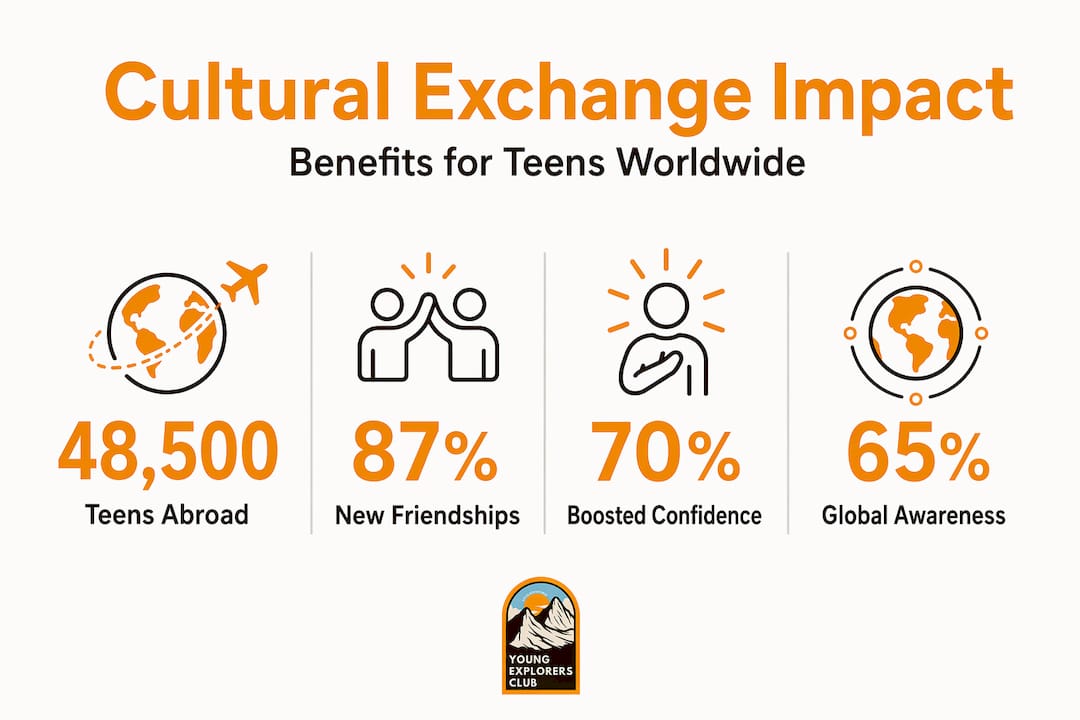
The data from real exchange programs supports this. Over 48,500 young Americans participated in exchange programs in China since 2023, engaging across cultural, academic, and social dimensions. At Wenzhou-Kean University alone, 501 young Americans participated in programs combining practical skills with cultural heritage learning over roughly 18 months. These aren’t small numbers. They reflect a growing recognition that international cultural exposure at a young age produces real, measurable results.
The role of host families and community interaction
One of the most powerful, and least discussed, aspects of cultural exchange programs for teens is what happens at the relational level. Not in the classroom. Not on the tour. At the dinner table, in the family home, in the informal moments that make up real daily life in another culture.
Exchange is a two-way process. Teens gain enormously, but so do the communities and families who receive them.
- Psychological safety deepens learning. When teens feel genuinely welcomed by a host family, they engage more openly with the culture rather than retreating into the comfort of their own group. That openness is what separates surface exposure from deep learning.
- Host families gain too. Families who welcome exchange students report deeper cultural understanding and a broadened worldview, often citing the experience as one of the most enriching of their lives.
- Community exposure to diversity matters. When local communities interact with teens from different backgrounds, it builds familiarity with difference and reduces the kind of cultural anxiety that isolation tends to produce.
A common misconception is worth addressing directly. Many families assume hosting an exchange student involves financial compensation. It doesn’t. Hosting is a volunteer experience under J-1 visa guidelines, centered entirely on relationship-building and mutual learning. The reward is the relationship itself.
“The real classroom in cultural exchange isn’t a building. It’s the kitchen table of a family who chose to welcome a stranger, and the teen who chose to show up.”
Understanding how adventure shapes teen resilience through relational and environmental challenge is exactly what makes host family placements so powerful when done well.
How parents and educators can maximize exchange outcomes
Knowing the benefits of cultural exchange is one thing. Knowing how to structure the experience so those benefits actually land is another. Parents and educators have more influence over outcomes than most realize, both before and after the exchange itself.
| Stage | What to do | Why it matters |
|---|---|---|
| Before departure | Set realistic expectations; normalize discomfort | Prevents panic during the culture shock phase |
| During exchange | Encourage observation before reaction; check in without hovering | Builds self-reliance without isolation |
| Post-exchange | Schedule structured reflection conversations | Reflection converts exposure into lasting growth |
| Integration | Connect exchange experience to academic and personal goals | Embeds gains into the teen’s broader development narrative |
Preparation matters more than most families give it credit for. Teens who arrive knowing what culture shock feels like, and understanding it as a phase rather than a failure, move through it faster and extract more from the experience. This is also where educators can contribute. Integrating cultural exchange into broader educational goals, rather than treating it as an extracurricular, signals to teens that what they’re doing has real academic and personal weight.
During the exchange, the instinct to over-communicate and over-support is understandable. Resist it. Proactive social engagement from the teen, not rescue from the parent, is what builds the self-efficacy that makes exchange transformative.
Pro Tip: Build a post-exchange debrief into your schedule before your teen even leaves. A structured conversation within two weeks of return, focused on specific moments of growth and discomfort, dramatically improves how much of the experience converts into lasting personal development.
Learning how to prepare your teen for adventure camps abroad gives parents a concrete framework for this kind of structured support, from logistics to emotional preparation.
My perspective: discomfort is the point
I’ve worked alongside young people navigating international environments for years, and the pattern I keep seeing is this: the teens who get the most out of cultural exchange are not the ones who felt most comfortable. They’re the ones who felt most uncomfortable early, and had just enough support to push through it rather than retreat.
What I’ve learned is that most families underestimate how much of cultural exchange’s value lives in that friction. We talk a lot about the fun parts, the friendships, the food, the scenery. Those things matter. But the moment a teen realizes they’ve solved a real problem in a foreign context, without a parent or teacher to bail them out, is the moment something permanent changes in them.
The impact of cultural experiences on teenagers isn’t just measurable in research studies. I’ve seen it in how teens carry themselves after they return. There’s a groundedness there that doesn’t come from school trips or family vacations. It comes from being genuinely tested in an unfamiliar world.
My honest take: we should stop treating cultural exchange as a reward for high-achieving teens and start treating it as a developmental tool for all of them. The ones who seem least ready are often the ones who gain the most.
— Guillem
Give your teen a real cultural exchange experience
If you’re convinced that cultural exchange is more than a travel perk, the next question is where your teen can actually access that kind of experience in a structured, supportive environment.

At Youngexplorersclub, the programs are built around exactly this kind of immersive, developmentally intentional experience. Based in Switzerland, with a bilingual English and French environment, the teen summer camp combines outdoor adventure, cultural learning, and real peer interaction across nationalities. This isn’t a tourist program with a cultural label on it. It’s a structured environment designed to put teens in the productive discomfort that builds real growth. For schools and groups looking for tailored options, custom cultural programs are available to fit specific educational goals and age groups.


