

TL;DR:
- Educational travel provides hands-on learning experiences that foster cognitive, emotional, and social development beyond traditional classrooms. It strengthens family relationships through shared exploration and reflection, generating lasting memories and empathy. Effective programs incorporate deliberate planning, active inquiry, and age-appropriate, structured activities to maximize educational outcomes.
Educational travel for families is the intentional use of real-world experiences to deliver hands-on learning that no classroom can replicate. Parents who treat travel as curriculum rather than vacation give their children a measurable cognitive and emotional advantage. Research from 2026 confirms that field trips boost applied knowledge and intrinsic motivation far beyond traditional instruction. This article explains the evidence behind educational travel, how to plan it well, and what types of programs actually deliver results.
Why choose educational travel for families over traditional learning
Educational travel is not a supplement to schooling. It is a distinct learning model where children acquire knowledge through observation, interaction, and direct experience rather than textbooks. The difference matters because out-of-school environments benefit both cognitive and affective domains, including scientific process skills, empathy, and communication, in ways that structured classroom settings rarely achieve.
The 2026 Springer Nature study on STEM field trips found that active participation in real environments produces stronger intrinsic motivation than traditional instruction. That finding has a direct implication for families: a child who touches a fossil at a natural history museum, navigates a heritage trail, or builds a shelter in the Swiss Alps is not just having fun. That child is forming durable knowledge connections that stick.
Educational travel also addresses a gap that many parents recognize but struggle to name. School teaches content. Travel teaches context. When a child sees the scale of a Roman amphitheater, reads a topographic map in the field, or converses in French with a local guide, abstract concepts become concrete. That shift from abstract to concrete is the core mechanism behind why family learning experiences through travel outperform passive study.
The learning benefits documented across 2026 research include:
- Motivation and engagement: Children show higher intrinsic interest when learning is tied to real environments.
- Cognitive development: Applied knowledge retention increases when theory meets direct experience.
- Affective development: Museum-based learning builds emotional empathy and cultural heritage awareness.
- Scientific process skills: Out-of-school science venues strengthen observation, inquiry, and reasoning.
- Social abilities: Group travel builds communication, teamwork, and perspective-taking.
Pro Tip: When selecting educational trips for kids, prioritize programs that include guided inquiry and interactive tasks over passive tours. A guide who asks children questions and prompts reflection delivers more learning value than one who simply narrates facts.
How does family travel strengthen relationships and create lasting memories?
Family travel positively influences communication, strengthens bonds, and contributes to lifelong wellbeing. A 2026 literature review links travel with improved family satisfaction and a reduced likelihood of family breakdown. That is a striking finding. Shared challenge and shared discovery create emotional closeness that routine daily life rarely generates.

The mechanism is straightforward. When a family navigates an unfamiliar city together, solves a logistical problem at a train station, or completes a heritage trail as a team, they build a shared story. Shared stories become the foundation of family identity. Children who travel with their parents report stronger feelings of being understood and valued, which carries forward into adolescence.
Empathy is another underrated benefit of family travel with purpose. Visiting communities with different histories, languages, and traditions expands a child’s frame of reference in ways that reading about those communities cannot. UNESCO’s community heritage tourism projects, such as the trail in Chitral, demonstrate how hands-on community engagement deepens understanding of ecology, sustainability, and indigenous knowledge simultaneously.
The risks are real too. Poorly planned travel creates stress rather than bonding. Overpacked itineraries, insufficient rest, and mismatched expectations between parents and children are the most common failure points. The families who benefit most from educational travel are the ones who plan for recovery time and treat the trip as a shared experience rather than a performance.
- Shared problem-solving builds trust and communication between parents and children.
- Cultural exposure develops empathy and broadens children’s worldview.
- Unstructured exploration time allows children to process and internalize what they have seen.
- Reduced screen time during travel creates space for genuine conversation and connection.
Pro Tip: Build at least one unscheduled afternoon into every multi-day educational trip. Children need time to absorb experiences, ask spontaneous questions, and simply be curious without an agenda. That unstructured time often produces the most memorable moments.
How to plan effective educational travel experiences for your family
Effective educational travel requires deliberate design. UNESCO research is clear that structured learning intentions and active participation maximize educational impact. Without that structure, even a visit to the Louvre or the Swiss National Museum becomes passive sightseeing with little lasting value.
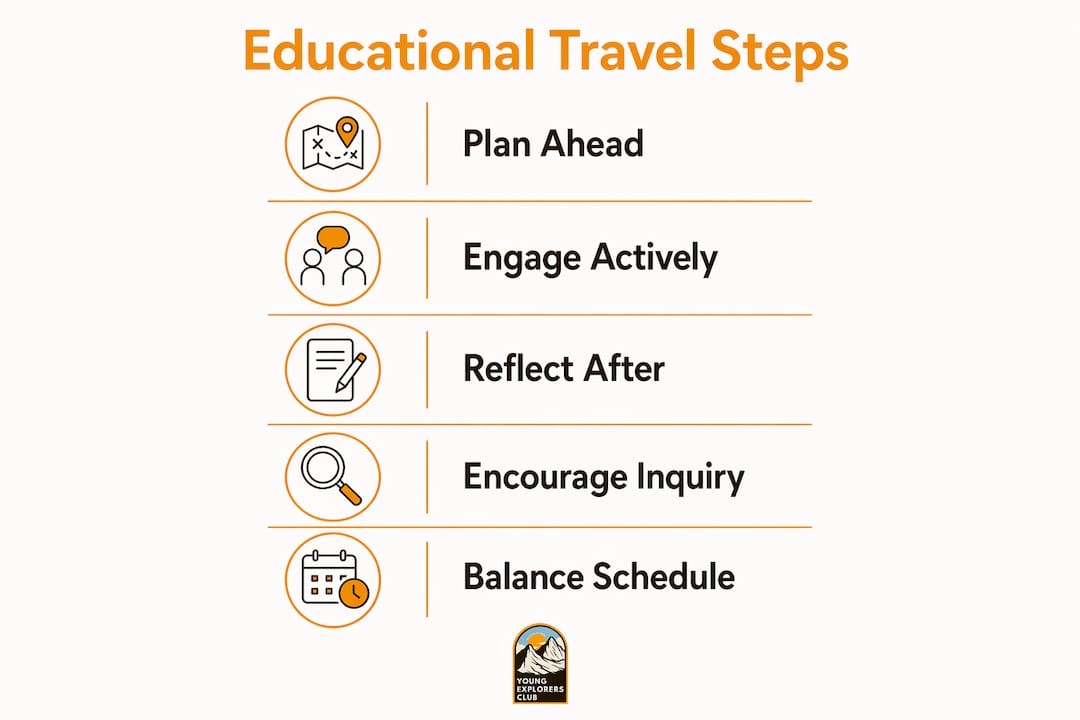
The difference between passive sightseeing and structured educational travel comes down to three elements: preparation before the visit, active inquiry during the visit, and reflection afterward. Most families invest in the middle element and skip the other two. That is the single biggest planning mistake parents make.
Here is a practical planning sequence that produces real results:
- Set learning goals before you book. Decide what you want your children to understand or be able to do after the trip. Goals can be simple: “Understand why the Romans built aqueducts” or “Be able to identify three local bird species.”
- Select sites with interactive programming. Look for museums, heritage trails, and outdoor classrooms that offer hands-on activities, not just exhibits. Programs with pre and post testing demonstrate real academic gains.
- Prepare inquiry questions in advance. Give children two or three questions to investigate during the visit. This shifts them from passive observers to active learners.
- Schedule reflection time. After each major experience, spend 10 to 15 minutes discussing what surprised them, what they want to know more about, and how it connects to something they already know.
- Address logistics early. Advance planning and clear communication are documented barriers to successful educational travel. Book tickets, confirm program details, and prepare children for what to expect.
The reflection step is the most underestimated. Research on out-of-school science education confirms that scaffolding and reflection are the primary mechanisms that translate travel experiences into lasting learning. Without them, memories fade and knowledge does not transfer.
What types of educational travel work best for families?
Educational travel is not a single format. It spans a wide range of experiences, each with different learning focuses and age suitability. Understanding the options helps parents match the right program to their children’s ages, interests, and learning needs.
| Travel type | Learning focus | Best age range |
|---|---|---|
| Museum visits | Cultural heritage, history, science literacy | 6 and up |
| UNESCO heritage trails | Ecology, sustainability, indigenous knowledge | 8 and up |
| Outdoor adventure camps | Teamwork, resilience, nature science | 8 to 17 |
| Language immersion programs | Communication, cultural fluency | 10 and up |
| Community service travel | Empathy, civic responsibility, global awareness | 12 and up |
Museum-based programs with structured pedagogy deliver the strongest measurable outcomes. The 2026 mixed-methods study on museum learning found that programs using control groups and pre and post assessments produced real gains in academic achievement and cultural understanding. Parents should ask program providers directly whether they use any form of structured assessment or learning evaluation.
Outdoor adventure camps represent a growing category of family adventure travel that combines physical challenge with environmental education. Switzerland, in particular, offers terrain that makes outdoor classrooms genuinely immersive. Mountain navigation, survival skills, and ecological observation in alpine environments produce learning outcomes that no urban museum can replicate.
Language immersion programs add a layer of cognitive challenge that accelerates learning across all subjects. Children who spend two weeks communicating in a second language develop stronger working memory, better problem-solving flexibility, and greater cultural empathy. For families seeking educational travel ideas tailored to children aged 8 to 17, combining outdoor adventure with language learning is the highest-value combination available.
Key takeaways
Educational travel delivers its strongest results when parents treat it as deliberate curriculum design, not spontaneous sightseeing.
| Point | Details |
|---|---|
| Learning beats passive touring | Structured inquiry before, during, and after visits produces measurable academic gains. |
| Family bonds strengthen through travel | Shared challenges and discoveries build communication, trust, and lifelong memories. |
| Reflection is non-negotiable | Without post-experience reflection, travel memories fade without transferring to lasting knowledge. |
| Match program type to age and goals | Outdoor camps, heritage trails, and museum programs each serve different learning objectives. |
| Evidence-based programs outperform branding | Choose providers who use structured assessments or explicit pedagogy over those who simply market “educational” experiences. |
What I’ve learned about educational travel that most parents miss
I have seen families return from extraordinary destinations and describe the trip as “nice.” That word is the warning sign. It means the experience was pleasant but not transformative. The gap between “nice” and “transformative” is almost always the absence of intentional design.
The parents who get the most from educational travel are the ones who do the work before they leave. They read about the destination with their children, set specific questions to investigate, and build in time to talk about what they saw. They treat curiosity as the goal, not knowledge transfer. A child who leaves a trip asking more questions than they arrived with has had a genuinely educational experience.
The most common mistake I see is treating educational travel as a checklist. Visit the museum. Check. Walk the heritage trail. Check. That approach produces fatigue, not learning. The families who thrive are the ones who slow down, follow their children’s curiosity, and let one unexpected discovery derail the afternoon plan.
I also think parents underestimate how much they learn alongside their children. Educational travel is not a service you purchase for your kids. It is an experience you share with them. That shared learning is what creates the memories that last decades, not the photographs.
— Guillem
Discover educational travel programs with Youngexplorersclub
Youngexplorersclub designs outdoor and educational experiences in Switzerland that combine adventure, language learning, and hands-on discovery for children and families. Every program is built around active participation, not passive observation.
Whether your family is looking for a week of alpine survival skills, a bilingual summer camp, or a structured outdoor learning program, Youngexplorersclub offers formats designed to produce real growth. The weekly activities program in Vaud gives children regular access to interactive learning in natural environments, while the international summer camp integrates adventure travel with language development and personal challenge. Explore the full range of programs and find the experience that fits your family’s goals.


