

TL;DR:
- Summer camps are powerful social skills classrooms that promote communication, empathy, and conflict resolution through experiential learning. They especially benefit children who struggle socially by removing labels, removing screens, and fostering genuine peer connections in immersive, supportive environments. Longer, high-quality, and repeated overnight camps produce the most lasting social and emotional development, forming a vital lifelong toolkit.
Most parents send their kids to summer camp hoping they’ll have fun, make a few friends, and come home a little more independent. What they don’t expect is that camp might be one of the most powerful social skills classrooms their child will ever experience. Research confirms that structured nature experiences in summer camps consistently support growth in social belonging, communication, and relationship skills through experiential learning. The evidence is clear: what happens around the campfire, on the climbing wall, or during a group challenge isn’t just play. It’s formation.
Key Takeaways
| Point | Details |
|---|---|
| Social skills shape success | Camps provide unique opportunities for kids to build communication, empathy, and teamwork skills critical for lifelong outcomes. |
| Lasting growth for every child | Camps especially benefit shy or socially struggling children, with the biggest gains in supportive, screen-free environments. |
| Program quality counts | Immersive, overnight, and comprehensive programs lead to the strongest, longest-lasting social-emotional impact. |
| Nature immersion amplifies learning | Time away from screens in nature-rich camps boosts emotion recognition and real-world friendship skills. |
Why social skills matter for kids
Before we look at how camps deliver these benefits, it’s worth pausing on why social skills deserve so much attention in the first place. Parents often focus on academic performance, sports results, or creative talents. Social skills sit quietly in the background until something goes wrong: a friendship falls apart, a group project becomes a disaster, or a teenager struggles to speak up for themselves.
Social skills predict success in virtually every area of life. Kids who can communicate clearly, manage their emotions, and cooperate with others tend to do better in school, form healthier relationships, and perform better in the workplace as adults. These aren’t soft extras. They’re foundational.
Social-emotional learning (SEL) research backs this up strongly. SEL programs show meaningful effects on social and emotional skills, with effect sizes ranging from 0.18 to 0.57. Curriculum-based approaches that use repeated, structured practice tend to produce the strongest outcomes. Summer camps apply the same mechanics through what educators call Kolb’s experiential learning cycle: do something, reflect on it, learn a principle, and apply it again.
Here’s what that looks like in practice. A child joins a group of strangers and has to work together to set up camp, navigate a trail, or complete a team challenge. They feel the immediate consequences of poor communication. They try again. They improve. That cycle, repeated dozens of times across a single week, produces the kind of social learning that hours of classroom instruction rarely achieves.
Key social skills that children build through this process include:
- Active listening and reading nonverbal cues
- Conflict resolution and knowing when to compromise
- Empathy built through shared physical experiences
- Self-regulation under pressure, like when a task gets hard or group dynamics shift
- Leadership and followership, often in the same afternoon
“Social competence developed in childhood forms the scaffolding on which adult relationships, career performance, and emotional well-being are built. The earlier and more consistently it is practiced, the more durable it becomes.” This is why the social skills development at summer camps conversation matters so much for parents choosing how to invest their child’s summer.
How camps build social skills: The evidence
Understanding why social skills matter sets the stage for looking at how camps deliver those benefits in the real world.
Camps work differently from school. There are no grades, no report cards, and no fixed desks. What replaces those structures is something far more powerful for social learning: genuine interdependence. Kids need each other. They share meals, sleeping spaces, responsibilities, and challenges. That shared context creates the conditions for real relationship-building rather than surface-level socialization.

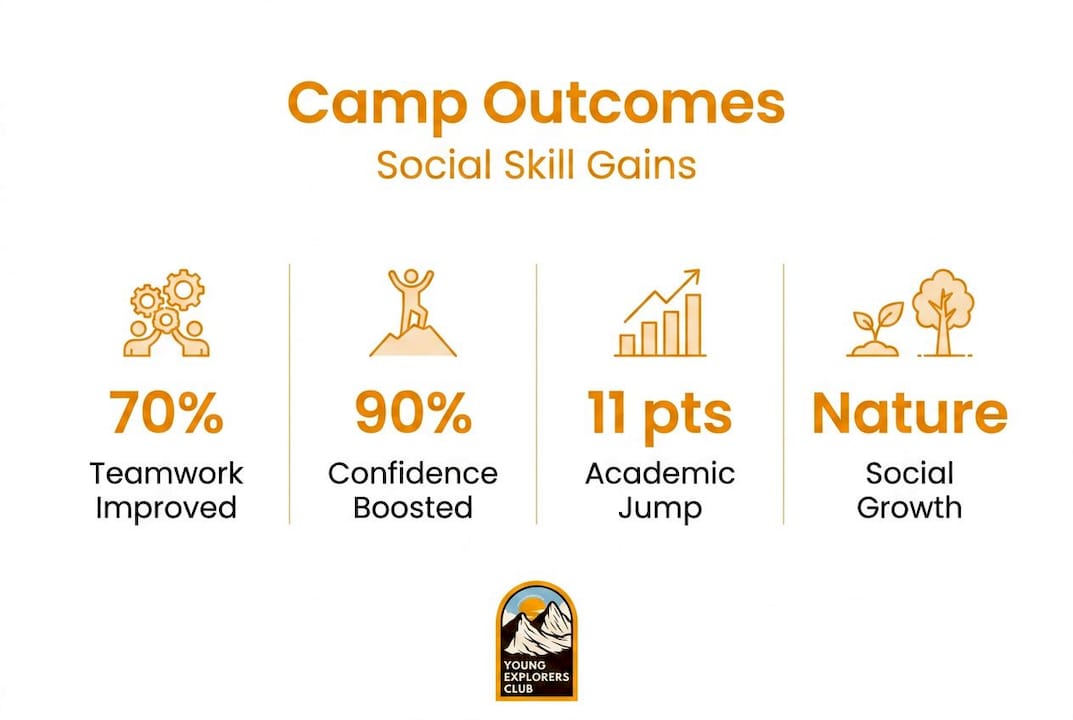
The American Camp Association reports that 70 to 90 percent of campers and parents note positive changes in teamwork, social skills, and self-confidence. That’s a striking figure, and it reflects the breadth of the impact. More than 14 million young people attend camp in the U.S. alone every year, making camps one of the most widely used youth development tools available to families.
Nature adds another layer. Structured nature experiences in outdoor camp settings consistently support growth in social belonging, communication, and relationship skills. Being outside removes many of the social triggers that create friction at home: screens, competitive games, and the social comparison that happens constantly on social media. What replaces those triggers is something simpler and more human.
Here’s a breakdown of how specific camp activities connect to measurable social outcomes:
| Camp activity | Social skill targeted | Reported outcome |
|---|---|---|
| Team challenges and ropes courses | Cooperation, trust-building | Improved group communication |
| Outdoor cooking and camp chores | Shared responsibility | Better negotiation and listening |
| Nature hikes and navigation tasks | Problem-solving in groups | Greater confidence in peer situations |
| Drama and storytelling circles | Empathy and perspective-taking | Stronger emotional vocabulary |
| Conflict resolution sessions | Self-regulation and fairness | Fewer peer conflicts by end of camp |
Research also links improved social skills to a measurable 11-point percentile jump in academic achievement. That connection matters because it tells us that investing in a child’s social growth isn’t separate from investing in their academic future. They’re the same investment. You can explore how camps support social skills naturally and why the outdoor environment is such a powerful catalyst for that process.
The relationship piece is equally significant. Camp is often the first place a child builds a friendship without parental involvement or school structure. They choose each other based purely on shared experience. Those healthy peer relationships formed at camp often last years, sometimes decades. Parents regularly describe a child coming home with a best friend they’d never met before drop-off day.
Pro Tip: If you want to know how deeply a camp builds social skills, don’t just look at its activity list. Ask how conflict between campers is handled. Ask whether group reflection is built into the program. The answers reveal whether social growth is intentional or accidental.
Which kids benefit most? The power of safe, screen-free environments
While the evidence is compelling, parents often ask: will my child truly benefit, and what about those who struggle socially?
The short answer is that all children benefit from quality camp experiences, but research shows the most significant gains often happen for kids who struggle socially in traditional environments. Edge case research confirms that youth with social or behavioral challenges show greater lasting gains from camp, especially when the program quality is high. Safe, supportive environments predict stronger interpersonal growth, and that effect is especially pronounced for children from lower-income backgrounds who may have fewer social opportunities outside school.
Why do struggling kids often gain the most? A few reasons stand out. First, camp removes the social labels kids carry from school. No one at camp knows who was the quiet kid, the awkward one, or the one who never got picked for teams. Everyone starts fresh. That reset is profoundly liberating for children who have built an identity around social struggle.
Second, screen-free immersion removes the biggest barrier to real emotional connection. Children who spend significant time on screens often find it harder to read facial expressions, interpret tone of voice, and pick up on the subtle social signals that make in-person connection work. Research confirms that screen-free nature immersion actively boosts emotion recognition, which is the foundation of empathy and social intelligence.
Third, the physical nature of outdoor activities creates a natural equalizer. A child who struggles to contribute in an academic classroom may excel at reading a trail map, building a fire, or demonstrating courage on a climbing wall. These moments of visible competence shift how peers see the child, and more importantly, how the child sees themselves.
Here’s what to look for when evaluating a camp’s social environment:
- Low camper-to-counselor ratios so each child gets personal attention
- Structured but flexible group activities that require real cooperation
- Explicit conflict resolution protocols rather than just discipline policies
- Mixed age groups that encourage mentorship and varied social dynamics
- Screen-free policies that create genuine space for connection
You can find guidance on helping your child make friends quickly at camp, and on how outdoor camps help kids build real friendships that extend well beyond the program itself.
“The most important thing isn’t finding a camp that matches your child’s existing strengths. It’s finding one that creates enough safety for them to discover new ones.”
Short-term wins vs. lasting impact: What makes the difference?
With these insights, let’s help you choose a camp that sets your child up for lasting transformation.
Not all camp experiences are equal in terms of long-term social impact. Research is clear that the depth and duration of the experience matters enormously. Short-term versus lasting gains depend heavily on two factors: dosage (how long and how intensively the child is immersed) and quality (how well the program is structured to reinforce learning).
Supplemental SEL approaches, meaning programs that add social-emotional components as an add-on rather than integrating them throughout, show weaker effect sizes around 0.07. Comprehensive, curriculum-based approaches that weave social skill development into every activity produce significantly stronger outcomes. Overnight camps consistently outperform day camps because sustained contact over multiple days allows relationships to deepen naturally. A single afternoon of activities builds familiarity. A week of shared sleeping, eating, and adventuring builds trust.
| Camp type | Social depth | Typical effect |
|---|---|---|
| Day camp (1 week) | Surface level | Short-term confidence gains |
| Residential overnight (1 week) | Moderate to deep | Friendship formation, communication gains |
| Residential overnight (2+ weeks) | Deep | Lasting teamwork, empathy, resilience |
| Repeat attendance (multiple summers) | Deepest | Identity-level growth, leadership emergence |
Repeat attendance deepens outcomes in ways that a single session simply cannot replicate. Kids who return year after year show progressively greater social and leadership development. They move from being new campers figuring out the social dynamics to being the experienced participants who model the culture and mentor others. That arc is one of the most powerful growth pathways available to a young person outside of formal education.
Here’s how you can maximize your child’s social gains from the experience:
- Choose residential over day camps when possible for deeper, sustained social immersion.
- Aim for programs of at least one week, longer if your child is ready.
- Look for structured social skill components, not just a list of fun activities.
- Plan for repeat attendance over multiple summers if your budget allows.
- Debrief with your child after camp, asking specific questions about friendships, challenges, and what they learned about working with others.
- Reinforce camp behaviors at home, celebrating the social skills your child used at camp when you see them applied in everyday life.
Thinking about how camps foster team spirit without competition can also help you evaluate whether a program is genuinely building cooperative social skills or simply rewarding individual performance.
Pro Tip: Ask camp staff how they track social development across the session. Programs that can describe specific milestones or behavioral indicators are far more likely to deliver lasting results than those that rely purely on camper happiness ratings.
What most parents miss about social skills and camps
Having unpacked what actually influences camp outcomes for kids, here’s what we see parents and even educators often overlook.
Most parents evaluate camps based on the activity lineup. They want to know if there’s a climbing wall, a lake, or a cool science program. That focus is understandable, but it misses the real value entirely. The activities are the vehicle. The social learning is the destination.
We also see parents underestimate what we call the “invisible curriculum” of camp: the quiet but relentless practice of resilience, adaptability, and empathy that happens not during organized activities but in the moments between them. How does your child handle a conflict with a cabin mate at 9pm when they’re tired and homesick? How do they respond when a team challenge fails and someone looks for someone to blame? Those moments, invisible to the parent waiting at home, are often the most formative of the entire experience.
The biggest return on investment from a great camp experience isn’t a new sport or a language certificate. It’s a lifelong toolkit for relating to others, including people who are different, people who challenge them, and people from entirely different cultures. In a globally connected world, that toolkit is genuinely priceless. Programs like ours that operate in multilingual, multinational environments give children the chance to practice these skills in a cross-cultural context that most schools simply can’t replicate. That’s the hidden value in choosing a program that builds confidence and independence through genuinely international experiences.
Explore Swiss camps that grow social skills
If the research and insights above have shifted how you see summer camp, the next step is finding a program that intentionally delivers on this promise. Not every camp does.
At The Young Explorers Club, social skill development isn’t an afterthought. It’s built into every element of the program, from multilingual group activities in the Swiss Alps to cooperative challenges that demand real teamwork and communication. Whether your child is already socially confident or is someone who could use a fresh start with a new group of peers, our Swiss summer camp experiences are designed to grow every child. Explore our full range of international summer camps in Switzerland to find the right fit, or get practical guidance on preparing for camp in Switzerland so your child starts with confidence.
Recommended
- How Camps Foster Team Spirit Without Competition | Young Explorers Club Switzerland
- Why Camps Are A Safe Space For Personal Growth | Young Explorers Club Switzerland
- How Camps Encourage Healthy Peer Relationships | Young Explorers Club Switzerland
- How International Summer Camps Boost Confidence And Independence | Young Explorers Club Switzerland
- Why Magical Videos Make Holiday Memories Last for Children — WonderLens | WonderLens


