

TL;DR:
- Outdoor sports foster essential social and emotional skills, offering measurable benefits beyond traditional education.
- Thoughtfully designed programs emphasize challenge, reflection, and relationships, leading to lasting developmental impacts.
Most parents, when thinking about their child’s education, picture classrooms, textbooks, and homework. What rarely comes to mind is a muddy hillside climb, a canoe paddle across a mountain lake, or a team trying to solve a survival challenge in the Swiss Alps. Yet research now suggests that those outdoor moments may do more for a child’s long-term development than many traditional lessons ever could.
Key Takeaways
| Point | Details |
|---|---|
| SEL thrives outdoors | Outdoor sports boost social and emotional learning in ways that classroom lessons often cannot. |
| Program quality matters | Structured activities and skilled staff are key to unlocking long-term benefits. |
| Lasting personal growth | Well-designed outdoor education builds resilience, leadership, and collaboration for life. |
| Ask the right questions | Parents should look for well-facilitated, evidence-based programs for their children. |
Why outdoor sports matter for educational development
With those first questions in mind, let’s explore why outdoor sports have become such a central pillar of progressive education.
The term “outdoor sports” covers far more than organized athletics. Think hiking, canoeing, rock climbing, orienteering, team survival challenges, and cooperative adventure games. What unites them is the environment: nature, unpredictability, and real physical engagement. These experiences demand something different from a child than sitting in a row and listening.
Increasingly, educators and researchers are pointing to outdoor sports as a primary vehicle for building competencies that schools struggle to teach directly. According to Studia Sportiva at Masaryk University, Outdoor Adventure Education (OAE) supports Social and Emotional Learning through experiential methods that foster emotional regulation, collaboration, leadership, and resilience. These are not soft extras. They are the building blocks of a functioning adult.
“Meta-analysis shows that nature contact benefits cognitive functioning (r=0.034), while subjective contact with nature aids social functioning (r=0.237).” — Educational Psychology Review
The data confirms what many camp counselors have long observed: kids who spend meaningful time outdoors grow in measurable ways. At the same time, personal growth at camp extends well beyond what any single sport can provide.
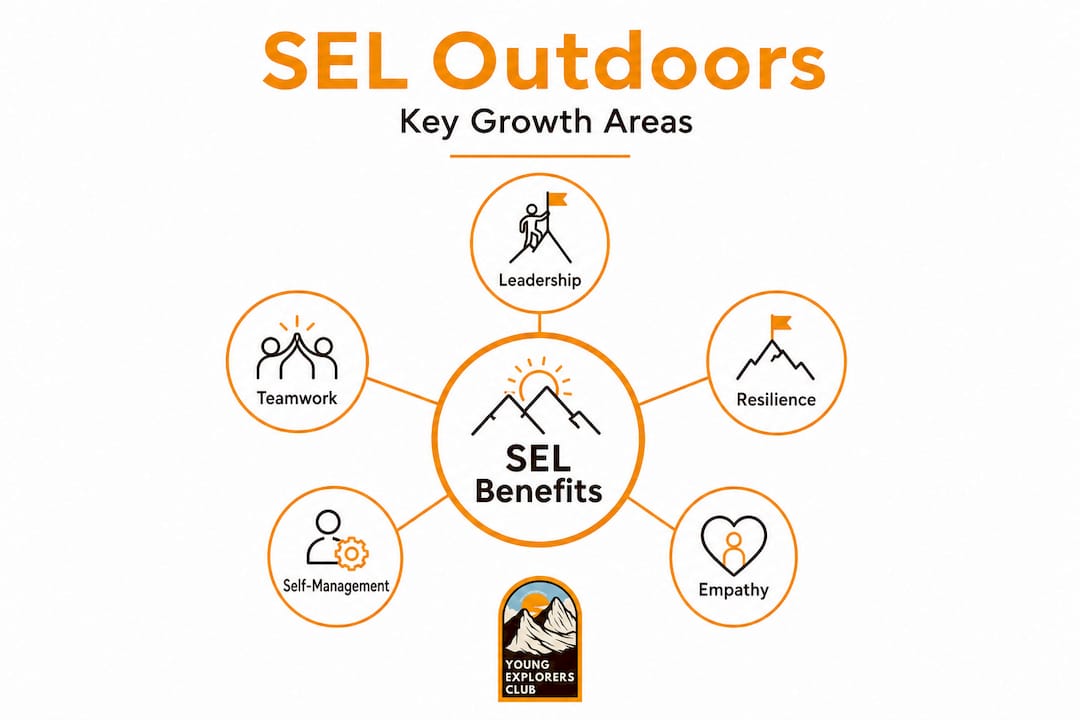
Here are the six most important benefits outdoor sports deliver to young people:
- Emotional regulation: Managing fear, frustration, and excitement in real-time situations
- Teamwork and communication: Navigating shared goals under pressure
- Leadership: Taking responsibility when a group needs direction
- Resilience: Recovering from setbacks, whether a failed climb or a rained-out hike
- Cognitive flexibility: Problem-solving in dynamic, unpredictable settings
- Empathy: Understanding how others feel when the challenge is shared and visible
Social and Emotional Learning, commonly abbreviated as SEL, is the structured process through which children develop these competencies. SEL is not a new idea, but the outdoor setting accelerates and deepens it in ways that classroom-based programs rarely match. Developing emotional resilience through camps is one of the most consistent findings in youth development research, and it starts with getting kids outside and challenged.
How outdoor activities shape mental and emotional growth
Now that we’ve established the importance, let’s dig into how different outdoor sports settings actively shape young minds and personalities.
Not all outdoor experiences work the same way. A structured team relay race and an unstructured afternoon exploring a forest both have value, but they build different skills. Understanding that difference helps parents choose programs that match what their child actually needs.
| Activity type | Structure level | Primary skills developed | Best suited for |
|---|---|---|---|
| Organized team sports | High | Collaboration, communication, rule-following | Children who thrive with clear expectations |
| Guided nature hikes | Medium | Observation, patience, group dynamics | All children, especially introverts |
| Solo challenges (navigation, campcraft) | Low to medium | Self-reliance, decision-making, confidence | Older children and teens |
| Adventure group challenges | High | Leadership, trust-building, creative problem-solving | Children with social or behavioral needs |
Structured nature experiences (SNEs) in summer camps, as reviewed in Behavioral Sciences (MDPI), show lasting improvements in mental, emotional, and social health (MESH) competencies, particularly for youth who already struggle with social or behavioral challenges. This finding is significant. It means that the children who often seem least suited to group outdoor activities may actually benefit the most.
For introverted children or those new to a social group, the physical activity itself becomes a bridge. When you’re paddling a canoe together, you don’t have to come up with conversation topics. The task creates connection. That’s a powerful thing for a child who finds social situations draining.
The research also describes what educators call the OAE learning cycle. Think of it as a four-step loop that makes experience educational rather than just entertaining:
- Challenge: The child encounters something genuinely difficult, physically or emotionally
- Experience: They engage fully, succeeding, failing, or adapting
- Reflect: With support from a counselor or group, they think through what happened and what it meant
- Apply: They take the insight forward into the next challenge or back into daily life
OAE uses experiential learning through activities like hiking and canoeing, combined with deliberate debriefing sessions, to transfer SEL lessons into everyday life. This is the key design element that separates meaningful outdoor education from a fun day outside.
Pro Tip: When evaluating summer programs, ask specifically whether they include group debriefing sessions after major activities. Programs that skip reflection are leaving most of the educational value on the table.
Research also highlights that girls, newcomers to a social group, and children with prior behavioral challenges can all benefit differently from outdoor programming. Inclusive design matters. A well-structured program anticipates diverse needs and adjusts accordingly. Building natural social skills development is not accidental; it depends on thoughtful facilitation. Similarly, fostering healthy peer relationships at camp often becomes one of the most lasting gifts a child takes home.

Social and emotional learning: Bringing SEL to life outdoors
Appreciating mental health and adaptation is only the beginning. Let’s see what the research says about the science of Social and Emotional Learning outside school walls.
SEL has five recognized core competencies: self-awareness, self-management (which includes emotional regulation), social awareness, relationship skills, and responsible decision-making. Outdoor sports, when well designed, touch all five in a single afternoon. That’s rare. Most classroom activities target only one or two at a time.
Here’s how specific outdoor camp activities map to SEL competencies:
| Camp activity | SEL competency developed | How it works in practice |
|---|---|---|
| Team climbing challenge | Self-management, relationship skills | Managing fear while supporting teammates |
| Group navigation exercise | Responsible decision-making | Making choices under pressure with real consequences |
| Conflict resolution in team sports | Social awareness, empathy | Hearing other perspectives when stakes are real |
| Leadership rotation on hikes | Self-awareness, leadership | Noticing personal strengths and limits |
| Campfire reflection circle | All five competencies | Articulating feelings and listening to peers |
A rapid review of 19 empirical studies since 2010 confirms that OAE consistently benefits SEL outcomes when programs are supported by clear objectives and inclusive facilitation. The keyword there is “when.” Design quality matters enormously.
Statistic to consider: In studies on Finnish school camps, OAE supported relational resilience among young people through what researchers call “supported vulnerability,” meaning children were encouraged to take emotional risks in a safe environment, leading to mutual growth and lasting relational confidence.
Some practical examples from real camp settings:
- A group of 12-year-olds navigating a ropes course disagree on the best strategy. The resulting conflict, when handled by a skilled facilitator, becomes a live lesson in listening and compromise that no worksheet could replicate.
- A teen who usually dominates group conversations takes a turn as the silent team member during a hiking challenge. She later reports this changed how she sees her own leadership style.
- A shy 10-year-old who rarely speaks up at school leads his bunk team to the fastest time on an orienteering course. His confidence visibly shifts.
These moments are not accidental. They happen because the program designs for them. Programs that foster team spirit without making everything about winning create the psychological safety where SEL moments like these are most likely to occur. And when children make real friends outdoors, those relationships often become the most enduring outcome of the whole experience.
Opportunities and challenges: What parents should know
Armed with knowledge of SEL and holistic growth, parents must next recognize the practical realities and variables in choosing the right outdoor education experience.
The research is encouraging, but honest parents and educators need to acknowledge that not every outdoor program delivers these outcomes. Duration matters. A single weekend camping trip may produce a positive memory, but research consistently shows that sustained engagement over weeks produces deeper, more lasting change. The structure of the program, the training of the staff, and the intentionality of the design all shape results significantly.
Enriched outdoor environments increase vigorous physical activity, but the effects on cognitive, psychological, and social outcomes are more mixed, partly because study quality varies and programs differ widely. This is an important caution: nature alone is not the intervention. The people designing and running the experience are.
Real barriers exist too. Program cost is the most obvious one. Outdoor education of the kind we’re describing requires qualified staff, safe equipment, and suitable natural environments. That investment is justified by the outcomes, but it does mean parents need to look carefully at what a program actually offers versus what it charges. European PE educators, per research from the University of Seville Repository, recognize OAE as a catalyst for holistic development but consistently note barriers including insufficient resources and limited policy support.
Before enrolling your child, ask yourself these three questions:
- What is this program’s stated educational philosophy? If the answer is vague or focuses only on fun and activity, dig deeper.
- How are counselors and instructors trained, and do they understand SEL specifically? Enthusiasm is not a substitute for training.
- How does the program support the transition home? The best programs brief parents and give children tools to carry their growth forward.
Pro Tip: Prioritize programs that can describe, in concrete terms, how they integrate SEL into daily activities rather than treating it as a side event. Ask for examples of what a typical day looks like and where reflection happens.
The research also makes clear that family involvement at home significantly extends and reinforces the gains made at camp. Parents who ask thoughtful questions, celebrate growth rather than just achievement, and keep the outdoor mindset alive between sessions give their children a major advantage. For more on this, exploring what happens when kids learn to boost their confidence and independence in a structured international setting is genuinely instructive.
Looking deeper: Why outdoor education works in the real world
Here’s a perspective that much of the research literature dances around but rarely says directly: outdoor education is not optional enrichment. It is essential development. The child who learns to regulate their emotions on a ropes course, lead a group through a difficult trail, and repair a friendship strained by a competition is learning things that no academic curriculum currently delivers at scale.
The strongest gains in outdoor education consistently appear where three elements align: genuine challenge, structured reflection, and meaningful relationships with facilitators. Remove any one of those, and the experience becomes recreational rather than transformational. Nature is a powerful setting, but it is not magic. A forest trail without a thoughtful guide is just a walk.
Implementation barriers persist despite the broadly recognized value of outdoor education, which means access remains unequal. This is an argument for families to actively seek out high-quality programs rather than assuming their child’s school will provide this experience.
What we see too often, even in well-intentioned camps, is a focus on the sport itself rather than the person doing it. A child can become a good football player without ever developing empathy. They can complete a hike without once reflecting on what they felt when it got hard. Activity without reflection is exercise. Activity with reflection, challenge, and relationship is education. The difference is entirely in how the program is designed.
Parents should also resist the assumption that the most physically impressive program is the most educationally sound. A camp with a longer activity list or more dramatic alpine scenery is not automatically superior to one with fewer options and more intentional facilitation. When you look at why personal growth matters in the long arc of a child’s life, the quality of the human experience always outweighs the size of the brochure.
Discover the Young Explorers Club difference
Ready to put outdoor learning and SEL into practice? Here’s how Young Explorers Club can help your family take the next step.
At Young Explorers Club, every program is intentionally designed around the same principles the research supports: challenge, reflection, skilled facilitation, and real community. Based in Switzerland, the programs combine mountain biking, climbing, survival skills, and multisport adventures with structured SEL practices built into each day, not added as an afterthought.
For families interested in adding a language dimension, bilingual learning camps offer a uniquely immersive environment where children develop confidence in English and French alongside outdoor skills. And because the program draws participants from across the world, your child naturally becomes part of international summer camp communities, building friendships and perspectives that last far beyond a single summer. Explore the full program details and register for the summer ahead.


