Why teamwork in camps boosts confidence and growth
Discover why promoting teamwork in camps fosters confidence and growth in kids. Unlock their potential through shared outdoor experiences!
TL;DR:
- Most parents choose summer camps for fun and skills, but the key benefit is the development of teamwork under outdoor pressure. Camp teamwork fosters trust, problem-solving, empathy, and inclusion through shared challenges, leading to lasting personal growth. Structured, deliberate team experiences significantly enhance social confidence, resilience, and character in children and teens.
Most parents booking a summer camp for their kids are thinking about fun, adventure, and maybe a new skill or two. What they rarely anticipate is that the single most powerful thing their child will gain is not a kayaking technique or a few words of French. It’s the experience of working closely with others toward a shared goal under real outdoor pressure. Teamwork is the hidden engine inside every great camp program, and understanding how it works can help you choose an experience that genuinely changes your child’s life.
Table of Contents
- Understanding teamwork in camp environments
- Key benefits of teamwork for campers
- How teamwork powers inclusion and character growth
- Real teamwork: What it looks like at camp
- Why most people undervalue teamwork at camp (and what parents miss)
- Discover transformative camps built on teamwork
- Frequently asked questions
Key Takeaways
| Point | Details |
|---|---|
| Teamwork drives growth | Outdoor camps use teamwork to nurture confidence, social skills, and resilience in kids and teens. |
| Inclusive environments matter | Camp teamwork fosters a sense of belonging for children of all backgrounds and personalities. |
| Lasting emotional benefits | Cooperative camp activities significantly reduce anxiety and boost happiness in youth. |
| Real-life teamwork is practical | From building rafts to navigating hikes, teamwork at camp prepares kids for real-world challenges. |
| Parents should look deeper | Choosing camps with strong teamwork programs leads to deeper, longer-lasting life lessons. |
Understanding teamwork in camp environments
With a fresh perspective on the camp experience, it’s time to clarify what teamwork looks like away from classrooms and sports fields.
Teamwork, at its core, means cooperating with others to reach a shared goal. But what makes camp teamwork different from anything your child encounters at school or in a weekend soccer league is the combination of novelty, nature, and genuine interdependence. Out on a mountain trail or navigating a river, the usual social hierarchies dissolve. Nobody’s grade in math matters. What matters is who can read a map, who stays calm when it rains, and who encourages the group when energy drops.
A Finnish action research study on relational resilience among 71 youth aged 14 to 15 found that week-long nature-based camps actively support relational resilience through what researchers called “supported vulnerability,” mutual growth, and relational confidence. In other words, when kids face real challenges together, they build real trust. That’s something a group project in a classroom rarely achieves.
The structure of camp teamwork also looks quite different from other contexts. Here’s a quick comparison:
| Context | Teamwork style | Key driver | Outcome focus |
|---|---|---|---|
| School classroom | Role-assigned, teacher-led | Grades and compliance | Academic performance |
| Competitive sports | Position-based, coach-directed | Winning | Athletic achievement |
| Summer camp | Fluid, peer-supported | Shared experience | Personal and social growth |
Key factors that make outdoor camp teamwork uniquely effective include:
- Mixed-age groups that push younger kids to look up and older kids to lead
- Unfamiliar challenges that level the playing field and force creative problem-solving
- Peer reliance where there is no adult handing out all the answers
- A low-stakes but high-stakes feeling where the challenge is real but there’s no test on Friday
Understanding how team spirit in camps works differently from competition-driven environments helps parents set the right expectations before their child ever packs a bag.
Key benefits of teamwork for campers
Now that we’ve defined camp teamwork, let’s explore the science-backed benefits it brings to young participants.
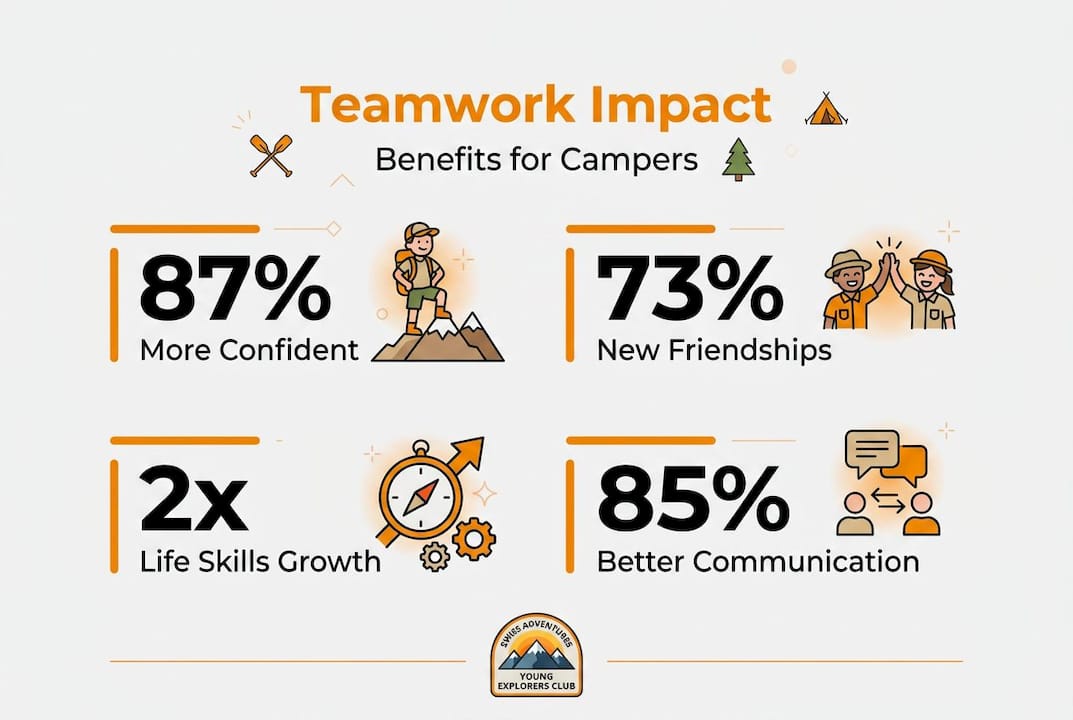
The research on overnight camp programs is surprisingly strong. A meta-analysis of 8 studies involving 720 participants found that overnight camps reduce anxiety symptoms with a Cohen’s d of -0.25, a meaningful effect size, and also produce measurable gains in positive emotion and self-confidence. That’s not just campers saying they had a good time. That’s statistically significant improvement in mental health indicators.
What drives those changes? Teamwork is a major factor. Working in groups on shared outdoor goals builds several overlapping skills at once:
- Communication — Campers learn to speak up clearly, listen actively, and adapt their message to the group
- Problem-solving — Novel challenges require thinking out loud, proposing ideas, and testing solutions together
- Empathy — Spending full days with the same group develops genuine emotional awareness
- Conflict resolution — Disagreements happen. Camp gives kids a safe place to navigate them without walking away
These aren’t soft skills. They’re foundational life skills that researchers link directly to future academic success, healthy relationships, and professional adaptability.
The camp peer relationships formed during teamwork-heavy programs also tend to be more durable than those formed in regular social settings. That’s because they’re forged under conditions of shared challenge rather than shared preference.
Pro Tip: Encourage your child to spend five minutes at the end of each camp day thinking about one moment where the team worked well. This simple reflection habit helps cement the learning and makes the benefits stick well beyond the last campfire.
Practical examples of teamwork activities that deliver these benefits include team obstacle challenges, multi-day group hikes, cooperative art installations, and outdoor cooking projects where every person handles a different task. Each of these scenarios activates every skill on the list above simultaneously. The data on teen growth and resilience through adventure programs consistently points to these shared challenges as the turning point for real personal development.
How teamwork powers inclusion and character growth
Benefits aside, let’s dive deeper into how teamwork can actively shape a camper’s sense of belonging and character.
One of the most underrated outcomes of well-designed camp teamwork is what it does to social belonging. Children who arrive at camp shy, anxious, or unsure of their social identity often find that a shared mission creates belonging faster than any icebreaker game ever could. When your job is to hold the rope while your teammate climbs, you don’t have time to worry about whether you’re cool enough. You’re needed. And being needed is one of the most powerful social experiences a young person can have.
“Camps are essential labs for social inclusion and personal growth, offering youth structured opportunities to practice empathy, leadership, and cooperation in ways that formal education rarely provides.”
University of Utah researchers recently launched a five-year character camp evaluation specifically to validate the long-term impact of teamwork on youth inclusion and character development. The scale of the study reflects growing academic consensus that camps are not extracurricular extras. They’re serious developmental environments.
Teamwork at camp cultivates specific character strengths that carry forward into adult life:
- Empathy grows when you spend extended time with people from different backgrounds, as happens naturally in international programs
- Patience develops when the group moves at the pace of its slowest member and that’s not a failure but a feature
- Responsibility solidifies when other people are genuinely counting on you to show up and follow through
- Trust builds through repeated experiences of vulnerability and support
The international camp culture in Switzerland adds another dimension entirely. When a team includes children from five different countries and three different first languages, the act of working together is itself an education in cross-cultural empathy. Research on team challenges and resilience confirms that diverse teams facing novel challenges build deeper social connections than homogeneous groups doing familiar tasks.
Real stories from camp counselors and families tell the same story consistently. A child who refused to speak in front of others at school will step up to direct the group during a wilderness navigation challenge. A teen who struggled to make friends finds a natural connection the moment she realizes a teammate shares her problem-solving instinct. These breakthroughs are not accidents. They’re the predictable output of well-designed teamwork.
Real teamwork: What it looks like at camp
With the importance of teamwork clear, let’s look at what real-world teamwork looks like in camp programs and how it’s structured.
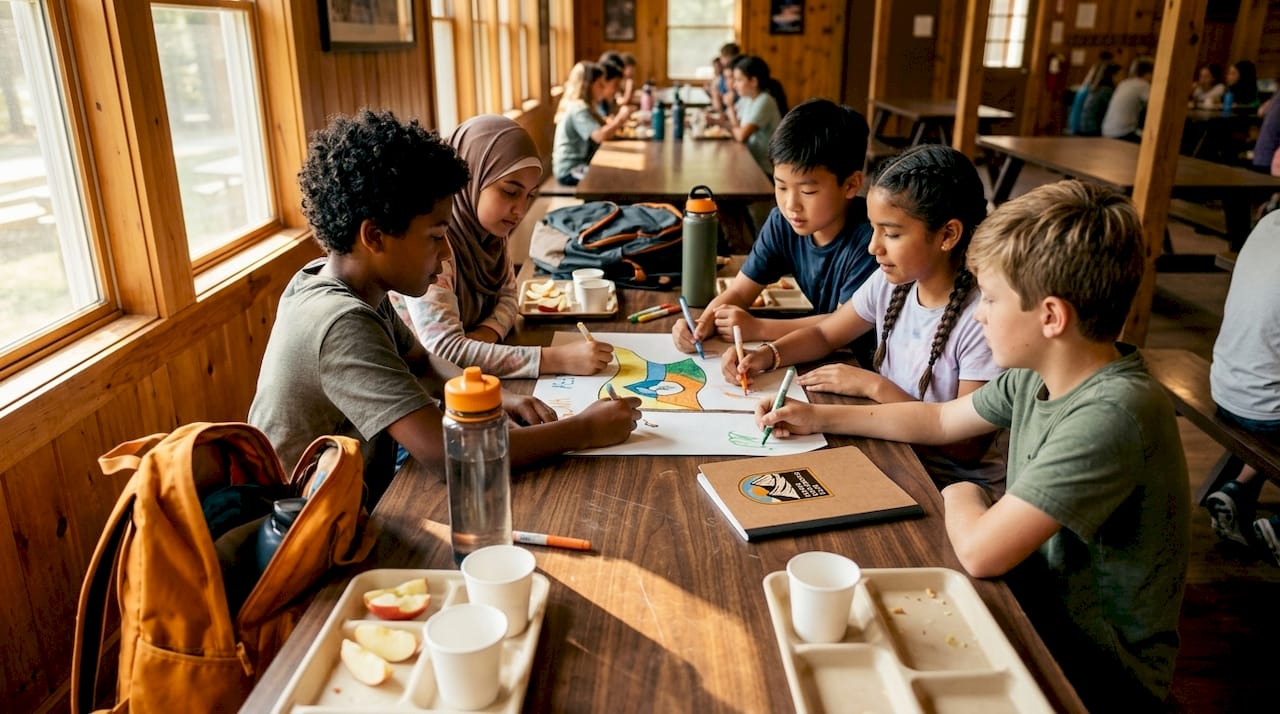
Imagine a group of eight campers, aged 12 to 15, tasked with building a makeshift raft using only the materials provided in a camp supply kit. They have 90 minutes. Here’s what actually happens:
- The challenge is explained. No instructions are given beyond the goal and the materials list. The group must figure out the approach themselves.
- Roles emerge organically. One camper starts sketching a design. Another begins sorting materials. A third notices potential problems and raises them with the group.
- Conflict surfaces. Two campers disagree on the best structure. This is where the real learning begins as they must negotiate, test ideas, and accept that neither has the complete answer.
- An encourager appears. Often the quietest member of the group steps into this role, keeping energy up when frustration hits the team halfway through.
- The team succeeds or adapts. Either the raft floats or the team learns immediately from failure and has a conversation about what went wrong. Both outcomes are valuable.
- Debrief happens. A counselor facilitates a short conversation. What worked? What was hard? What would you do differently? This reflection phase is where the growth gets locked in.
This sequence reflects what adventure education specialists call the “challenge by choice” framework. Everyone participates at their comfort level, but the group’s shared goal pulls every individual slightly beyond their usual boundary. Research-backed team-building exercises outside of camp settings confirm the same principle: structured challenge plus reflection equals measurable team cohesion.
The key insight for parents is that roles at camp don’t get permanently assigned. Today’s encourager becomes tomorrow’s leader. This week’s map-reader becomes next week’s problem-solver. Every time roles shift, a new set of skills gets activated.
Pro Tip: When speaking with a camp program director, ask specifically how often campers rotate roles during group activities. Programs that build rotation into their structure consistently produce stronger leadership outcomes than those that let the same dominant personalities run every task.
Why most people undervalue teamwork at camp (and what parents miss)
Here’s an uncomfortable truth that we’ve seen repeatedly: the most committed, research-informed parents often still pick camps based on the wrong criteria.
They look at facilities. They check the activity list. They ask about language immersion opportunities and counselor qualifications. All of those things matter. But the question almost nobody asks is this: How is teamwork deliberately built into the daily experience here?
That gap in priorities has real consequences. A camp with a beautiful climbing wall and a passive group structure will produce a child who can talk about the climbing wall. A camp with a modest set of activities and a deeply intentional team culture will produce a child who comes home different. More confident. More socially capable. More resilient when things go wrong.
We’ve watched introverted children surprise themselves completely in the right team environment. Not because anyone forced them to speak up or pushed them into leadership. But because the team created a space where their specific contribution was genuinely needed, and they felt that. That feeling is transformative in a way no solo achievement ever quite matches.
The evidence on adventure activities for teens consistently points to structured group challenge as the driver of the deepest personal growth, not the activity itself. The mountain is a vehicle. The team is the engine.
So our strong advice is this: when you’re evaluating summer camps, put teamwork structure at the top of your questions list. Ask how it’s built in. Ask how it’s reflected on. Ask how it adapts for different personality types. A camp that can answer those questions clearly is a camp that will send your child home genuinely changed.
Discover transformative camps built on teamwork
If you’ve been reading through this guide, you already understand that the best camp experiences are built around more than just thrilling activities. They’re built around people working together toward something real.
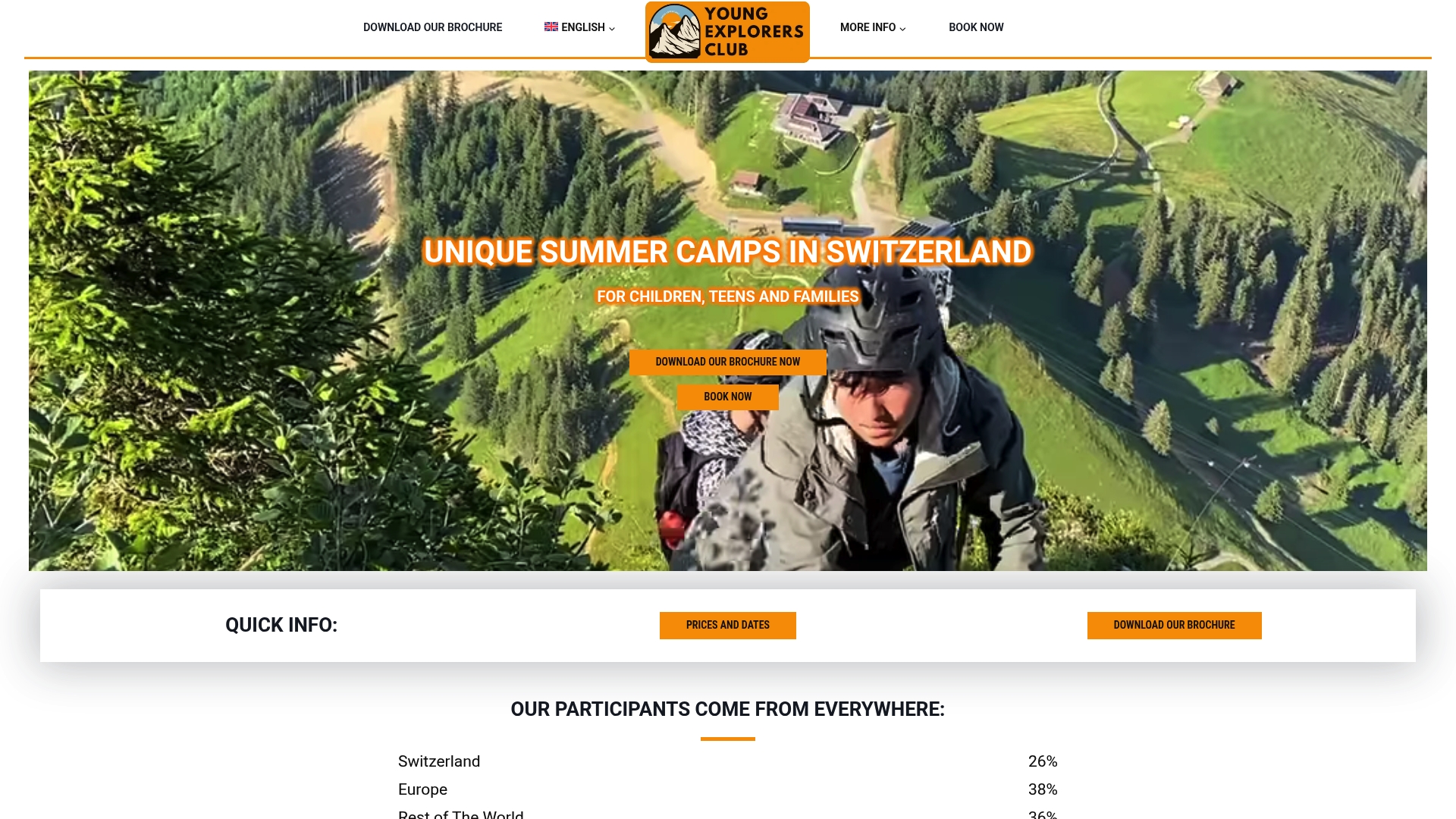
At Young Explorers Club, every program is designed so that teamwork is not an add-on but the foundation. From mountain biking challenges in the Swiss Alps to survival skill sessions that require every team member’s contribution, our international camps bring together children and teens from across the globe in a bilingual environment that makes Switzerland summer camps genuinely unique. Whether your child is eight or seventeen, our structured team approach ensures they leave with more than memories. They leave with skills, friendships, and confidence that last. Explore our international camp community to find the program that fits your family.
Frequently asked questions
How does teamwork at camp reduce anxiety or shyness?
Cooperative camp experiences create low-pressure social situations where contribution matters more than social status, and research confirms that overnight camps produce measurable reductions in anxiety symptoms alongside gains in confidence and positive emotion.
What age groups benefit most from teamwork at camp?
Teamwork benefits children across all ages from 8 to 17, but research specifically highlights adolescents aged 14 to 15 as showing especially strong gains in relational resilience and social confidence through nature-based camp experiences.
What are typical teamwork activities in summer camps?
Common camp teamwork activities include group hikes, raft-building challenges, wilderness navigation, outdoor cooking projects, cooperative climbing tasks, and team relay events designed to require every participant’s active contribution.
Can teamwork at camp help with making friends?
Yes, teamwork-centered camp programs accelerate friendship formation because shared challenge creates genuine bonds faster than shared preference, and ongoing university research continues to validate camps’ role in fostering inclusion and lasting social connection.
Recommended
- How Camps Foster Team Spirit Without Competition | Young Explorers Club Switzerland
- How International Summer Camps Boost Confidence And Independence | Young Explorers Club Switzerland
- Why Camps Are A Safe Space For Personal Growth | Young Explorers Club Switzerland
- The Importance Of Positive Attitude Training Pre-camp | Young Explorers Club Switzerland